18 results for "Children"

A power governments cannot suppress

Zinn, Howard
“Zinn writes with an enthusiasm rarely encountered in the leaden prose of academic history. . .” – New York Times Book Review A Power Governments Cannot Suppress is Howard Zinn’s major new collection of essays on American history, class, immigration, justice, and ordinary citizens who have made a difference. Howard Zinn unlocks America’s current political/ ethical crisis and challenges us to confront power for the common good. Bringing a profoundly human perspective to the diverse subjects he writes about – the Founding Fathers, government dishonesty, winning the war on terrorism, respecting the holocaust, defending the rights of immigrants – Zinn approaches history from an active, engaged point of view. He writes, “America’s future is linked to how we understand our past. For this reason, writing about history, for me, is never a neutral act.” Zinn opens the book with an essay titled “If History is to be Creative,” a reflection on the role and responsibility of the engaged historian. “To think that history-writing must aim simply to recapitulate the failures that dominate the past,” writes Zinn, “is to make historians collaborators in an endless cycle of defeat.” “If history is to be creative, to anticipate a possible future without denying the past, it should, I believe, emphasize new possibilities by disclosing those hidden episodes of the past when, even if in brief flashes, people showed their ability to resist, to join together, and occasionally win. I am supposing, or perhaps only hoping, that our future may be found in the past’s fugitive moments of compassion rather than in its solid centuries of warfare.” Buzzing with ideas, stories, and anecdotes spanning from the Revolutionary War and the War with Mexico through to World War II, Vietnam, 9/11, and the U.S. occupation of Iraq, Zinn’s view of American history is not a praise of famous leaders, but those who rebelled against them in the name of social justice. While writing extensively on current events and the consequences of U.S. policy in Afghanistan and Iraq, Zinn also dedicates entire chapters to troublemakers like Henry David Thoreau, Eugene Debs, Philip Berrigan, Italian immigrants Sacco & Vanzetti, and heralds not the soldiers who fought for George Washington, but those who deserted the Revolutionary Army because of intolerable mistreatment from elitist commanding officers. For Zinn, the voices and stories of ordinary working Americans, immigrants, working people, and soldiers comprise the real storyline of our history. Featuring essays penned over an eight-year period, A Power Governments Cannot Suppress is Howard Zinn’s first writerly work in several years, an invaluable post-9/11-era addition to the themes that run through his bestselling classic, A People’s History Of the United States. "Thank you, Howard Zinn. Thank you for telling us what none of our leaders are willing to: The truth. And you tell it with such brilliance, such humanity. It is a personal honor to be able to say I am a better citizen because of you." —Michael Moore “This brilliant new book – like Howard Zinn’s presence, and his whole life, is the best possible antidote to political despair. Read it, and rejoin the struggle for a human world and a foreign policy that’s good for children.” – Daniel Ellsberg
City Lights 2007 293 pages

Young guns: a new generation of conservative leaders

Cantor, Eric
America urgently needs a new direction. But who will provide it? The time has come to move the country forward with a clear agenda based on common sense for the common good. THERE IS A BETTER WAY. Make no mistake: Congressmen Eric Cantor, Paul Ryan, and Kevin McCarthy are proud Republicans. But they believe the party had lost sight of the ideals it believes in, like economic freedom, limited government, the sanctity of life, and putting families first. This isn’t your grandfather’s Republican party. These Young Guns of the House GOP—Cantor (the leader), Ryan (the thinker), and McCarthy (the strategist)—are ready to take their belief in the principles that have made America great and translate it into solutions that will make the future even better, solutions that will create private sector jobs, maximize individual freedom, and establish a better world for our children. This groundbreaking book is a call to action that sets forth a plan for growth, opportunity, and commitment that will propel this country to prosperity once again. Together, the Young Guns are changing the face of the Republican party and giving us a new road map back to the American dream.
Threshold Editions 2010-09-14 211 pages

The House of Government: a saga of the Russian Revolution

Slezkine, Yuri
"On the 100th anniversary of the Russian Revolution, the epic story of an enormous apartment building where Communist true believers lived before their destruction. The House of Government is unlike any other book about the Russian Revolution and the Soviet experiment. Written in the tradition of Tolstoy's War and Peace, Grossman's Life and Fate, and Solzhenitsyn's The Gulag Archipelago, Yuri Slezkine's gripping narrative tells the true story of the residents of an enormous Moscow apartment building where top Communist officials and their families lived before they were destroyed in Stalin's purges. A vivid account of the personal and public lives of Bolshevik true believers, the book begins with their conversion to Communism and ends with their children's loss of faith and the fall of the Soviet Union. Completed in 1931, the House of Government, later known as the House on the Embankment, was located across the Moscow River from the Kremlin. The largest residential building in Europe, it combined 550 furnished apartments with public spaces that included everything from a movie theater and a library to a tennis court and a shooting range. Slezkine tells the chilling story of how the building's residents lived in their apartments and ruled the Soviet state until some eight hundred of them were evicted from the House and led, one by one, to prison or their deaths. Drawing on letters, diaries, and interviews, and featuring hundreds of rare photographs, The House of Government weaves together biography, literary criticism, architectural history, and fascinating new theories of revolutions, millennial prophecies, and reigns of terror. The result is an unforgettable human saga of a building that, like the Soviet Union itself, became a haunted house, forever disturbed by the ghosts of the disappeared."--Publisher description
Princeton University Press 2017 1104 pages

Plunder and deceit: big government's exploitation of young people and the future

Levin, Mark R.
#1 New York Times bestselling author and radio host Mark R. Levin delivers a "bracing meditation” ( National Review ) on the ways our government has failed the next generation. In modern America, the civil society is being steadily devoured by a ubiquitous federal government. But as the government grows into an increasingly authoritarian and centralized federal Leviathan, many parents continue to tolerate, if not enthusiastically champion, grievous public policies that threaten their children and successive generations with a grim future at the hands of a brazenly expanding and imploding entitlement state poised to burden them with massive debt, mediocre education, waves of immigration, and a deteriorating national defense. Yet tyranny is not inevitable. In Federalist 51, James Madison explained with cautionary insight the essential balance between the civil society and governmental restraint: “In framing a government which is to be administered by men over men, the great difficulty lies in this: you must first enable the government to control the governed; and in the next place oblige it to control itself.” This essential new book is, against all odds, a likeminded appeal to reason and audacity—one intended for all Americans but particularly the rising generation. Younger people must find the personal strength and will to break through the cycle of statist manipulation, unrelenting emotional overtures, and the pressure of groupthink, which are humbling, dispiriting, and absorbing them; to stand up against the heavy hand of centralized government, which if left unabated will assuredly condemn them to economic and societal calamity. Levin calls for a new civil rights movement, one that will foster liberty and prosperity and cease the exploitation of young people by statist masterminds. He challenges the rising generation of younger Americans to awaken to the cause of their own salvation, asking: will you acquiesce to a government that overwhelmingly acts without constitutional foundation—or will you stand in your own defense so that yours and future generations can live in freedom?
Threshold Editions 2015 244 pages

Capitol men: the epic story of Reconstruction through the lives of the first Black congressmen

Dray, Philip
Pulitzer Prize finalist Philip Dray shines a light on a little known group of men: the nation's first black members of Congress. These men played a critical role in pushing for much-needed reforms in the wake of a traumatic civil war, including public education for all children, equal rights, and protection from Klan violence. But they have been either neglected or maligned by most historians--their "glorious failure" chalked up to corruption and "ill-preparedness."--From publisher description.
Houghton Mifflin Co 2008 463 pages

Rediscovering Americanism: and the tyranny of progressivism

Levin, Mark R.
"'I often wonder what Thomas Jefferson, George Washington, James Madison ..., and the other Founders would think about today's America ... Of course, they would be mesmerized by all the modern inventions and conveniences of everyday life; but what of the ubiquitous nature of the federal government? Surely they would object.' So begins Rediscovering Americanism, a searing plea by ... bestselling author Mark R. Levin for a return to America's most sacred values. In stunning fashion, Levin revisits the Founders' ideal of limited government based on natural law--and their frequent warnings about the perils of overreach by the federal government--and he concludes that the Founders would be outraged and disappointed to see where we've ended up. Levin condemns the scourge of creeping progressivism and excoriates the statists and progressives for making the Founders' ideals less and less achievable with each year and each so-called victory. He shows how progressivism seeks to refute the American heritage of individual liberty and completely overhaul modern life, growing into a government with no limits and leading us into a new age of authoritarianism, far from the Founders' dream of a limited government as delineated in the Constitution. Levin returns to the impassioned question he's explored in each of his ... books: How do we save our exceptional country? Because our values are in such a precarious state, he argues that a restoration to the essential truths on which our country was founded has never been more urgent. Understanding these principles, in Levin's words, can 'serve as the antidote to tyrannical regimes and governments.' Rediscovering Americanism is not an exercise in nostalgia, but an appeal to his fellow citizens to reverse course. In this crucial thesis, Mark R. Levin brings his celebrated, sophisticated analysis to the troubling question of America's future, and reminds us of what we are losing and what we must restore for the sake of our children and our children's children."--Jacket.
Threshold Editions 2017-07 259 pages

Jack: the struggles of John F. Kennedy

Parmet, Herbert S.
List of Illustrations Prologue A Happy Family The Kennedy Children & Their World Period of Adjustment A Harvard Man The First Book The War A Hero in the South Pacific Joe The Second Son Emerges A New Candidate Portrait of a Congressman America's Younger Statesman To the Senate The Senator from New England The Senator & the World Dismal Days Profiles in Courage Madly for Adlai Preparing for Chicago The Showdown at Chicago The Pulitzer Prize-Winning Senator Human Rights Labor Reform The Perfect Politician Emphatic Reelection Courting the Liberals The Literary Campaign The Labor Trap Taking the Step Epilogue Notes Acknowledgments Index
Dial Press 1980 586 pages

Still life with bombers: Israel in the age of terrorism

Horovitz, David Phillip
When peace talks between Palestinian and Israeli leaders collapsed at Camp David in 2000, a conflict as bloody as any that had ever occurred between the two peoples began. Now David Horovitz—editor of "'The Jerusalem Report—explores the quotidian and profound effects this conflict and its attendant terrorism have had on the lives of ordinary men, women and children. Horovitz describes the “grim lottery” of life in Israel since 2000. He makes clear that far from becoming blasé or desensitized, its citizens respond with deepening horror every time the front pages are disfigured by the rows of passport portraits presenting the faces of the newly dead. He takes us to the funeral of a murdered Israeli, where the presence of security personnel underlines that nowhere is safe. He describes how his wife must tell their children to close their eyes when they pass a just-exploded bus on the way to school, so that the images of carnage won’t haunt them. He talks with government officials on both sides of the conflict, with relatives of murdered victims, with Palestinian refugees, and with his own friends and family, letting us sense what it feels like to live with the constant threat and the horrific frequency of shootings and suicide bombings. Examining the motives behind the violence, he blames mistaken policies and actions on the Israeli as well as the Palestinian side, and details the suffering of Palestinians deprived of basic freedoms under strict Israeli controls .But at the root of this conflict, he argues, is terrorism and Yasser Arafat’s deliberate use of it after spurning a genuine opportunity for peace at Camp David, and then misleading his people, and much of the world, about what was on offer there. He describes how the world’s press has too often allowed prejudgment to replace fair-minded reporting. And finally, Horovitz makes us see the vast depth and extent of the mistrust between Israelis and Palestinians and the enormous challenges that underlie new attempts at peacemaking.Human and harrowing—and yet projecting an unexpected optimism—Still Life with Bombers affords us a remarkably balanced and insightful understanding of a seemingly intractable conflict.
Alfred A. Knopf 2004 266 pages

Arctic mirrors: Russia and the small peoples of the North

Slezkine, Yuri
For over five hundred years the Russians wondered what kind of people their Arctic and sub-Arctic subjects were. "They have mouths between their shoulders and eyes in their chests," reported a fifteenth-century tale. "They rove around, live of their own free will, and beat the Russian people," complained a seventeenth-century Cossack. "Their actions are exceedingly rude. They do not take off their hats and do not bow to each other," huffed an eighteenth-century scholar. They are "children of nature" and "guardians of ecological balance," rhapsodized early nineteenth-century and late twentieth-century romantics. Even the Bolsheviks, who categorized the circumpolar foragers as "authentic proletarians," were repeatedly puzzled by the "peoples from the late Neolithic period who, by virtue of their extreme backwardness, cannot keep up either economically or culturally with the furious speed of the emerging socialist society."Whether described as brutes, aliens, or endangered indigenous populations, the so-called small peoples of the north have consistently remained a point of contrast for speculations on Russian identity and a convenient testing ground for policies and images that grew out of these speculations. InArctic Mirrors, a vividly rendered history of circumpolar peoples in the Russian empire and the Russian mind, Yuri Slezkine offers the first in-depth interpretation of this relationship. No other book in any language links the history of a colonized non-Russian people to the full sweep of Russian intellectual and cultural history. Enhancing his account with vintage prints and photographs, Slezkine reenacts the procession of Russian fur traders, missionaries, tsarist bureaucrats, radical intellectuals, professional ethnographers, and commissars who struggled to reform and conceptualize this most "alien" of their subject populations.Slezkine reconstructs from a vast range of sources the successive official policies and prevailing attitudes toward the northern peoples, interweaving the resonant narratives of Russian and indigenous contemporaries with the extravagant images of popular Russian fiction. As he examines the many ironies and ambivalences involved in successive Russian attempts to overcome northern-and hence their own-otherness, Slezkine explores the wider issues of ethnic identity, cultural change, nationalist rhetoric, and not-so European colonialism. --
Cornell University Press 1994 456 pages

The loyal son

Epstein, Daniel Mark
Ben Franklin is the most lovable of America's founding fathers. His wit, his charm, his inventiveness--even his grandfatherly appearance--are legendary. But this image obscures the scandals that dogged him throughout his life. In The Loyal Son, award-winning historian Daniel Mark Epstein throws the spotlight on one of the more enigmatic aspects of Franklin's biography: his complex and confounding relationship with his illegitimate son William. When he was twenty-four, Franklin fathered a child with a woman who was not his wife. He adopted the boy, raised him, and educated him to be his aide. Ben and William became inseparable. After the famous kite-in-a-thunderstorm experiment, it was William who proved that the electrical charge in a lightning bolt travels from the ground up, not from the clouds down. On a diplomatic mission to London, it was William who charmed London society. He was invited to walk in the procession of the coronation of George III; Ben was not. The outbreak of the American Revolution caused a devastating split between father and son. By then, William was royal governor of New Jersey, while Ben was one of the foremost champions of American independence. In 1776, the Continental Congress imprisoned William for treason. George Washington made efforts to win William's release, while his father, to the world's astonishment, appeared to have abandoned him to his fate. A fresh take on the combustible politics of the age of independence, The Loyal Son is a gripping account of how the agony of the American Revolution devastated one of America's most distinguished families. Like Nathaniel Philbrick and David McCullough, Epstein is a storyteller first and foremost, a historian who weaves together fascinating incidents discovered in long-neglected documents to draw us into the private world of the men and women who made America.
Ballantine 2017 438 pages

The free world

Bezmozgis, David
'Terrific ... Combines comic brilliance with a poignant portrait of a family trapped between two worlds' Sunday Times In the summer of 1978 the Krasnansky family - bickering, tired and confused - arrive in Rome. Alongside thousands of other Soviet Jewish refugees they await passage to a new home in the West. But escaping Communism is not so easy, especially when some of the Krasnanskys insist on bringing it with them. It is harder still when their American sponsor lets them down and they find they're stuck. What follows is a tragic yet comic tale of reckless brothers and long-suffering sisters, ailing parents and innocent children, of love affairs and criminal liaisons, of a wonderfully troubled family and a perpetually wandering people, and their epic search for a home...
Penguin 2012 356 pages

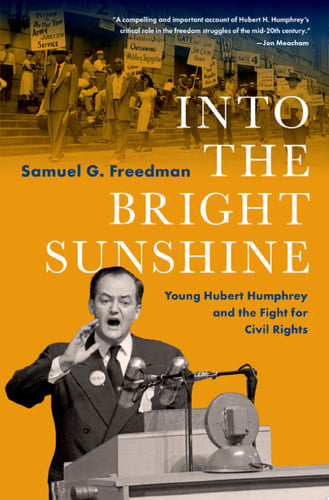
Into the bright sunshine: young Hubert Humphrey and the fight for civil rights

Freedman, Samuel G.
"Hubert Humphrey, a fallen hero and a dying man, rose on rickety legs to approach the podium of the Philadelphia Convention Hall, his pulpit for the commencement address at the University of Pennsylvania. He clutched a sheaf of paper with his speech for the occasion, typed and double-spaced by an assistant from his extemporaneous dictation, and then marked up in pencil by Humphrey himself. A note on the first page, circled to draw particular attention, read simply, "30 years ago--Here." In this place, at that time, twenty-nine years earlier to be precise, he had made history. From the dais now, Humphrey beheld five thousand impending graduates, an ebony sea of gowns and mortarboards, broken by one iconoclast in a homemade crown, two in ribboned bonnets, and another whose headgear bore the masking-tape message HI MA PA. In the horseshoe curve of the arena's double balcony loomed eight thousand parents and siblings, children, and friends. Wearing shirtsleeves and cotton shifts amid the stale heat, they looked like pale confetti from where Humphrey stood, and their flash cameras flickered away, a constellation of pinpricks"--
Oxford University Press 2023 488 pages

The La Follettes of Wisconsin: love and politics in progressive America

Weisberger, Bernard A.
The La Follettes of Wisconsin—Robert, Belle, and their children, Bob Jr., Phil, Fola, and Mary—are vividly brought to life in this collective biography of an American political family. As governor of Wisconsin (1901–06) and U.S. Senator (1906–25), "Fighting Bob" battled relentlessly for his Progressive vision of democracy—an idealistic mixture of informed citizenry and enlightened egalitarianism. By contrast, the private man suffered from intense, isolated periods of depression and relied heavily on his family for survival. Together, "Old Bob" and his beloved wife, Belle Case La Follette—a lawyer, journalist, and Progressive leader in her own right—raised their children in the distinctly uncompromising La Follette tradition of challenging social and political ills. Fola became a campaigner for women's suffrage, Phil was governor of Wisconsin, and "Young Bob" became a U.S. senator.
University of Wisconsin Press 2013-12-19 364 pages

Against the tide: one woman's political struggle

Keyserling, Harriet
In 1944, when New York City native Harriet Keyserling arrived in the small South Carolina town of Beaufort, she found herself in an environment that seemed foreign to her. Coming to Beaufort with her husband - a native son and local physician - she was a liberal northerner in the conservative South and a Jew in a predominantly Christian world. These religious and political differences only intensified her feelings of being an outsider - a thread that would run through much of her life and career. After successfully raising four children and professionally volunteering for most of her adult life, Keyserling became involved in state and local politics. Driven by passion for the causes she supports, she organized a chapter of the League of Women Voters, became the first woman to serve on the Beaufort County Council, and, at the age of fifty-four, was elected to the state General Assembly. She served for sixteen years before retiring in 1992, when the growing rancor and partisanship of the legislature became intolerable for her. Against the Tide tells the intensely personal story of an unconventional politician struggling to gain self-confidence, beat the odds, and make a lasting dif
University of South Carolina Press 2004 388 pages

The Winona LaDuke reader: a collection of essential writings

LaDuke, Winona
For more than twenty years, Winona LaDuke has impressed people around the world with her oratory and debate skills and as an advocate for Native American rights, champion of women’s and children’s issues, protector of the environment, and as a leading voice of the Green Party. A charismatic and inspiring speaker and writer, LaDuke possesses a stirring passion that comes through in the 30 speeches, articles, and fiction excerpts compiled in The Winona LaDuke Reader. This is the first collection of the many political speeches and "think-pieces" that she has written for magazines such as Sierra, Smithsonian’s American Indian, and more.
Voyageur Press 2002 304 pages

Revolutions thwarted: Poland, South Africa, Iran, Brazil, and the legacies of communism

Rose, John
"In 1917, a band of communist revolutionaries stormed the Winter Palace of Tsar Nicholas II, a dramatic and explosive act marking that Vladimir Lenin's communist revolution was now underway. But Lenin would not be satisfied with overthrowing the Tsar. His goal was a global revolt that would topple all Western capitalist regimes starting with the British Empire. This book tells the story of the British spies in revolutionary Russia and their mission to stop Lenin's red tide from washing across the free world. They were an eccentric cast of characters, led by Mansfield Cumming, a one-legged, monocle-wearing former sea captain, and included novelist W. Somerset Maugham, beloved children's author Arthur Ransome, and the dashing, ice-cool Sidney Reilly, the legendary Ace of Spies and a model for Ian Fleming's James Bond. Cumming's network would pioneer the field of covert action and would one day become Britain's Military Intelligence 6 (MI -6) -- book jacket.
Bookmarks Publications 2025 408 pages

The world that was ours

Bernstein, Hilda
It reads like a thriller page after page. . . . The loveliest of Hilda Bernsteins works about the ugliest of times.Albie Sachs, The Independent Were it not for ordinary heroes like the Bernsteins, South Africa would not be free today.Guardian It was 1963 in South Africa during Apartheid when Lionel Rusty Bernstein was arrested, along with Nelson Mandela and fifteen other leaders of the African National Congress. They were charged with 221 acts of sabotage designed to ferment violent revolution. Rusty was one of two individuals acquitted, and the rest received life sentences. In The World that was Ours, his wife, Hilda Bernstein, offers an astonishing personal account of the events leading up to the Rivonia Trial and describes how, as a white family with four children, they managed to fight a hostile and unjust regime. There was a long night ahead. We are unable to read. We listen all the time, listen for the sound of a car in anticipation that the police will come. If he is in the hands of the police, surely they will bring him to the house to search; they always raid after an arrest. Hilda Bernstein (19152006) lived in London, but in 1933 moved to South Africa where she married Lionel Bernstein. She was elected as a Communist to the Johannesburg City Council; helped found the multiracial Federation of South African Women; and worked closely with the African National Congress Womens League in opposition to apartheid.
Persephone 2009-12-31 394 pages