29 results for "Children"

Nudge: the final edition

Thaler, Richard H.,Sunstein, Cass R.
"Every day we make choices--about food and other purchases, financial investments, our children's health and education, even the causes we champion or the planet itself. Unfortunately, we often choose poorly. Using dozens of eye-opening examples and drawing on decades of behavioral science research, Nudge shows how sensible "choice architecture" can help us to overcome the biases that lead to bad decisions and nudge us toward the best decisions for ourselves, our families, and our society"--
Penguin Books, an imprint of Penguin Random House LLC 2021-08-03 366 pages

Option B: facing adversity, building resilience and finding joy

Sandberg, Sheryl
In 2015, Sheryl Sandberg's husband, Dave Goldberg, died suddenly at the age of forty-eight. Sandberg and her two young children were devastated, and she was certain that their lives would never have real joy or meaning again. Just weeks later, Sandberg was talking with a friend about the first father-child activity without a father. They came up with a plan for someone to fill in. But I want Dave, she cried. Her friend put his arm around her and said, Option A is not available. So let's just kick the shit out of Option B. Everyone experiences some form of Option B. We all deal with loss: jobs lost, loves lost, lives lost. The question is not whether these things will happen but how we face them when they do. Thoughtful, honest, revealing and warm, Option B weaves Sandberg's experiences coping with adversity with new findings from Adam Grant and other social scientists. The book features stories of people who recovered from personal and professional hardship, including illness, injury, divorce, job loss, sexual assault and imprisonment. These people did more than recover-many of them became stronger. Option B offers compelling insights for dealing with hardships in our own lives and helping others in crisis. It turns out that post-traumatic growth is common-even after the most devastating experiences many people don't just bounce back but actually bounce forward. And pre-traumatic growth is also possible: people can build resilience even if they have not experienced tragedy. Sandberg and Grant explore how we can raise strong children, create resilient communities and workplaces, and find meaning, love and joy in our lives.
WH Allen 2017-04-24 226 pages

I've never met an idiot on the river: reflections on family, photography, and fly fishing

Winkler, Henry
Now in paperback, this New York Times best-selling collection of humorous anecdotes and heartfelt observations from Henry Winkler shares the joy and wisdom he’s accumulated while honing his skills as a fly-fisherman. An accomplished sportsman who meticulously records the measurements of every fish he hooks, Winkler has learned that his yearly trips to the river are not just about catching trout. More importantly, they’re about adopting the proper perspective on life. Or, as Winkler puts it, when he’s fly-fishing, the river acts like a “washing machine for my brain,” recharging him and reminding him that anything is possible. Winkler makes a habit of sharing his angling adventures with his wife, Stacey, and their three children, Jed, Zoe, and Max. The Winklers’ annual trip, where they can escape the busy-ness of everyday life, has brought them together as a family. On the river, Henry has grown to appreciate the support his wife and children give him, learned to listen, and developed the confidence to publish his outdoor photography in his first non-fiction book. An expression of the inherent optimism that stems from the simplicity of the outdoors, I’ve Never Met an Idiot on the River is an invitation to share in the realizations and achievements Winkler has found while fishing. Hopefully it will help you catch a few of your own.
Insight 2013-04-23 144 pages

The blessing of a skinned knee: using Jewish teachings to raise self-reliant children

Mogel, Wendy
In the trenches of a typical day, every parent encounters a child afflicted with ingratitude and entitlement. Parents want so badly to raise self-disciplined, appreciative, and resourceful children who are not spoiled. But how to accomplish this feat? The answer has eluded the best-intentioned individuals who overprotect, overindulge, and overschedule their children's lives. Sharing stories of everyday parenting problems and examining them through the lens of the Torah, the Talmud, and important Jewish teachings, The Blessing of a Skinned Knee shows parents how to teach children to honor and respect others. Parents will learn to accept that their children are both ordinary and unique, and treasure the power and holiness of the present. Mogel makes these teachings relevant for any era, and any household of any faith. A unique parenting book, The Blessing of a Skinned Knee is both inspiring and effective in the day-to-day challenge of raising self-reliant children --
Penguin Compass 2001 300 pages

The second self: computers and the human spirit

Turkle, Sherry
"In The Second Self, Sherry Turkle looks at the computer not as a 'tool,' but as part of our social and psychological lives; she looks beyond how we use computer games and spreadsheets to explore how the computer affects our awareness of ourselves, of one another, and of our relationship with the world. 'Technology,' she writes, 'catalyzes changes not only in what we do but in how we think.' First published in 1984, The Second Self is still essential reading as a primer in the psychology of computation. This twentieth anniversary edition allows us to reconsider two decades of computer culture - to (re)experience what was and is most novel in our new media culture and to view our own contemporary relationship with technology with fresh eyes. Turkle frames this classic work with a new introduction, a new epilogue, and extensive notes added to the original text. Turkle talks to children, college students, engineers, AI scientists, hackers, and personal computer owners - people confronting machines that seem to think and at the same time suggest a new way for us to think - about human thought, emotion, memory, and understanding. Her interviews reveal that we experience computers as being on the border between inanimate and animate, as both an extension of the self and part of the external world. Their special place betwixt and between traditional categories is part of what makes them compelling and evocative. (In the introduction to this edition, Turkle quotes a PDA user as saying, 'When my Palm crashed, it was like a death. I thought I had lost my mind.') Why we think of the workings of a machine in psychological terms - how this happens, and what it means for all of us - is the ever more timely subject of The Second Self." -
MIT Press 2005-09-30 372 pages

On freedom

Sunstein, Cass R.
"In this pathbreaking book, New York Times bestselling author Cass Sunstein asks us to rethink freedom. He shows that freedom of choice isn't nearly enough. To be free, we must also be able to navigate life. People often need something like a GPS device to help them get where they want to go--whether the issue involves health, money, jobs, children, or relationships. In both rich and poor countries, citizens often have no idea how to get to their desired destination. That is why they are unfree. People also face serious problems of self-control, as many of them make decisions today that can make their lives worse tomorrow. And in some cases, we would be just as happy with other choices, whether a different partner, career, or place to live--which raises the difficult question of which outcome best promotes our well-being. Accessible and lively, and drawing on perspectives from the humanities, religion, and the arts, as well as social science and the law, On Freedom explores a crucial dimension of the human condition that philosophers and economists have long missed--and shows what it would take to make freedom real."--Page [2] of cover.
Princeton University Press 2019-02-26 127 pages

Kid stuff: marketing sex and violence to America's children

Diane Ravitch,Joseph P. Viteritti
American children spend a substantial part of their lives watching television and movies, playing video games, and listening to music containing explicit sex and violence. From Doom and Grand Theft Auto III to Eminem and Marilyn Manson, a strain of the popular culture has become increasingly toxic. One of the most pressing—and controversial—issues facing parents and educators in America today is understanding how exposure to these media affects the social and psychological development and behavior of children and teenagers. In Kid Stuff , Diane Ravitch and Joseph P. Viteritti bring together experts in media studies, child psychology, and public health to assess the dangers posed by "tox pop" to American society. Drawing on thirty years of research, the contributors find convincing evidence that such "entertainment" can harm children and teenagers, despite the self-serving denials of the media industry. Balancing their concerns for the welfare of children with respect for the First Amendment, Kid Stuff furthers the ongoing dialogue about how a democratic society can protect its children from the pernicious extremes of popular media. Contributors: Craig A. Anderson, Jeffrey Jensen Arnett, Peter G. Christenson, Edward Donnerstein, Jeanne B. Funk, Todd Gitlin, Kay S. Hymowitz, Elisabeth Lasch-Quinn, Nell Minow, Newton Minow, Thomas N. Robinson, Stacy L. Smith
Johns Hopkins University Press 2003-05-28 267 pages

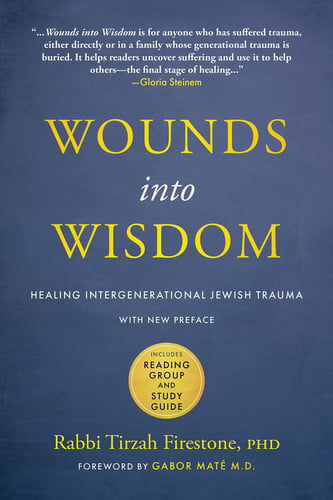
Wounds into wisdom: healing intergenerational Jewish trauma

Firestone, Tirzah
"Our past does not simply disappear. The painful history of our ancestors and their rich cultural wisdom intertwine within us to create the patterns of our future. Even when past trauma remains unspoken or has long been forgotten, it becomes part of us and our children-a legacy of both strength and woundedness that shapes our lives. In this book, Tirzah Firestone brings to life the profound impact of protracted historical trauma through the compelling narratives of those whose lives were marred by racial persecution and displacement. The tragic story of Firestone's own family lays the groundwork for these revealing testimonies of recovery, forgiveness, and moral leadership. Throughout, Firestone interweaves their voices with neuroscientific and psychological findings, as well as relevant and inspiring Jewish teachings. Seven principles emerge from these wise narratives-powerful prescriptive tools that speak to anyone dealing with the effects of past traumatic injury. At the broadest level, these principles are directives for staying morally awake in a world rife with terror"--
Monkfish Book Publishing Company 2022 258 pages

After such knowledge: memory, history, and the legacy of the Holocaust

Hoffman, Eva
Sixty years after the Holocaust, the author of Lost in Translation explores the difficult process of preserving an authentic version of its tragic events. As the Holocaust recedes in time, the guardianship of its legacy is being passed on from its survivors and witnesses to the next generation. How should they, in turn, convey its knowledge to others? What are the effects of a traumatic past on its inheritors? And what are the second generation's responsibilities to its received memories?In this meditation on the long aftermath of atrocity, Eva Hoffman -a child of Polish Jews who survived the Holocaust with the help of neighbors, but whose entire families perished -probes these questions through personal reflections, and through broader explorations of the historical, psychological, and moral implications of the second-generation experience. She examines the subterranean processes through which private memories of suffering are transmitted, and the more willful stratagems of collective memory. She traces the second generation's trajectory from childhood intimations of horror, through its struggles between allegiance and autonomy, and its complex transactions with children of per
Public Affairs 2004-01-07 301 pages

Blue eyes, brown eyes: a cautionary tale of race and brutality

Bloom, Stephen G.
"The day after Martin Luther King, Jr.'s assassination, Jane Elliott, a third-grade schoolteacher in rural Iowa, tried out a shocking experiment to show the scorching impact of racism on children. Elliott separated her students according to the color of their. Those with brown eyes would lord over those with blue eyes. The brown-eyed students were given permission to heckle and berate the blue-eyed students, even to start fights with them. The Blue-Eyed, Brown-Eyed Experiment would become world famous. Elliott would go on to appear on Johnny Carson's Tonight Show, followed by a stormy White House conference, and tens of thousands of media events and diversity training sessions around the world. Elliott taught "Black Lives Matter" fifty years before the phrase was ever uttered. Yet the small town where Elliott began the incendiary experiment never forgot or forgave her. She paid a price for her hard-fought fame. But was Elliott the benign and enlightened mother of diversity she claimed to be? The damage she caused still reverberates. An indelible, confounding portrait of a woman driven to succeed, set against the backdrop of a proud and upright farming community"--
University of California Press 2021-10-05 263 pages

How to help your child overcome your divorce

Benedek, Elissa P.
The latest information, advice, and answers from one of the nation’s leading psychiatrists Children always suffer the most during a divorce, and parents don’t know what to say or do to help them. Drawn from more than twenty years of clinical and forensic experience, this invaluable manual gives answers to some of the most common questions on which divorced parents seek guidance, such as: Helping children adjust to separation and divorce Telling children about how the divorce will affect them Reassuring children that their parents will continue to love and care for them—and then just doing that Helping avoid many of the parenting pitfalls common after divorce Keeping the relationship between ex-spouses as free of conflict as possible Cooperating with ex-spouses on matters pertaining to the children Helping children feel good about themselves and grow as individuals
Newmarket 2011 336 pages

Animals and the human imagination: a companion to animal studies

Aaron Gross,Anne Vallely
Human beings have long imagined their subjectivity, ethics, and ancestry with and through animals, yet not until the mid-twentieth century did contemporary thought reflect critically on animals' significance in human self-conception. Thinkers such as French philosopher Jacques Derrida, South African novelist J. M. Coetzee, and American theorist Donna Haraway have initiated rigorous inquiries into the question of the animal, now blossoming in a number of directions. It is no longer strange to say that if animals did not exist, we would have to invent them.This interdisciplinary and cross-cultural collection reflects the growth of animal studies as an independent field and the rise of "animality" as a critical lens through which to analyze society and culture, on a par with race and gender. Essays consider the role of animals in the human imagination and the imagination of the human; the worldviews of indigenous peoples; animal-human mythology in early modern China; and political uses of the animal in postcolonial India. They engage with the theoretical underpinnings of the animal protection movement, representations of animals in children's literature, depictions of animals in contemporary art, and the philosophical positioning of the animal from Aristotle to Derrida. The strength of this companion lies in its timeliness and contextual diversity, which makes it essential reading for students and researchers while further developing the parameters of the discipline.
Columbia University Press 2012-04-24 371 pages

The Holocaust is over, we must rise from its ashes

Burg, Avraham
Modern-day Israel, and the Jewish community, are strongly influenced by the memory and horrors of Hitler and the Holocaust. Burg argues that the Jewish nation has been traumatized and has lost the ability to trust itself, its neighbors or the world around it. He shows that this is one of the causes for the growing nationalism and violence that are plaguing Israeli society and reverberating through Jewish communities worldwide. Burg uses his own family history--his parents were Holocaust survivors--to inform his innovative views on what the Jewish people need to do to move on and eventually live in peace with their Arab neighbors and feel comfortable in the world at large. Thought-provoking, compelling, and original, this book is bound to spark a heated debate around the world.
Palgrave Macmillan 2010 253 pages

The power of play: learning what comes naturally

Elkind, David
In modern childhood, free, unstructured play time is being replaced more and more by academics, lessons, competitive sports, and passive, electronic entertainment. While parents may worry that their children will be at a disadvantage if they are not engaged in constant, explicit learning or using the latest "educational" games, David Elkind's The Power of Play reassures us that unscheduled imaginative play goes far in preparing children for academic and social success. Through expert analysis of the research and powerful situational examples, Elkind shows that, indeed, creative spontaneous activity best sets the stage for academic learning in the first place: Children learn mutual respect and cooperation through role-playing and the negotiation of rules, which in turn prepare them for successful classroom learning; in simply playing with rocks, for example, a child could discover properties of counting and shapes that are the underpinnings of math; even a toddler's babbling is a necessary precursor to the acquisition of language. An important contribution to the literature about how children learn, The Power of Play suggests ways to restore play's respected place in children's lives, at home, at school, and in the larger community. In defense of unstructured "down time," it encourages parents to trust their instincts and resist the promise of the wide and dubious array of educational products on the market geared to youngsters.
Da Capo Press 2007 240 pages

Why fairy tales stick: the evolution and relevance of a genre

Zipes, Jack
In his latest book, fairy tales expert Jack Zipes explores the question of why some fairy tales "work" and others don't, why the fairy tale is uniquely capable of getting under the skin of culture and staying there. Why, in other words, fairy tales "stick." Long an advocate of the fairy tale as a serious genre with wide social and cultural ramifications, Jack Zipes here makes his strongest case for the idea of the fairy tale not just as a collection of stories for children but a profoundly important genre. Why Fairy Tales Stick contains two chapters on the history and theory of the genre, followed by case studies of famous tales (including Cinderella, Snow White, and Bluebeard), followed by a summary chapter on the problematic nature of traditional storytelling in the twenty-first century.
Routledge 2006 332 pages