4 results for "Children"

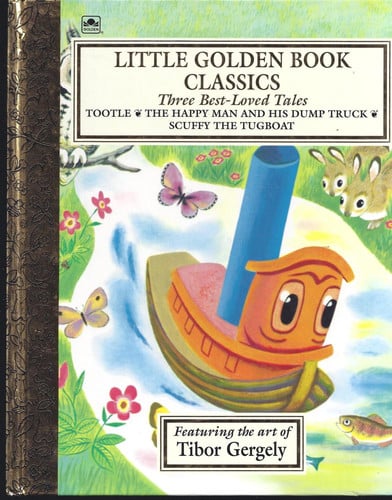
Three Best-Loved Tales Tootle; The Happy Man and His Dump Truck; Scuffy the Tugboat

Gergely, Tibor
Tootle, the baby locomotive, goes to the village of Lower Trainswitch to learn how to become a working locomotive. A man with a dump truck takes all of his friends for a ride and lets them use his dumper for a slide. Tuffy sails down a stream, into the river, and finally into the ocean, where he is rescued by the man with polka-dot tie.
Random House Children's Books 1992-07 80 pages

The children of Noah: Jewish seafaring in ancient times

Patai, Raphael
Here the late Raphael Patai (1910-1996) recreates the fascinating world of Jewish seafaring from Noah's voyage through the Diaspora of late antiquity. In a work of pioneering scholarship, Patai weaves together Biblical stories, Talmudic lore, and Midrash literature to bring alive the world of these ancient mariners. As he did in his highly acclaimed book The Jewish Alchemists, Patai explores a subject that has never before been investigated by scholars. Based on nearly sixty years of research, beginning with study he undertook for his doctoral dissertation, The Children of Noah is literally Patai's first book and his last. It is a work of unsurpassed scholarship, but it is accessible to general readers as well as scholars.An abundance of evidence demonstrates the importance of the sea in the lives of Jews throughout early recorded history. Jews built ships, sailed them, fought wars in them, battled storms in them, and lost their lives to the sea. Patai begins with the story of the deluge that is found in Genesis and profiles Noah, the father of all shipbuilders and seafarers. The sea, according to Patai's interpretation, can be seen as an image of the manifestation of God's power, and he reflects on its role in legends and tales of early times. The practical importance of the sea also led to the development of practical institutions, and Patai shows how Jewish seafaring had its own culture and how it influenced the cultures of Mediterranean life as well. Of course, Jewish sailors were subject to the same rabbinical laws as Jews who never set sail, and Patai describes how they went to extreme lengths to remain in adherence, even getting special emendations of laws to allow them to tie knots and adjust rigging on the Sabbath.The Children of Noah is a capstone to an extraordinary career. Patai was both a careful scholar and a gifted storyteller, and this work is at once a vivid history of a neglected aspect of Jewish culture and a treasure trove of sources for further study. It is a stimulating and delightful book.
Princeton University Press 1999-12-05 224 pages

Busing and backlash: white against white in a California school district

Rubin, Lillian B.
This title is part of UC Press's Voices Revived program, which commemorates University of California Press’s mission to seek out and cultivate the brightest minds and give them voice, reach, and impact. Drawing on a backlist dating to 1893, Voices Revived makes high-quality, peer-reviewed scholarship accessible once again using print-on-demand technology. This title was originally published in 1972.
University of California Press 1972 248 pages

The Birkenhead Drill

Douglas W. Phillips
In 1852, the British H.M. troopship Birkenhead foundered. More than 400 men chose to drown or be eaten alive by sharks rather than allow one woman or child to suffer. This is the story of the bravery and heroism that has come to be known as the Birkenhead drill. - Cover. The British H.M. Troopship Birkenhead was the crowning glory of her generation. The first iron-hulled vessel of war, she was believed to be unusually resilient and seaworthy. On the night of February 26, 1852, she was sailing for the coast of South Africa with about 638 men, women, and children aboard, including a large contingent of military reinforcements for the troops engaged in the Kaffir Wars. At about 2:00 a.m., the vessel struck a ledge off Cape Danger. Twenty minutes later, she was submerged. Before she sank, an important decision was made. The men would sacrifice their lives for the women and children. They would willingly die rather than even possibly capsize the overloaded boats on which the women and children sought refuge. Over the next few hours, wives and children watched as their loved ones drowned or were consumed by man-eating sharks engaged in a wild feeding frenzy. The heroism of these men not only established the maritime principle of "women and children first," but served to inspire generations of men and women to stand by the ancient Christian principles of heroic manhood
Vision Forum 2004-04 83 pages