6 results for "Cognitive Psychology"

Mind change: how digital technologies are leaving their mark on our brains

Greenfield, Susan
"Google. Facebook. Twitter. Repeat. We live in a world unimaginable even a few decades ago, one like no other in human history. It's a parallel world where we can be on the move in the real world, yet always hooked into an alternative time and place. And although it's a two-dimensional world of sight and sound, it offers instant information, connected identities, and constant novelty. In this world, our screen technologies are increasingly where we work, where we unwind, where we relieve our boredom and where we learn. The subsequent transformation in how we live and think is a vitally important issue, perhaps even the most important issue of our time. When toddlers are given iPads, and adults spend ten hours a day staring at a screen, can we afford to assume that our brave new screen technologies are harmless tools? Blending a wide range of scientific studies, news events, and cultural criticism with brio and verve, Mind Change presents an incisive snapshot of the global 'now.' Greenfield examines how the dawn of the Digital Age has already altered our cultural landscape, fueled an epidemic of oversharing, and transformed how we learn, remember and spread information -- and how these innovations are changing our physical brains. A warning cry, a shot across the bow, and a call to action, Mind Change explores the social, cultural and physiological ramifications of our new digital lifestyle"--
Random House 2015-02-10 348 pages

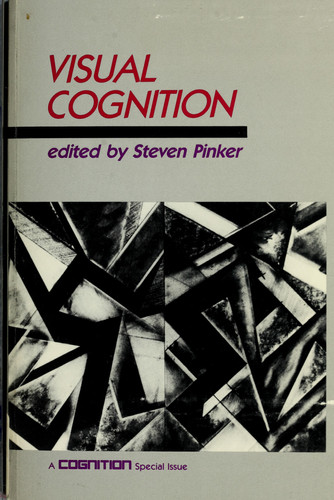
Visual cognition

Steven Pinker
These essays tackle some of the central issues in visual cognition, presentingexperimental techniques from cognitive psychology, new ways of modeling cognitive processes oncomputers from artificial intelligence, and new ways of studying brain organization fromneuropsychology, to address such questions as: How do we recognize objects in front of us? How do wereason about objects when they are absent and only in memory? How do we conceptualize the threedimensions of space? Do different people do these things in different ways? And where are theseabilities located in the brain?While this research, which appeared as a special issue of the journalCognition, is at the cutting edge of cognitive science, it does not assume a highly technicalbackground on the part of readers. The book begins with a tutorial introduction by the editor,making it suitable for specialists and nonspecialists alike.Steven Pinker is Associate Professor,Department of Psychology and Center for Cognitive Science at MIT.
MIT Press 1985 280 pages

Descartes' baby: how the science of child development explains what makes us human

Bloom, Paul
"If you really want to understand human nature, you must observe people as they are before they are corrupted by language and culture, by MTV and Hebrew school. You must look at babies." So contends psychologist Paul Bloom-whom Steven Pinker calls "the wunderkind of cognitive science"-in this fascinating account of how we learn to make sense of reality. All humans see the world in two fundamentally different ways: Even babies have a rich understanding of both the physical and social worlds. They expect objects to obey principles of physics, and they're startled when things disappear or defy gravity. Yet they can also read emotions and respond with anger, sympathy, and joy.In Descartes' Baby, Bloom draws on a wealth of scientific discoveries to show how these two ways of knowing give rise to such uniquely human traits as humor, disgust, religion, art, and morality. The myriad ways that our dualist perspectives, born in infancy, undergo development throughout our lives and profoundly influence our thoughts, feelings, and actions is the subject of this richly rewarding book.
Basic Books 2004-04-13 271 pages

Thought without language

Lawrence Weiskrantz,Fyssen Foundation
Does thought depend crucially on language, as some philosophers maintain, or can abstract reasoning and other faculties exist in the absence of language? This voume, based on a Fyssen Foundation symposium held in Versailles in April 1987, addresses this crucial question in a new way, bringing together experts on non-verbal thinking in adults, in pre-linguistic infants, and in animals. The nineteen chapters, discussion and editorial comment represent an impressive body of material, shedding new light on many aspects of the problem. Topics covered include the role of the non-verbal right cerebral hemisphere in humans; the investigation of non-verbal aspects of various categories of cognition (such as abstract reasoning, spatial awareness, and pattern recognition); evidence for cognition without concious awareness; and neurological and developmental evidence. The concluding chapter is a personal account by a gifted but dyslexic mathematician of the nature of his handicap and the non-vebal reasoning that he has developed to cope with this. various
Clarendon 1988 533 pages

Words, thoughts, and theories

Gopnik, Alison
Words, Thoughts, and Theories articulates and defends the "theory theory" of cognitive and semantic development, the idea that infants and young children, like scientists, learn about the world by forming and revising theories, a view of the origins of knowledge and meaning that has broad implications for cognitive science. Gopnik and Meltzoff interweave philosophical arguments and empirical data from their own and other's research. Both the philosophy and the psychology, the arguments and the data, address the same fundamental epistemological question: How do we come to understand the world around us? Recently, the theory theory has led to much interesting research. However, this is the first book to look at the theory in extensive detail and to systematically contrast it with other theories. It is also the first to apply the theory to infancy and early childhood, to use the theory to provide a framework for understanding semantic development, and to demonstrate that language acquisition influences theory change in children.The authors show that children just beginning to talk are engaged in profound restructurings of several domains of knowledge. These restructurings are similar to theory changes in science, and they influence children's early semantic development, since children's cognitive concerns shape and motivate their use of very early words. But, in addition, children pay attention to the language they hear around them and this too reshapes their cognition, and causes them to reorganize their theories.
MIT 1998-09-01 268 pages