11 results for "Data Science"

Cracking the Bible code

Satinover, Jeffrey
Cracking the Bible Code is the true account of the most amazing scientific research ever undertaken. References to important names, dates, and historical events have been found encoded in the book of Genesis. No individual could have known this informationfrom what grew in the garden of Eden to details of the Gulf War. Mystics and sages have long held that these codes existed, proving God's direct hand in all that was and is to be. Incredible? Yes. But some of today's greatest scientific minds have been unable as yet to disprove the codes.If the codes are genuine, they will forever change our view of God, faith, and our fate. Cracking the Bible Code explores the extraordinary possibilities and the furor surrounding the codes in a riveting story that is equal parts holy quest, Byzantine intrigue, and cutting-edge science.
W. Morrow 1997-10-08 346 pages

Computer age statistical inference: algorithms, evidence, and data science

Efron, Bradley,Hastie, Trevor
The twenty-first century has seen a breathtaking expansion of statistical methodology, both in scope and influence. 'Data science' and 'machine learning' have become familiar terms in the news, as statistical methods are brought to bear upon the enormous data sets of modern science and commerce. How did we get here? And where are we going? How does it all fit together? Now in paperback and fortified with exercises, this book delivers a concentrated course in modern statistical thinking. Beginning with classical inferential theories - Bayesian, frequentist, Fisherian - individual chapters take up a series of influential topics: survival analysis, logistic regression, empirical Bayes, the jackknife and bootstrap, random forests, neural networks, Markov Chain Monte Carlo, inference after model selection, and dozens more. The distinctly modern approach integrates methodology and algorithms with statistical inference. Each chapter ends with class-tested exercises, and the book concludes with speculation on the future direction of statistics and data science.
Cambridge University Press 2021-06-17 491 pages

Matrix-computations

Golub, Gene H.
Revised and updated, the third edition of Golub and Van Loan's classic text in computer science provides essential information about the mathematical background and algorithmic skills required for the production of numerical software. This new edition includes thoroughly revised chapters on matrix multiplication problems and parallel matrix computations, expanded treatment of CS decomposition, an updated overview of floating point arithmetic, a more accurate rendition of the modified Gram-Schmidt process, and new material devoted to GMRES, QMR, and other methods designed to handle the sparse unsymmetric linear system problem.
North Oxford Academic 1983 476 pages

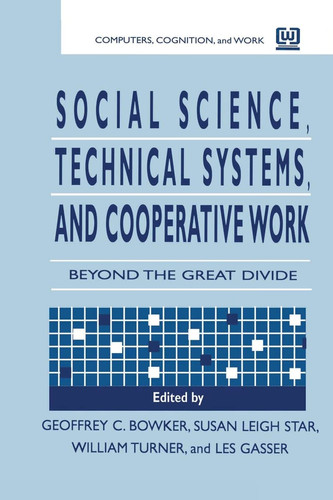
Social science, technical systems, and cooperative work: beyond the great divide

Geoffrey C. Bowker,Les Gasser,Susan Leigh Star,William Turner
This book is the first to directly address the question of how to bridge what has been termed the ""great divide"" between the approaches of systems developers and those of social scientists to computer supported cooperative work--a question that has been vigorously debated in the systems development literature. Traditionally, developers have been trained in formal methods and oriented to engineering and formal theoretical problems; many social scientists in the CSCW field come from humanistic traditions in which results are reported in a narrative mode. In spite of their differences in style,
Lawrence Erlbaum Associates 1997 470 pages

Integral Operators in the Theory of Linear Partial Differential Equations

Bergman, Stefan
The present book deals with the construction of solutions of linear partial differential equations by means of integral operators which transform analytic functions of a complex variable into such solutions. The theory of analytic functions has achieved a high degree of deve lopment and simplicity, and the operator method permits us to exploit this theory in the study of differential equations. Although the study of existence and uniqueness of solutions has been highly developed, much less attention has been paid to the investigation of function theo retical properties and to the explicit construction of regular and singular solutions using a unified general procedure. This book attempts to fill in the gap in this direction. Integral operators of various types have been used for a long time in the mathematical literature. In this connection one needs only to mention Euler and Laplace. The author has not attempted to give a complete account of all known operators, but rather has aimed at developing a unified approach. For this purpose he uses special operators which preserve various function theoretical properties of analytic functions, such as domains of regularity, validity of series development, connection between the coefficients of these developments and location and character of singularities, etc. However, all efforts were made to give a complete bibliography to help the reader to find more detailed information.
Springer 2014-10-09 156 pages

Computational Excursions in Analysis and Number Theory

Borwein, Peter
* Preface * Introduction * LLL and PSLQ * Pisot and Salem Numbers * Rudin-Shapiro Polynomials * Fekete Polynomials * Products of Cyclotomic Polynomials * Location of Zeros * Maximal Vanishing * Diophantine Approximation of Zeros * The Integer-Chebyshev Problem * The Prouhet-Tarry-Escott Problem * The Easier Waring Problem * The Erdös-Szekeres Problem * Barker Polynomials and Golay Pairs * The Littlewood Problem * Spectra * Appendix A: A Compendium of Inequalities * B: Lattice Basis Reduction and Integer Relations * C: Explicit Merit Factor Formulae * D: Research Problems * References * Index
Springer 2012-09-18 232 pages

Humane politics and methods of inquiry

Pool, Ithiel de Sola
Ithiel de Sola Pool was a distinguished scholar of the political process, and one of the most original thinkers in the development of an integrated social science. This volume focuses upon his contributions to the development of research methods that deepen our understanding of human behaviour. The book is divided into five parts treating the analysis of communications, computer simulation, forecasting, network theory, and the social sciences in political contexts. The first part considers the problems and possibilities of analysis raised by the unprecedented quantity of data made available by widespread and improved communications technology; what should be counted and how should inferences be made. Part two explores computer simulation in the study of presidential election patterns and how it can provide in-depth analyses of crisis situations in history. Part three focuses on strategies for predicting the future of international politics and methods to forecast the impacts of new communications technologies, while part four offers a rigorous analysis of domestic and global contact networks and the so-called "small world" phenomenon. Part five is concerned with external challenges to the use of social science to create more humane politics, including the question of value neutrality, ideology, "deconstructive" critical theory, and threats by government to the health of universities. In a concluding essay Lloyd Etheredge draws upon Pool's work to discuss several new ways in which the methods treated in this volume can be applied to contemporary social change.
Transaction Publishers 2016 315 pages