
2 results for "Developmental Psychology"

Just babies: the origins of good and evil

Bloom, Paul
"A leading cognitive scientist argues that a deep sense of good and evil is bred in the bone. From Sigmund Freud to Lawrence Kohlberg, psychologists have long believed that we begin life as amoral animals. After all, isn't it the parents' role to turn babies into civilized beings who can experience empathy and shame, and override selfish impulses? In Just Babies, Paul Bloom argues that humans are in fact hardwired with a sense of morality. Drawing upon years of original research at his Yale lab, he shows that babies and toddlers can judge the goodness and badness of others' actions; that they act to soothe those in distress; and that they feel guilt, shame, pride, and righteous anger. Yet this innate morality is tragically limited. Our natural strong moral feelings toward those in our own group--same family, same race--are offset by ingrained dislike, even hatred, of those in different groups. Put more simply, we are natural-born bigots. Vivid and intellectually probing, Just Babies argues that through intelligence and creativity we can transcend the primitive sense of morality we are born with. This erudite yet accessible book will captivate readers of Steven Pinker, Philip Zimbardo, and Robert Wright"--
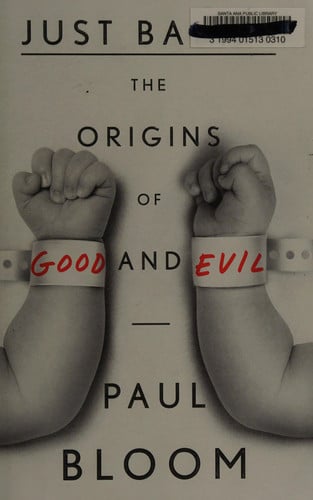
Crown Publishers 2013 273 pages

Mind and morals: essays on cognitive science and ethics

Larry May,Marilyn Friedman,Andy Clark
The essays in this anthology deal with the growing interconnections between moral philosophy and research that draws upon neuroscience, developmental psychology, and evolutionary biology. The essays in this anthology deal with the growing interconnections between moral philosophy and research that draws upon neuroscience, developmental psychology, and evolutionary biology. This cross-disciplinary interchange coincides, not accidentally, with the renewed interest in ethical naturalism. In order to understand the nature and limits of moral reasoning, many new ethical naturalists look to cognitive science for an account of how people actually reason. At the same time, many cognitive scientists have become increasingly interested in moral reasoning as a complex form of human cognition that challenges their theoretical models. The result of this collaborative, and often critical, interchange is an exciting intellectual ferment at the frontiers of research into human mentality. Sections and Contributors Ethics Naturalized, Owen Flanagan, Mark L. Johnson, Virginia Held - Moral Judgments, Representations, and Prototypes, Paul M. Churchland, Andy Clark, Peggy DesAutels, Ruth Garrett Millikan - Moral Emotions, Robert M. Gordon, Alvin I. Goldman, John Deigh, Naomi Scheman - Agency and Responsibility James P. Sterba, Susan Khin-Zaw, Helen E. Longino, Michael E. Bratman A Bradford Book
MIT Press 1996 315 pages