7 results for "Economic History"

Theory and History

Ludwig von Mises
Like Hayek, Mises moved beyond economics in his later years to address questions regarding the foundation of all social science. But unlike Hayeks attempts, Misess writings on these matters have received less attention than they deserve. Theory and Histor, writes Rothbard in his introduction, "remains by far the most neglected masterwork of Mises. Here Mises defends his all-important idea of methodological dualism: one approach to the hard sciences and another for the social sciences. He defends the epistemological status of economic proposition. He has his most extended analysis of those who want to claim that there is more than one logical structure by which we think about reality. He grapples with the problem of determinism and free will. And presents philosophy of history and historical research. Overall, this is a tremendously lucid defense of the fundamental Misesian approach to social philosophy. "It is Misess great methodological work, explaining the basis of his approach to economics, and providing scintillating critiques of such fallacious alternatives as historicism, scientism, and Marxian dialectical materialism. Austrian economics will never enjoy a genuine renaissance until economists read and absorb the vital lessons of this unfortunately neglected work." Theory and History should be required for any student of 20th century ideas.
Ludwig von Mises ,Institute 2007 384 pages

Political Awakenings Conversations with History

Harry Kreisler
As a kid, Noam Chomsky handed out the Daily Mirror at his uncle's newsstand on 72nd Street, inadvertently finding himself in a buzzing intellectual and political hub for European immigrants in New York. Iranian human rights Nobelist Shirin Ebadi and her husband signed their own legal contract, attempting to restore equality to their marriage after the Iranian Revolution effectively erased the legal rights of women. Elizabeth Warren set out to expose those frauds declaring bankruptcy and taking advantage of the system-only to discover, in her research, a very different story of hard-working middle-class families facing economic collapse in the absence of a social safety net. While studying at Oxford, a young Tariq Ali made a bet with a friend that he could work the Vietnam War into every single answer on his final exams. In this rousing, thoughtful, often funny, and always inspiring volume, a diverse and impressive group of thinkers reflect on those formative experiences that shaped their own political commitments. A fascinating new window into the revealing links between the personal and the political, Political Awakenings will engage readers across generations.
ReadHowYouWant.com 2011-03 384 pages

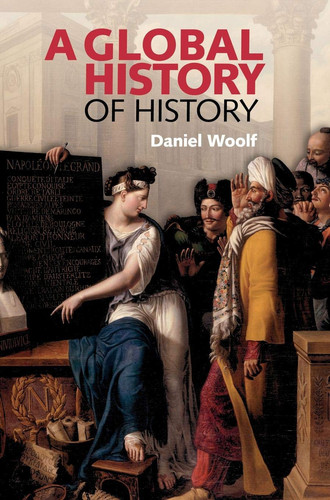
A global history of history

Woolf, D. R.
A global history of historical writing, thought and the development of the historical discipline from the ancient world to the present. This is a definitive guide to human efforts to recover, understand and represent the past, bringing together different historical traditions and their social, economic, political and cultural contexts. Daniel Woolf offers clear definitions of different genres and forms of history and addresses key themes such as the interactions between West and East, the conflict of oral, pictographic, and written accounts of the past and the place of history in society and in politics. Numerous textual extracts and illustrations in every chapter capture the historical cultures of past civilizations and demonstrate the different forms that historical consciousness has taken around the world. The book offers unique insights into the interconnections between different historical cultures over 3000 years and relates the rise of history to key themes in world history. --
Cambridge University Press 2011-02-17 568 pages

The Ellen Meiksins Wood Reader

Ellen Meiksins Wood
Ellen Meiksins Wood is a leading contemporary political theorist who has been described as the founder, together with Robert Brenner, of Political Marxism,' a distinct version of historical materialism which has inspired a research program that spans a number of academic disciplines. Organized thematically, this Reader provides an overview of her original interpretations of capitalism, and many different topics.
Haymarket Books 2013-11-05 368 pages

Shadow Pasts: 'Amateur Historians' and History's Mysteries

Rubinstein, William D Professor
For many intelligent people, the stuff of history does not consist of the kind of dry-as-dust investigations of diplomatic, economic, or political history that most university historians research and write about, but the famous topics of "history's mysteries"- who was Jack the Ripper? Was there a conspiracy to kill President Kennedy? Did Richard III murder the Princes in the Tower? What are the mysteries of the ancient Pyramids?Not only have a great many books and articles been written on these and similar topics by so-called "amateur historians," but they have generated societies, conferences, newsletters, and television programmes. Many people who are not academic historians take a keen interest in these topics, and have in some cases made themselves real experts on them, with interesting theories of their own. Despite all of this, however, these topics are virtually ignored by academic historians and can be treated with contempt. In Shadow Pasts, William D. Rubinstein a well-known and widely published history professor, examines seven of the most famous and interesting topics which have been discussed, debated, examined, and written about by "amateur historians. Each of these mysteries and the theories surrounding them are examined in detail, with Professor Rubinstein presenting his own original and sometimes surprising conclusions about what really happened.
Routledge 2016 208 pages

The distortion of America

Handlin, Oscar
Oscar Handlin is best known as America's leading historian of ethnicity and the immigrant experience in the new nation. In 1961 he produced what was perhaps the first critique of anti-Americanism as an ideological expression of Marxism-Leninismin the schools of higher learning. In his new opening essay to this second edition, he both tells how he was able to perceive the cancer of communist ideology early, and why this new edition is needed now. The Distortion of America is a handbook on avoiding error, a methodological primer on how historians gather evidence, presume witnesses to be reliable or not, and develop forms of verification in the conduct of analysis and research. As such this work is an introduction to the study of history, as well as an examination of specific instances of ideology and mindless passion as ruinous ways to look at America. Handlin shows how social history kept his vision close to the experiences of ordinary people, whose heritage of freedom and dedication to individual liberty was the necessary antidote to academic exaggeration. Six additional chapters supplement those gathered in the earlier collection. Two written in the 1950s describe the forces that later created the economic strength of the United States, while a third treats the problem of race which long contributed to the distortions of America. An account of Yugoslavia before its collapse describes the class divisions responsible for present troubles. By contrast, no inkling of the tensions that would erupt in bloody civil war caught the attention of hundreds of journalists who crowded Sarajevo in 1984. A brief article shows the relevance to China of democracy in the United States. The final new entry is a memorable piece on how the career of Arthur Koestler exemplifies the difficulties of the ex-communist in an unsympathetic environment. These essays illustrate Handlin's working philosophy: "the study of the human past persuades me that, despite the frequent risks of failure, man has the capacity to make order an find purpose in the world in which he lives when he uses the power of his reason to do so."
Transaction Publishers 1996 232 pages