15 results for "Economics"

The innovators: how a group of hackers, geniuses, and geeks created the digital revolution

Isaacson, Walter
"Following his blockbuster biography of Steve Jobs, The Innovators is Walter Isaacson's revealing story of the people who created the computer and the Internet. It is destined to be the standard history of the digital revolution and an indispensable guide to how innovation really happens. What were the talents that allowed certain inventors and entrepreneurs to turn their visionary ideas into disruptive realities? What led to their creative leaps? Why did some succeed and others fail? In his masterly saga, Isaacson begins with Ada Lovelace, Lord Byron's daughter, who pioneered computer programming in the 1840s. He explores the fascinating personalities that cr eated our current digital revolution, such as Vannevar Bush, Alan Turing, John von Neumann, J.C.R. Licklider, Doug Engelbart, Robert Noyce, Bill Gates, Steve Wozniak, Steve Jobs, Tim Berners-Lee, and Larry Page. This is the story of how their minds worked and what made them so inventive. It's also a narrative of how their ability to collaborate and master the art of teamwork made them even more creative. For an era that seeks to foster innovation, creativity, and teamwork, The Innovators shows how they happen"--
Simon & Schuster 2014 542 pages

Iron ambition: my life with Cus D'Amato

Tyson, Mike,Sloman, Larry
"From the former heavyweight champion and New York Times-bestselling memoirist comes an intimate look at the life and leadership lessons of Cus D'Amato, the legendary boxing trainer and Mike Tyson's surrogate father. When Cus D'Amato first saw thirteen-year-old Mike Tyson spar in the ring, he proclaimed, "That's the heavyweight champion of the world." D'Amato, who had previously managed the careers of world champions Floyd Patterson and Jose Torres, would go on to train the young Tyson and raise him as a son. D'Amato died a year before Tyson became the youngest heavyweight champion in history. In Tyson's bestselling memoir Undisputed Truth, he recounted the role D'Amato played in his formative years, adopting him at age sixteen after his mother died and shaping him both physically and mentally after Tyson had spent years living in fear and poverty. In Iron Ambition, Tyson elaborates on the life lessons that D'Amato passed down to him, and reflects on how the trainer's words of wisdom continue to resonate with him outside the ring. The book also chronicles Cus's courageous fight against the mobsters who controlled boxing, revealing more than we've ever known about this singular cultural figure"--
Blue Rider Press 2017 465 pages

The education of a value investor: my transformative quest for wealth, wisdom, and enlightenment

Spier, Guy
"What happens when a young Wall Street investment banker spends a small fortune to have lunch with Warren Buffett? He becomes a real value investor. In this fascinating inside story, Guy Spier details his career from Harvard MBA to hedge fund manager. But the path was not so straightforward. Spier reveals his transformation from a Gordon Gekko wannabe, driven by greed, to a sophisticated investor who enjoys success without selling his soul to the highest bidder. Spier's journey is similar to the thousands that flock to Wall Street every year with their shiny new diplomas, aiming to be King of Wall Street. Yet what Guy realized just in the nick of time was that the King really lived 1,500 miles away in Omaha, Nebraska. Spier determinedly set out to create a new career in his own way. Along the way he learned some powerful lessons which include: why the right mentors and partners are critical to long term success on Wall Street; why a topnotch education can sometimes get in the way of your success; that real learning doesn't begin until you are on your own; and how the best lessons from Warren Buffett have less to do with investing and more to do with being true to yourself. Spier also reveals some of his own winning investment strategies, detailing deals that were winners but also what he learned from deals that went south. Part memoir, part Wall Street advice, and part how-to, Guy Spier takes readers on a ride through Wall Street but more importantly provides those that want to take a different path with the insight, guidance, and inspiration they need to carve out their own definition of success"--
Palgrave Macmillan 2014-09-09 214 pages

How to succeed in business without really crying

Leifer, Carol
"For many years, television comedy was an exclusive all boys' club--until a brilliant comedian named Carol Leifer came along, blazing a trail for funny women everywhere. From Late Night with David Letterman and Saturday Night Live to Seinfeld, The Ellen Show, and Modern Family, Carol has written for and/or performed on some of the best TV comedies of all time. This hilarious collection of essays charts her extraordinary three-decade journey through show business, illuminating her many triumphs and some missteps along the way--and offering valuable lessons for women and men in any profession. Part memoir, part guide to life, and all incredibly funny,How to Succeed in Business without Really Crying offers tips and tricks for getting ahead, finding your way, and opening locked doors--even if you have to use a sledgehammer" --
Quirk Books 2014-04-08 239 pages

From the ground up: a journey to reimagine the promise of America

Schultz, Howard,Gordon, Joanne
"From the longtime CEO and chairman of Starbucks, a bold, dramatic work about the new responsibilities that leaders, businesses, and citizens share in American society today--as viewed through the intimate lens of one man's life and work. What do we owe one another? How do we channel our drive, ingenuity, even our pain, into something more meaningful than individual success? And what is our duty in the places where we live, work, and play? These questions are at the heart of the American journey. They are also ones that Howard Schultz has grappled with personally since growing up in the Brooklyn housing projects and while building Starbucks from eleven stores into one of the world's most iconic brands. In From the Ground Up, Schultz looks for answers in two interwoven narratives. One story shows how his conflicted boyhood--including experiences he has never before revealed--motivated Schultz to become the first in his family to graduate from college, then to build the kind of company his father, a working-class laborer, never had a chance to work for: a business that tries to balance profit and human dignity. A parallel story offers a behind-the-scenes look at Schultz's unconventional efforts to challenge old notions about the role of business in society. From health insurance and free college tuition for part-time baristas to controversial initiatives about race and refugees, Schultz and his team tackled societal issues with the same creativity and rigor they applied to changing how the world consumes coffee. Throughout the book, Schultz introduces a cross-section of Americans transforming common struggles into shared successes. In these pages, lost youth find first jobs, aspiring college students overcome the yoke of debt, post-9/11 warriors replace lost limbs with indomitable spirit, former coal miners and opioid addicts pave fresh paths, entrepreneurs jump-start dreams, and better angels emerge from all corners of the country. From the Ground Up is part candid memoir, part uplifting blueprint of mutual responsibility, and part proof that ordinary people can do extraordinary things. At its heart, it's an optimistic, inspiring account of what happens when we stand up, speak out, and come together for purposes bigger than ourselves. Here is a new vision of what can be when we try our best to lead lives through the lens of humanity."--Dust jacket.
Random House 2019 352 pages

Good for the money: my fight to pay back America

Benmosche, Bob
"In 2009, at the peak of the financial crisis, AIG - the American insurance behemoth - was sinking fast. It was the peg upon which the nation hung its ire and resentment during the financial crisis: the pinnacle of Wall Street arrogance and greed. When Bob Benmosche climbed aboard as CEO, it was widely assumed that he would go down with his ship. In mere months, he turned things around, pulling AIG from the brink of financial collapse and restoring its profitability. Before three years were up, AIG had fully repaid its staggering debt to the U.S. government - with interest.Good for the Money is an unyielding leader's memoir of a career spent fixing companies through thoughtful, unconventional strategy. With his brash, no-holds-barred approach to the job, Benmosche restored AIG's employee morale and good name. His is a story of perseverance, told with refreshing irreverence in unpretentious terms.Called "an American hero" by Andrew Ross Sorkin, author of Too Big to Fail, Benmosche was a self-made man who never forgot what life is like for the nation's 99-percent; again and again, he pushed back against obstinate colleagues to salvage American jobs and industry. Good for the Money affords you a front-row seat for Benmosche's heated battles with major players from Geithner to Obama to Cuomo, and offers incomparable lessons in leadership from the legendary CEO who changed the way Wall Street does business"--
St. Martin's Press 2016-04-12 271 pages

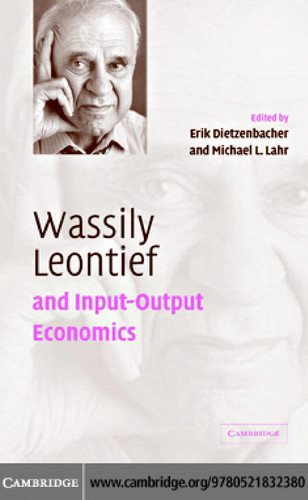
Wassily Leontief and input-output economics

Wassily Leontief,Erik Dietzenbacher,Michael L. Lahr
Wassily Leontief (1905–1999) was the founding father of input-output economics, for which he received the Nobel Prize in 1973. This book offers a collection of papers in memory of Leontief by his students and close colleagues. The first part, 'Reflections on Input-Output Economics', focuses upon Leontief as a person and scholar as well as his personal contributions to economics. It includes contributions by Nobel Laureate Paul A. Samuelson who shares his memories of a young Professor Leontief at Harvard and ends with the last joint interview with Wassily and his wife, to date previously unpublished. The second part, 'Perspectives of Input-Output Economics', includes theoretical and empirical research inspired by Leontief's work and offers a wide-ranging sample of the state of interindustry economics, a field Leontief founded. This is a strong collection likely to appeal to a wide range of professionals in universities, government, industry and international organizations.
Cambridge University Press 2004-03-25 396 pages

Bad boy: my life on and off the canvas

Fischl, Eric
In Bad Boy , renowned American artist Eric Fischl has written a penetrating, often searing exploration of his coming of age as an artist, and his search for a fresh narrative style in the highly charged and competitive New York art world in the 1970s and 1980s. With such notorious and controversial paintings as Bad Boy and Sleepwalker, Fischl joined the front ranks of America artists, in a high-octane downtown art scene that included Andy Warhol, David Salle, Julian Schnabel, and others. It was a world of fashion, fame, cocaine and alcohol that for a time threatened to undermine all that Fischl had achieved. In an extraordinarily candid and revealing memoir, Fischl discusses the impact of his dysfunctional family on his art—his mother, an imaginative and tragic woman, was an alcoholic who ultimately took her own life. Following his years as a student at Cal Arts and teaching in Nova Scotia, he describes his early years in New York with the artist April Gornik, just as Wall Street money begins to encroach on the old gallery system and change the economics of the art world. Fischl rebelled against the conceptual and minimalist art that was in fashion at the time to paint compelling portraits of everyday people that captured the unspoken tensions in their lives. Still in his thirties, Eric became the subject of a major Vanity Fair interview, his canvases sold for as much as a million dollars, and The Whitney Museum mounted a major retrospective of his paintings. Bad Boy follows Fischl’s maturation both as an artist and sculptor, and his inevitable fall from grace as a new generation of artists takes center stage, and he is forced to grapple with his legacy and place among museums and collectors. Beautifully written, and as courageously revealing as his most provocative paintings, Bad Boy takes the reader on a roller coaster ride through the passion and politics of the art world as it has rarely been seen before.
Crown 2012 357 pages

Jack Kemp: the bleeding-heart conservative who changed America

Kondracke, Morton,Barnes, Fred
"THE PURPOSE OF POLITICS IS NOT TO DEFEAT YOUR OPPONENT AS MUCH AS IT IS TO PROVIDE SUPERIOR LEADERSHIP AND BETTER IDEAS THAN THE OPPOSITION." --JACK KEMP The late 1970s were miserable for America. It was the post-Vietnam, post-Watergate era, a time of high unemployment, ruinous inflation, gasoline lines, Communist advances, and bottomed-out U.S. morale. In the 1980s, it all turned around: "stagflation" ended and nearly two decades of prosperity ensued. The Soviet Union retreated, then collapsed. America again believed in itself. And around the world, democratic capitalism was deemed "the end of history." Ronald Reagan's policies sparked the American renaissance, but the Gipper's leadership is only part of the story. The economic theory that underpinned America's success was pioneered by a star professional quarterback turned self-taught intellectual and "bleeding-heart conservative": Jack Kemp. Kemp's role in a pivotal period in American history is at last illuminated in this first-ever biography, which also has lessons for the politics of today. Kemp was the congressional champion of supply-side economics--the idea that lowering taxes would foster growth. Even today, almost no one advocates a return to a top income tax rate of 70 percent. Kemp didn't just challenge the Democratic establishment. He also encouraged his fellow Republicans to be growth (not austerity) minded, open their tent to minorities and blue-collar workers, battle poverty and discrimination, and once again become "the party of Lincoln." Kemp approached politics the same way he played quarterback for the Buffalo Bills: with a refusal to accept defeat. Yet he also was incapable of personal attack, arguing always on the level of ideas. He regarded opponents as adversaries, not enemies, and often cooperated with them to get things done. Despite many ups and downs, including failed presidential and vice-presidential bids, he represented a positive, idealistic, compassionate Republicanism. Drawing on never-published papers and more than one hundred Kemp Oral History Project interviews, noted journalists Morton Kondracke and Fred Barnes trace Kemp's life, from his childhood through his pro football career to his influential years as a congressman and cabinet secretary. As the American Dream seems to be waning and polarized politics stifles Washington, Kemp is a model for what politics ought to be. The Republican party and the nation are in desperate need of another Kemp.
Sentinel 2015 390 pages

Defining the age: Daniel Bell, his time and ours

Paul Starr,Julian E. Zelizer
"The sociologist Daniel Bell was an uncommonly acute observer of the structural forces transforming the United States and other advanced societies in the twentieth century. The titles of Bell's major books-The End of Ideology (1960), The Coming of Post-Industrial Society (1973), and The Cultural Contradictions of Capitalism (1976)-became hotly debated frameworks for understanding the era when they were published. In Defining the Age, Paul Starr and Julian Zelizer bring together a group of distinguished contributors to consider how well Bell's ideas captured their historical moment and continue to provide profound insights into today's world. Wide-ranging essays demonstrate how Bell's writing has informed thinking about subjects such as the history of socialism, the roots of the radical right, the emerging postindustrial society, and the role of the university. The book also examines Bell's intellectual trajectory and distinctive political stance. Calling himself "a socialist in economics, a liberal in politics, and a conservative in culture," he resisted being pigeon-holed, especially as a neoconservative. Defining the Age features essays from historians Jenny Andersson, David A. Bell, Michael Kazin, and Margaret O'Mara; sociologist Steven Brint; media scholar Fred Turner; and political theorists Jan-Werner Müller and Stefan Eich. While differing in their judgments, they agree on one premise: Bell's ideas deserve the kind of nuanced and serious attention that they finally receive in this book"--
Columbia University Press 2022 332 pages

In days to come: a new hope for Israel

Burg, Avraham
"Born in 1955, Avraham Burg witnessed firsthand many of the most dramatic and critical junctions in Israeli history. Here he chronicles the highs and lows of his country during the last five decades, beginning with the 1967 war, when, as a young boy, his mother brought him back Uzi cartridges from the Kotel, which he incorporated into the Chanukah menorah he made for his home economics class. Burg narrates the misplaced hopes of religious Zionism (informed by his conservative upbringing), Israel's obsession with military might (informed by his own experiences as a paratrooper), the country's democratic aspirations (informed by his tenure in the Knesset) and more. What he delivers, ultimately, is an analysis of the ambitions and failures of Israel and Judaism, from the unique standpoint of his generation--the children of the mythical "founders" who established the state. In Days to Come is Burg's philosophical inquiry into what Jewish-Israeli identity means today if you are personally, ethically, and politically opposed to what your country stands for. With bravery and candor, he urges his countrymen to dare to ask the difficult questions and accept the truth of difficult answers, have the courage to move on from trauma to trust, understand that Jews do not have monopoly over suffering but a responsibility to prevent crimes against humanity, have the will to solve the conflict between Israel and Palestine by adopting new paradigms, be ready to relinquish the privileges given to the Jews and create a shared space with equal rights for every human being, lay the groundwork for a constitutional reality in which every individual--under Israeli sovereignty or responsibility--has equal rights, and build a wall of separation between synagogue and state"--
Nation Books 2018 321 pages

History in my life: a memoir of three eras

Berend, T. Iván
Berend's memoir offers an interesting case study, a subjective addition to the "objective" historical works on Central and Eastern European state socialism. It describes the hard choices of intellectuals in a dictatorial state: 1. remain in isolation, concentrate on scholarly works, and exclude politics in your personal life; 2. be in opposition, criticize and unveil the regime, accept discrimination and exclusion; 3. remain within the establishment and work for reforming the country using legal possibilities to criticize the regime and to achieve changes from within. Ivan T. Berend, is Distinguished Professor at the University of California Los Angeles, Director of the European Studies Program. He was one of the masterminds of regime change in Hungary. He made a career in Hungary as a university professor, Rector of the University of Economics (1973-79), and President of the Hungarian Academy of Sciences (1985-90). He was President of the International Committee of Historical Sciences (1995-2000), and Vice-President of the International Economic History Association (1986-1994). His research interests are the complex economic, social, ideological, and cultural history of Central and Eastern Europe in the 19th-20th century; economic modernization; problems of European backwardness; transition from state socialism to capitalism. He published 26 books and more than 120 studies.--Publisher's description
Central European University Press 2009 276 pages

Historical encyclopedia of natural and mathematical sciences

Ben-Menahem, Ari
This milestone extensive work combines the essentials of history – biography, chronology, political and economic background – with the observations, theories, principles, laws and equations that constitute the specifics of science. The 5800-page Encyclopedia arises from the conviction that the optimal perspective on science is through the lens of history, setting aside traditional divisions of discipline and specialty, and rising above geopolitical boundaries. Reaching from 4,200 BCE to the 21st century CE, the Encyclopedia tells (as the author himself puts it) "not only who did it and when it was done but also precisely what was done." The author, Ari Ben-Menahem, surveys 100 generations of great thinkers, offering 2070 detailed biographies of scientists, engineers, explorers and inventors, who left their mark on the history of science and technology. The span of coverage is all-encompassing: mathematics, philosophy, logic, physical and environmental sciences (including physics, chemistry, astronomy, earth and space sciences and cosmology), life sciences (biology, medicine, physiology, botany, zoology and biochemistry), associated engineering disciplines, and the social sciences (among them economics, psychology, sociology, anthropology, linguistics and more). The six-volume Encyclopedia also includes 380 articles summarizing the time-line of ideas in the leading fields of science, technology, mathematics and philosophy, plus useful tables, figures and photos, and 20 ‘Science Progress Reports’ detailing scientific setbacks. Interspersed throughout are quotations, gathered from the wit and wisdom of sages, savants and scholars throughout the ages from antiquity to modern times.
Springer 2009-03-05 5986 pages

Struve, liberal on the Right, 1905-1944

Pipes, Richard
This volume completes the biography of Peter Struve (1870-1944), one of the most remarkable and influential Russian intellectuals of this century. More than anyone else in his time, Struve was the master of history, journalism, economics, international relations, and practical politics. A scholar and activist, he helped found the Marxist movement in Russia, initiated Marxist Revisionism there, and launched Lenin's career, and he was the theoretician and a cofounder of the Constitutional Democratic Party. After 1905--the years covered in this self-contained volume--Struve became the principal critic of the Russian intelligentsia and the main political ideologist of the anti-Bolshevik opposition during the Civil War and in emigration. His life was a part of the life of Russia as he struggled to craft a liberal democracy and wound up defeated and faced with an emerging totalitarian state. In writing about Struve, Richard Pipes turns biography into history. He lays bare the split soul of the Russian intellectuals--their irresponsibility, unwillingness to compromise, intolerance. Struve, the liberal turned conservative, preached to his countrymen physical and spiritual freedom based on law. He was a Westerner in his championing of social reform, legality, private property, and a vigorous state and foreign policy. This long and rich tradition of liberal-conservatism is recounted against the background of a "monstrous growth of political claims on the individual that caused intellectual and moral independence increasingly to be punished with ostracism, confinement, exile, and death."
Harvard University Press 1980 526 pages