
10 results for "Economics"

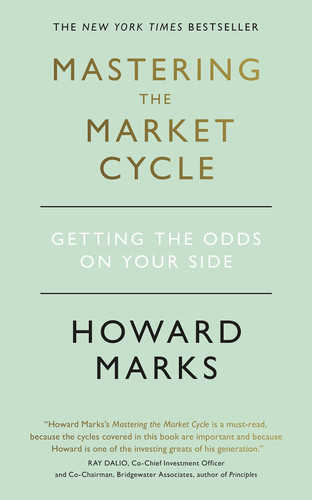
Mastering the market cycle: getting the odds on your side

Marks, Howard
A NEW YORK TIMES , WALL STREET JOURNAL , AND USA TODAY BESTSELLER The legendary investor shows how to identify and master the cycles that govern the financial markets. "A MUST-READ" Ray Dalio, bestselling author of Principles and Co-Chief Investment Officer and Co-Chairman, Bridgewater Associates "WHEN I SEE MEMOS FROM HOWARD MARKS IN MY MAIL, THEY'RE THE FIRST THING I OPEN AND READ" Warren Buffett " HOWARD IS A LEGENDARY INVESTOR" Tony Robbins We all know markets rise and fall, but when should you pull out, and when should you stay in? The answer is never black or white, but is best reached through a keen understanding of the reasons behind the rhythm of cycles. Confidence about where we are in a cycle comes when you learn the patterns of ups and downs that influence not just economics, markets, and companies, but also human psychology and the investing behaviors that result. If you study past cycles, understand their origins and remain alert for the next one, you will become keenly attuned to the investment environment as it changes. You'll be aware and prepared while others get blindsided by unexpected events or fall victim to emotions like fear and greed. By following Marks's insights - drawn in part from his iconic memos over the years to Oaktree's clients - you can master these recurring patterns to have the opportunity to improve your investing results. SEE WHAT REVIEWERS ARE SAYING ABOUT MASTERING THE MARKET CYCLE : ⭐⭐⭐⭐⭐ "This book lays the timeless fundamentals for investment success" ⭐⭐⭐⭐⭐ "A must-read" ⭐⭐⭐⭐⭐ " Excellent book on cycles and psychology"
Nicholas Brealey Publishing 2020-01-23 323 pages

Crisis economics: a crash course in the future of finance

Roubini, Nouriel
In this myth-busting book Nouriel Roubini shows that everything we think about economics is wrong. Financial crises are not unpredictable 'black swans', but an inherent part of capitalism. Only by remaking our financial systems to acknowledge this, can we get out of the mess we're in. Will there be another recession, and if so what shape? When will the next bubble occur? And what can we do about it? Here Roubini gives the answers, and lists his commandments for the future.
Penguin 2011-05-05 359 pages

The return of depression economics

Krugman, Paul R.
Today, the tragedy of the Great Depression looks gratuitous and unnecessary: Our economists and policy makers simply have gained too much experience since then. It could never happen again. Or could it? Over the course of the last two years, six Asian economies have experienced an economic slump that bears an eerie resemblance to the Great Depression. Russia defaulted on its debt in 1998--an event that, halfway around the world, drove Brazilian interest rates through the roof and terrified the U.S. bond market. Some of the brightest financiers in the world, working for the Long-Term Capital Corporation, thought they had the market licked only to find themselves in a jam that had all the makings of the overleveraged positions that caused the 1929 stock market crash. Paul Krugman, one of the world's top economists, recounts these events and more: He points out that they raise significant questions for which policy makers may not have answers. This paperback edition features a brand-new preface by Krugman on the financial realities of the past year.
W.W. Norton 2000 176 pages

How an economy grows and why it crashes: a tale

Schiff, Peter D.
"How an Economy Grows and Why it Crashes uses illustration, humor, and accessible storytelling to explain complex topics of economic growth and monetary systems. In it, economic expert and bestselling author of Crash Proof, Peter Schiff teams up with his brother Andrew to apply their signature "take no prisoners" logic to expose the glaring fallacies that have become so ingrained in our country's economic conversation.Inspired by How an Economy Grows and Why It Doesn't--a previously published book by the Schiffs' father Irwin, a widely published economist and activist--How an Economy Grows and Why It Crashes incorporates the spirit of the original while tackling the latest economic issues.With wit and humor, the Schiffs explain the roots of economic growth, the uses of capital, the destructive nature of consumer credit, the source of inflation, the importance of trade, savings, and risk, and many other topical principles of economics.The tales told here may appear simple of the surface, but they will leave you with a powerful understanding of How an Economy Grows and Why it Crashes"--
Wiley 2010-05-03 233 pages

Wassily Leontief and input-output economics

Wassily Leontief,Erik Dietzenbacher,Michael L. Lahr
Wassily Leontief (1905–1999) was the founding father of input-output economics, for which he received the Nobel Prize in 1973. This book offers a collection of papers in memory of Leontief by his students and close colleagues. The first part, 'Reflections on Input-Output Economics', focuses upon Leontief as a person and scholar as well as his personal contributions to economics. It includes contributions by Nobel Laureate Paul A. Samuelson who shares his memories of a young Professor Leontief at Harvard and ends with the last joint interview with Wassily and his wife, to date previously unpublished. The second part, 'Perspectives of Input-Output Economics', includes theoretical and empirical research inspired by Leontief's work and offers a wide-ranging sample of the state of interindustry economics, a field Leontief founded. This is a strong collection likely to appeal to a wide range of professionals in universities, government, industry and international organizations.
Cambridge University Press 2004-03-25 396 pages

The law of accumulation and breakdown of the capitalist system: being also a theory of crises

Grossmann, Henryk
Cover -- Title Page -- Copyright -- Dedication -- Contents -- Foreword Tony Kennedy -- Henryk Grossmann and the Theory of Capitalist Collapse Tony Kennedy -- Introduction by Henryk Grossmann -- 1 The Downfall of Capitalism in the Existing Literature -- The point at issue -- The conception of breakdown in the existing literature -- How Kautsky finally abandoned Marx's theory of accumulation and of breakdown -- Notes -- 2 The Law of Capitalist Breakdown -- Is there a theory of breakdown in Marx? -- Preliminary methodological remarks -- The equilibrium theory of the neo-harmonists -- The conditions and tasks of schematic analysis -- Why was classical economy alarmed by the fall in the rate of profit despite an expanding mass of profit? -- The views of classical economists on the future of capitalism (D Ricardo and J S Mill) -- The Marxist theory of accumulation and breakdown -- Marx's theory of breakdown is also a theory of crises -- An anti-critical interlude -- The logical and mathematical basis of the law of breakdown -- Why the Marxist theory of accumulation and breakdown was misunderstood -- The factors of the breakdown and the business cycle -- Crises and the theory of underconsumption -- The elasticity of accumulation -- The restricted development of productive forces under capitalism -- The Marxist theory of imperfect valorisation -- Notes -- 3 Modifying Countertendencies -- Introduction -- Part 1: Countertendencies Internal to the Mechanism of Capital -- Increases in the rate of profit through the expansion of productivity -- Reducing the costs of variable capital through increases in productivity -- Shortening the turnover time and its impact on the rate of surplus value -- The additional money capital required for an expanded scale of production -- The conflict between use value and exchange value
Pluto Press 1992-03-27 210 pages

Long waves of capitalist development: a Marxist interpretation : based on the Marshall lectures given at the University of Cambridge

Mandel, Ernest
In this revised and expanded edition of Long Waves of Capitalist Development , Ernest Mandel seeks to explain the underlying determinants of the booms and slumps of the trade cycle. Mandel first establishes that there have indeed been twenty- to twenty-five-year-long waves of capitalist expansion and contraction—and that these have persisted in the period since World War II. He then assembles evidence to show that while broad tendencies in the rate of profit have been decisive in triggering downturns, the ingredients necessary for a new upswing are, by contrast, generally political and extra-economic in character. He thereby demonstrates the falsity of neo-liberal doctrines, according to which the free market will itself generate a new formula for balanced and sustainable expansion. Long Waves of Capitalist Development not only offers a penetrating analysis of the ills that have afflicted contemporary capitalist economies but also surveys, and takes forward, one of the classical debates of modern economic history.
Verso 1995-06-17 174 pages

The Irreversible crisis: five essays

Magdoff, Harry
This is the fifth in the important series of essays by the former editors of Monthly Review analyzing the ongoing crisis of global capitalism. Following the multiple interconnected stock market crashes of October 1987, the economies of the capitalist world entered a new and dangerous phase of the crisis that began in the 1970s with the end of the post-WWII boom. Sweezy and Magdoff argue that far from being a temporary setback, the events of late 1987 are rooted in the nature of the capital accumulation process itself and therefore unlikely to be reversed. Their argument is especially prescient when viewed in light of the financial meltdown of 2008.
Monthly Review Press 1988 76 pages
