11 results for "Economics"

The worldly philosophers: the lives, times, and ideas of the great economic thinkers

Heilbroner, Robert L.
The bestselling classic that examines the history of economic thought from Adam Smith to Karl Marx—“all the economic lore most general readers conceivably could want to know, served up with a flourish” ( The New York Times ). The Worldly Philosophers not only enables us to see more deeply into our history but helps us better understand our own times. In this seventh edition, Robert L. Heilbroner provides a new theme that connects thinkers as diverse as Adam Smith and Karl Marx. The theme is the common focus of their highly varied ideas—namely, the search to understand how a capitalist society works. It is a focus never more needed than in this age of confusing economic headlines. In a bold new concluding chapter entitled “The End of the Worldly Philosophy?” Heilbroner reminds us that the word “end” refers to both the purpose and limits of economics. This chapter conveys a concern that today’s increasingly “scientific” economics may overlook fundamental social and political issues that are central to economics. Thus, unlike its predecessors, this new edition provides not just an indispensable illumination of our past but a call to action for our future.
Simon & Schuster 1999 365 pages

Inside the economist's mind: conversations with eminent economists

Paul A. Samuelson,William A. Barnett
By focusing on the human side as well as the intellectual dimensions of how economists work and think, this collection of interviews with top economists of the 20th century becomes a startling and lively introduction to the modern world of macroeconomics. A fun read! For more information, frequent updates, and to comment on the forthcoming book, visit William A. Barnett's weblog at http://economistmind.blogspot.com/. Acclaim for Inside the Economist's Mind "In candid interviews, these great economists prove to be fabulous story tellers of their lives and times. Unendingly gripping for insiders, this book should also help non-specialists understand how economists think." Professor Julio Rotemberg, Harvard University Business School, and Editor, Review of Economics and Statistics. "Economics used to be called the 'dismal science'. It will be impossible for anybody to hold that view anymore ... This is science with flesh and blood, and a lot of fascinating stories that you will find nowhere else." Dr. Jean-Pascal Bénassy, Paris-Jourdan Sciences Économiques, Paris, France "This book provides a rare and intriguing view of the personal and professional lives of leading economists ... It is like A Beautiful Mind , scaled by a factor of 16 [the number of interviews in the book]." Professor Lee Ohanian, University of California at Los Angeles " ... if you want an insider view of how economics has been developing in the last decades, this is the (only) book for you." Professor Giancarlo Gandolfo, University of Rome ‘La Sapienza,’ Rome "Here we see the HUMAN side of path-breaking research, the personalities and pitfalls, the DRAMA behind the science." Professor Francis X. Diebold, University of Pennsylvania, Philadelphia
Blackwell Pub 2007 419 pages

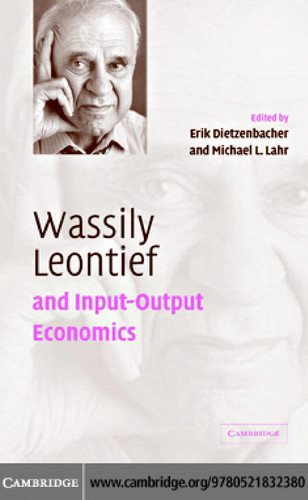
Wassily Leontief and input-output economics

Wassily Leontief,Erik Dietzenbacher,Michael L. Lahr
Wassily Leontief (1905–1999) was the founding father of input-output economics, for which he received the Nobel Prize in 1973. This book offers a collection of papers in memory of Leontief by his students and close colleagues. The first part, 'Reflections on Input-Output Economics', focuses upon Leontief as a person and scholar as well as his personal contributions to economics. It includes contributions by Nobel Laureate Paul A. Samuelson who shares his memories of a young Professor Leontief at Harvard and ends with the last joint interview with Wassily and his wife, to date previously unpublished. The second part, 'Perspectives of Input-Output Economics', includes theoretical and empirical research inspired by Leontief's work and offers a wide-ranging sample of the state of interindustry economics, a field Leontief founded. This is a strong collection likely to appeal to a wide range of professionals in universities, government, industry and international organizations.
Cambridge University Press 2004-03-25 396 pages

Keynes: useful economics for the world economy

Temin, Peter
As the global economic crisis continues to cause damage, some policy makers have called for a more Keynesian approach to current economic problems. In this book, the economists Peter Temin and David Vines provide an accessible introduction to Keynesian ideas that connects Keynes's insights to today's global economy and offers readers a way to understand current policy debates. John Maynard Keynes (1883-1946) created the branch of economics now known as macroeconomics. He played a major role in the reconstruction of Europe and the world economy after the Second World War. Keynesian economics came to be identified with efforts to mitigate the Great Depression and with postwar economic policies that helped power a golden age of economic growth. Temin and Vines argue that Keynes also provided a way to understand the interactions among nations, and therein lies his relevance for today's global crisis. Temin and Vines survey economic thinking before Keynes and explain how difficult it was for Keynes to escape from conventional wisdom. They set out the Keynesian analysis of a closed economy and expand the analysis to the international economy, using a few simple graphs to present Keynes's formal analyses in an accessible way. They discuss problems of today's world economy, showcasing the usefulness of a simple Keynesian approach to current economic policy choices. Keynesian ideas, they argue, can lay the basis for a return to economic growth.
The MIT Press 2014-09-12 117 pages

Models of my life

Simon, Herbert A.
In this candid and witty autobiography, Nobel laureate Herbert A. Simon looks at his distinguished and varied career, continually asking himself whether (and how) what he learned as a scientist helps to explain other aspects of his life. A brilliant polymath in an age of increasing specialization, Simon is one of those rare scholars whose work defines fields of inquiry. Crossing disciplinary lines in half a dozen fields, Simon's story encompasses an explosion in the information sciences, the transformation of psychology by the information-processing paradigm, and the use of computer simulation for modeling the behavior of highly complex systems. Simon's theory of bounded rationality led to a Nobel Prize in economics, and his work on building machines that think&-- based on the notion that human intelligence is the rule-governed manipulation of symbols&--laid conceptual foundations for the new cognitive science. Subsequently, contrasting metaphors of the maze (Simon's view) and of the mind (neural nets) have dominated the artificial intelligence debate. There is also a warm account of his successful marriage and of an unconsummated love affair, letters to his children, columns, a short story, and political and personal intrigue in academe.
MIT Press 1996-10-08 415 pages

The essential Hirschman

Hirschman, Albert O.
"The Essential Hirschman brings together some of the finest essays in the social sciences, written by one of the twentieth century's most influential and provocative thinkers. Albert O. Hirschman was a master essayist, one who possessed the rare ability to blend the precision of economics with the elegance of literary imagination. In an age in which our academic disciplines require ever-greater specialization and narrowness, it is rare to encounter an intellectual who can transform how we think about inequality by writing about traffic, or who can slip in a quote from Flaubert to reveal something surprising about taxes. The essays gathered here span an astonishing range of topics and perspectives, including industrialization in Latin America, imagining reform as more than repair, the relationship between imagination and leadership, routine thinking and the marketplace, and the ways our arguments affect democratic life. Throughout, we find humor, unforgettable metaphors, brilliant analysis, and elegance of style that give Hirschman such a singular voice.Featuring an introduction by Jeremy Adelman that places each of these essays in context as well as an insightful afterword by Emma Rothschild and Amartya Sen, The Essential Hirschman is the ideal introduction to Hirschman for a new generation of readers and a must-have collection for anyone seeking his most important writings in one book"--
Princeton University Press 2013 384 pages

Making Chicago price theory: Friedman-Stigler correspondence 1945-1957

Friedman, Milton
"Milton Friedman and George J. Stigler shaped economics as we know it today - their Chicago School laid the groundwork for much of the neoclassical tradition in economic analysis. This book brings together a collection of letters from these two Noble laureates from the post-war years, containing new information about their personal and professional relationships, and also illuminating the development of ideas which are now fundamental to economic theory. The book, edited by Dan and Claire Hammond, contains an introductory chapter, chronologies for Friedman and Stigler, and transcripts of 71 letters written from 1945 to 1957 along with enclosures."--BOOK JACKET
Routledge 2006 165 pages

The age of monopoly capital: selected correspondence of Paul A. Baran and Paul M. Sweezy, 1949-1964

Baran, Paul A.,Sweezy, Paul M.
The rich correspondence that preceded the publication of Monopoly Capital Paul A. Baran and Paul M. Sweezy were two of the leading Marxist economists of the twentieth century. Their seminal work, Monopoly Capital: An Essay on the American Economic and Social Order, published in 1966, two years after Baran's death, was in many respects the culmination of fifteen years of correspondence between the two, from 1949 to 1964. During those years, Baran, a professor of economics at Stanford, and Sweezy, a former professor of economics at Harvard, then co-editing Monthly Review in New York City, were separated by three thousand miles. Their intellectual collaboration required that they write letters to one another frequently and, in the years closer to 1964, almost daily. Their surviving correspondence consists of some one thousand letters. The letters selected for this volume illuminate not only the development of the political economy that was to form the basis of Monopoly Capital, but also the historical context—the McCarthy Era, the Cold War, the Cuban Missile Crisis—in which these thinkers were forced to struggle. Not since Marx and Engels carried on their epistolary correspondence has there has been a collection of letters offering such a detailed look at the making of a prescient critique of political economy—and at the historical conditions from which that critique was formed.
Monthly Review Press 2017-07-24 528 pages

Struve, liberal on the Right, 1905-1944

Pipes, Richard
This volume completes the biography of Peter Struve (1870-1944), one of the most remarkable and influential Russian intellectuals of this century. More than anyone else in his time, Struve was the master of history, journalism, economics, international relations, and practical politics. A scholar and activist, he helped found the Marxist movement in Russia, initiated Marxist Revisionism there, and launched Lenin's career, and he was the theoretician and a cofounder of the Constitutional Democratic Party. After 1905--the years covered in this self-contained volume--Struve became the principal critic of the Russian intelligentsia and the main political ideologist of the anti-Bolshevik opposition during the Civil War and in emigration. His life was a part of the life of Russia as he struggled to craft a liberal democracy and wound up defeated and faced with an emerging totalitarian state. In writing about Struve, Richard Pipes turns biography into history. He lays bare the split soul of the Russian intellectuals--their irresponsibility, unwillingness to compromise, intolerance. Struve, the liberal turned conservative, preached to his countrymen physical and spiritual freedom based on law. He was a Westerner in his championing of social reform, legality, private property, and a vigorous state and foreign policy. This long and rich tradition of liberal-conservatism is recounted against the background of a "monstrous growth of political claims on the individual that caused intellectual and moral independence increasingly to be punished with ostracism, confinement, exile, and death."
Harvard University Press 1980 526 pages