
8 results for "Economics"

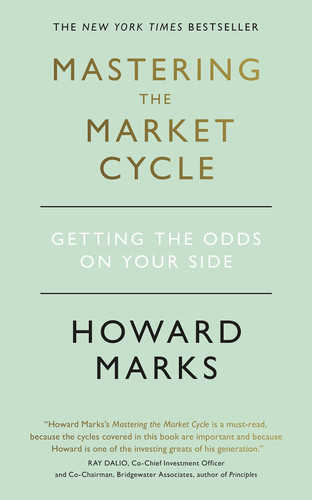
Mastering the market cycle: getting the odds on your side

Marks, Howard
A NEW YORK TIMES , WALL STREET JOURNAL , AND USA TODAY BESTSELLER The legendary investor shows how to identify and master the cycles that govern the financial markets. "A MUST-READ" Ray Dalio, bestselling author of Principles and Co-Chief Investment Officer and Co-Chairman, Bridgewater Associates "WHEN I SEE MEMOS FROM HOWARD MARKS IN MY MAIL, THEY'RE THE FIRST THING I OPEN AND READ" Warren Buffett " HOWARD IS A LEGENDARY INVESTOR" Tony Robbins We all know markets rise and fall, but when should you pull out, and when should you stay in? The answer is never black or white, but is best reached through a keen understanding of the reasons behind the rhythm of cycles. Confidence about where we are in a cycle comes when you learn the patterns of ups and downs that influence not just economics, markets, and companies, but also human psychology and the investing behaviors that result. If you study past cycles, understand their origins and remain alert for the next one, you will become keenly attuned to the investment environment as it changes. You'll be aware and prepared while others get blindsided by unexpected events or fall victim to emotions like fear and greed. By following Marks's insights - drawn in part from his iconic memos over the years to Oaktree's clients - you can master these recurring patterns to have the opportunity to improve your investing results. SEE WHAT REVIEWERS ARE SAYING ABOUT MASTERING THE MARKET CYCLE : ⭐⭐⭐⭐⭐ "This book lays the timeless fundamentals for investment success" ⭐⭐⭐⭐⭐ "A must-read" ⭐⭐⭐⭐⭐ " Excellent book on cycles and psychology"
Nicholas Brealey Publishing 2020-01-23 323 pages

The most important thing illuminated: uncommon sense for the thoughtful investor

Marks, Howard
Howard Marks's The Most Important Thing distilled the investing insight of his celebrated client memos into a single volume and, for the first time, made his time-tested philosophy available to general readers. In this edition, Marks's wisdom is joined by the comments, insights, and counterpoints of four renowned investors and investment educators: Christopher C. Davis (Davis Funds), Joel Greenblatt (Gotham Capital), Paul Johnson (Nicusa Capital), and Seth A. Klarman (Baupost Group). These experts lend insight into such concepts as "second-level thinking," the price/value relationship, patient opportunism, and defensive investing. Marks also adds his own annotations, expanding on his book's original themes and issues. A new chapter addresses the importance of reasonable expectations, and a foreword by Bruce C. Greenwald, called "a guru to Wall Street's gurus" by the New York Times , speaks on value investing, productivity, and the economics of information. *** Howard Marks, the chairman and cofounder of Oaktree Capital Management, is renowned for his insightful assessments of market opportunity and risk. After four decades spent ascending to the top of the investment management profession, he is today sought out by the world's leading value investors, and his client memos brim with insightful commentary and a time-tested, fundamental philosophy. Now for the first time, all readers can benefit from Marks's wisdom, concentrated into a single volume that speaks to both the amateur and seasoned investor. Informed by a lifetime of experience and study, The Most Important Thing explains the keys to successful investment and the pitfalls that can destroy capital or ruin a career. Utilizing passages from his memos to illustrate his ideas, Marks teaches by example, detailing the development of an investment philosophy that fully acknowledges the complexities of investing and the perils of the financial world. Brilliantly applying insight to today's volatile markets, Marks offers a volume that is part memoir, part creed, with a number of broad takeaways. Marks expounds on such concepts as "second-level thinking," the price/value relationship, patient opportunism, and defensive investing. Frankly and honestly assessing his own decisions--and occasional missteps--he provides valuable lessons for critical thinking, risk assessment, and investment strategy. Encouraging investors to be "contrarian," Marks wisely judges market cycles and achieves returns through aggressive yet measured action. Which element is the most essential? Successful investing requires thoughtful attention to many separate aspects, and each of Marks's subjects proves to be the most important thing. "This is that rarity, a useful book."--Warren Buffett
Columbia Business School Pub 2013-01-08 226 pages

The education of a value investor: my transformative quest for wealth, wisdom, and enlightenment

Spier, Guy
"What happens when a young Wall Street investment banker spends a small fortune to have lunch with Warren Buffett? He becomes a real value investor. In this fascinating inside story, Guy Spier details his career from Harvard MBA to hedge fund manager. But the path was not so straightforward. Spier reveals his transformation from a Gordon Gekko wannabe, driven by greed, to a sophisticated investor who enjoys success without selling his soul to the highest bidder. Spier's journey is similar to the thousands that flock to Wall Street every year with their shiny new diplomas, aiming to be King of Wall Street. Yet what Guy realized just in the nick of time was that the King really lived 1,500 miles away in Omaha, Nebraska. Spier determinedly set out to create a new career in his own way. Along the way he learned some powerful lessons which include: why the right mentors and partners are critical to long term success on Wall Street; why a topnotch education can sometimes get in the way of your success; that real learning doesn't begin until you are on your own; and how the best lessons from Warren Buffett have less to do with investing and more to do with being true to yourself. Spier also reveals some of his own winning investment strategies, detailing deals that were winners but also what he learned from deals that went south. Part memoir, part Wall Street advice, and part how-to, Guy Spier takes readers on a ride through Wall Street but more importantly provides those that want to take a different path with the insight, guidance, and inspiration they need to carve out their own definition of success"--
Palgrave Macmillan 2014-09-09 214 pages

How to really ruin your financial life and portfolio

Stein, Benjamin
"Hilarious advice on what NOT to do with money, from financial funny man Ben Stein Everyone's searching for the secrets to financial success, but what about the best ways to lose money. fast?! In How To Really Ruin Your Financial Life and Portfolio, bestselling author, economist, financial commentator, and media personality Ben Stein explains exactly what to do. to go bust! The ultimate "how-NOT-to" guide, the book gives readers invaluable tips that should be avoided at all costs. Written in Stein's own inimitable style, this hilarious guide provides essential financial advice on what not to do when it comes to managing money.From reading and acting upon investing newsletters to trading on a margin, from investing in bonds to breathlessly following CNBC, and from buying stock in firms you do not understand to believing in your own genius at stock picking to keeping as little cash on hand as possible, Stein presents the rules that every would-be investor needs to know, so they can do the exact opposite and actually make money. Fully revised and updated, this new edition presents all-new missteps that can destroy any portfolio. Fully revised and updated edition of the tongue-in-cheek bestseller that shows investors what not to do with their money Written by acclaimed author economist, financial commentator, and media personality Ben Stein Loaded with indispensable pieces of bad advice that readers should avoid at all costs A laugh-out-loud approach to personal finance, How To Really Ruin Your Financial Life and Portfolio is an accessible guide to money from the funniest man in finance"--
Wiley 2012-10-02 132 pages

Advances in behavioral finance

Richard H. Thaler
Modern financial markets offer the real world's best approximation to the idealized price auction marker envisioned in economic theory. Nevertheless, as the increasingly exquisite and detailed financial data demonstrate, financial markets often fail to behave as they should if trading were truly dominated by the fully rational investors that populate financial theories. These market anomalies have spawned a new approach to finance, one which as editor Richard Thaler puts it, "entertains the possibility that some of the agents in the economy behave less than fully rationally some of the time." Advances in Behavioral Finance collects together twenty-one percent articles that illustrate the power of this approach. More than just an assembly of exceptions to mainline theory, these papers illustrate how specific departures from fully rational decision making by individual market agents can provide explanations of otherwise puzzling market phenomena. To take several examples, Werner De Bondt and Thaler find an explanation for superior price performance of firms with poor recent earnings histories in the tendencies of investors to overreact to recent information. Richard Roll traces the negative effects of corporate takeovers on the stock prices of the acquiring firms to the overconfidence of managers, who fail to recognize the contributions of chance to their past successes. Andrei Shleifer and Robert Vishny show how the difficulty of establishing a reliable reputation for correctly assessing the value of long term capital projects can lead investment analysts, and hence corporate managers, to focus myopically on short term returns. The analyses in this wide-ranging collection demonstrate the growing success of behavioral approaches to understanding the behavior of financial markets. As a testing ground for assessing the empirical accuracy of behavioral theories, these successful studies of the stock market reach beyond the world of finance to suggest, very powerfully, the importance of pursuing behavioral approaches to other areas of economic life. Advances in Behavioral Finance is a solid beachhead for behavioral work in the financial arena and a clear promise of wider application for behavioral economics in the future
Russell Sage Foundation 1993-08-19 597 pages

Miss Independent: a simple 12-step plan to start investing and grow your own wealth

Lapin, Nicole
You've worked hard for your money and now it's time for your money to work for you. You will never earn or budget your way into real wealth. Growing your money significantly doesn't require starting with a lot of money. It requires a little bit of knowledge about taking smart risks and as much time as possible to take advantage of the glorious power of compound interest, which Einstein refers to as the eighth wonder of the world. From automating your savings to easy, no-stress investing strategies, Nicole will teach you how to take your financial knowledge and portfolio to the next level and start you on your journey to your ultimate destination: true financial independence.
HarperCollins Leadership, an imprint of HarperCollins 2022 262 pages