11 results for "Economics"

With all your possessions: Jewish ethics and economic life

Tamari, Meir
Despite age-old slanders about Jewish economic and business activity, a highly ethical system of laws and customs has always been central to Jewish life. Noted economist and rabbinical scholar Meir Tamari explains that the moral and religious tenets of Judaism have, in fact, created a unique economic framework within which Jews have worked successfully for thousands of years, combining free market practices with social welfare, competition with compassion.
Jason Aronson Inc 1998 340 pages

True Prosperity How to Have Everything

Yehuda Berg
Everyone wants to be financially successful, but great financial success often brings negative side effects in other areas. In this exciting book, Yehuda Berg shows why the true purpose of our lives is complete happiness and total fulfillment. Drawing on the lessons of years of study and teaching, True Prosperity shows how the teachings of Kabbalah, the world's oldest body of spiritual wisdom, can be used every day and every moment not only to achieve success in one aspect of life, but to avoid the setbacks in other areas that can render any accomplishment emy and meaningless.
ReadHowYouWant.com 2010-12 184 pages

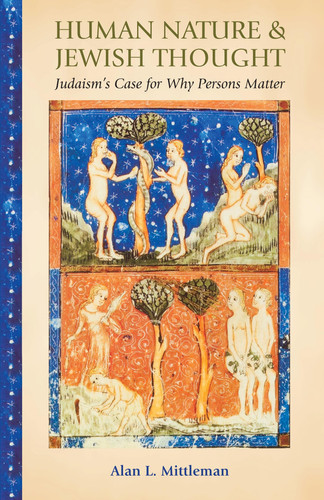
Human nature & Jewish thought: Judaism's case for why persons matter

Mittleman, Alan
This book explores one of the great questions of our time: How can we preserve our sense of what it means to be a person while at the same time accepting what science tells us to be true-namely, that human nature is continuous with the rest of nature? What, in other words, does it mean to be a person in a world of things? Alan Mittleman shows how the Jewish tradition provides rich ways of understanding human nature and personhood that preserve human dignity and distinction in a world of neuroscience, evolutionary biology, biotechnology, and pervasive scientism. These ancient resources can speak to Jewish, non-Jewish, and secular readers alike. Science may tell us what we are, Mittleman says, but it cannot tell us who we are, how we should live, or why we matter. Traditional Jewish thought, in open-minded dialogue with contemporary scientific perspectives, can help us answer these questions. Mittleman shows how, using sources ranging across the Jewish tradition, from the Hebrew Bible and the Talmud to more than a millennium of Jewish philosophy. Among the many subjects the book addresses are sexuality, birth and death, violence and evil, moral agency, and politics and economics. Throughout, Mittleman demonstrates how Jewish tradition brings new perspectives to-and challenges many current assumptions about-these central aspects of human nature. A study of human nature in Jewish thought and an original contribution to Jewish philosophy, this is a book for anyone interested in what it means to be human in a scientific age.
Princeton University Press 2015 215 pages

Jews, money and social responsibility: developing a "Torah of money" for contemporary life

Bush, Lawrence
Jews, Money and Social Responsibility is a lively discussion of socially responsible shopping, investment and philanthropy from an American Jewish perspective. The authors explore Judaism's teachings on economics, wealth, individual responsibility and community to develop a contemporary ethic of money and society. Their work offers a unifying vision of economic life that can sanctify and heal ourselves and our world.
Shefa Fund 1993 198 pages

The Transformation of Judaism From Philosophy to Religion

Jacob Neusner
An eminent scholar of the history of Judaism, Jacob Neusner shows in this work how Judaism changed from a philosophy to a religion between 200 and 400 C.E. 'The Transformation of Judaism' is a work both revolutionary in its method and unprecedented in its results. Comparing earlier and later sets of Judaic writings, Neusner sets forth how philosophy - abstract, elegant, orderly, and intellectual - turned into religion - tangible, down-to-earth, chaotic, and concrete. In the process, he offers an account of the birth of Judaism that has become normative. Moreover, Neusner's methodology can be applied to the study of religions other than Judaism because it examines the underpinnings of how a society sees the world (philosophy), orders itself (politics), and sustains itself (economics).
Wipf and Stock Publishers 2004-06-14 362 pages

The renewal of Palestine in the Jewish imagination

Ellis, Marc H.
"Beyond the immediate issues of politics and economics lie the larger and deeper realities of history and fidelity. As a Jew I am asking in these essays traditional religious questions in light of our present circumstances: What does it mean to be Jewish after the Holocaust and the consolidation of our empowerment in Israel/Palestine? Coming from a situation of oppression, what does it mean for Jewish history and theology to continue oppressing the Palestinian people? Has our empowerment in Israel brought us the freedom we so urgently needed, or has our abuse of power in Israel brought us a new enslavement and ghettoization which we did not seek, but now pursue almost blindly? Can we be healed of our trauma of Holocaust by finalizing the trauma of the Palestinian people which we as Jews have inflicted? At the lighting of the Shabbat candles, shall we bless our endeavor and thank God for making us into a warrior people?"--
Wipf & Stock 2016-05-02 158 pages

Rabbinic political theory: religion and politics in the Mishnah

Neusner, Jacob
In The Economics of the Mishnah Jacob Neusner showed how economics functioned as an active and generative ingredient in the system of the Mishnah. With this new study, Rabbinic Political Theory , he moves from the economics to the politics of the Mishnah, placing that politics in the broader context of ancient political theory. Neusner begins his study with a modification of Weber's categories for a theory of politics: myth, institutions, administration, passion, responsibility, and proportion. Detailing the Mishnah's conception of politics, Neusner considers what he calls the stable and static structure and system through comparison with Aristotle. Although Aristotle's Politics and the Mishnah share a common economic theory based on the fundamental unit of the householder, they diverge in their conceptions of political structure and order. Aristotle embeds economics within political economy, while, Neusner argues, the Mishnah presents the anomaly of an economics separated from politics. Using modern political terms, this study explicates the complicated politics developed by the philosopher-theologians of the Mishnah. It is a first-rate contribution to our understanding of the intersection of politics, political philosophy, and the Mishnaic system.
University of Chicago Press 1991-06-18 262 pages

Hellenistic Civilization and the Jews

Victor Tcherikover
The encounter between Jews and Greeks marked one of the most revolutionary meetings in the ancient world, for in that encounter politics, economics, culture, and religion changed dramatically. Victor Tcherikover, who devoted his entire scholarly life to the study of the Hellenistic period, offers here a benchmark assessment of that encounter. In this reprinted edition of his most famous work, including a new preface by University of Chicago Professor John J. Collins, Tcherikover uniquely combines "analyses of two of the most intriguing episodes of Jewish history in antiquity: the events that led to the Maccabean rebellion and the struggle for rights in Alexandria in the first century CE" (from the preface).
Baker Publishing Group 1999-06-01 580 pages