9 results for "Economics"

Freefall: free markets and the sinking of the global economy

Stiglitz, Joseph E.
This devastating and inspiring book, by one of the world's leading economic thinkers, lays out not only the course of the financial crisis which began in 2007, but also its underlying causes, and shows why much more radical reforms are needed than are currently being contemplated if we are to avoid similar 'systemic' crises in the future. Frefall shows why the bailout has been only marginally effective and how it could have been much more so, and outlines the enormous opportunity - not yet taken - to design a new global financial architecture. It is highly critical of many of the actions not only of George Bush's administration, but also of Barack Obama's. It shows why the bulk of the cost of recovery should be borne by those in the financial sector - not just for reasons of natural justice, but for compelling economic reasons also. More than any of this, it reminds readers to think constantly about what economics are for. Out of the crisis of our times, Joseph Stiglitz has crafted a tract which goes to the heart of economics and will be read long after the immediate impact of these mismanaged years has passed.
Allen Lane 2010 361 pages

The optimum quantity of money

Friedman, Milton
This classic set of essays by Nobel Laureate and leading monetary theorist Milton Friedman presents a coherent view of the role of money, focusing on specific topics related to the empirical analysis of monetary phenomena and policy. The early chapters cover factors determining the real quantity of money held in a community and the welfare implications of policies that affect the quantity held. The following chapters formally restate why quantity analysis has become central to the science of economics. Friedman's presidential address to the American Economic Association, included here, provides a general summary of his views on the role of monetary policy, with an emphasis on its limitations and its possibilities. This theoretical framework is used in examining a number of empirical problems: the demand for money, the explanation of price changes in wartime periods, and the role of money in business cycles. These essays summarize some of the most important results of Friedman's extensive research over the course of his lifetime. The chapters on policy that follow survey the positions of earlier economists and deal with the importance of lags and the implications of destabilizing speculation in foreign markets. Taken as a whole, The Optimum Quantity of Money provides a comprehensive view of the body of monetary theory developed in leading centers of monetary analysis. This work is essential reading for economists and graduate students in the field. The volume will be no less important for practicing business and banking personnel as well. The new statement by Michael Bordo, a student of Friedman's and an expert in the field, provides a sense of where the field now stands in the economy and academy. Milton Friedman is a senior fellow at the Hoover Institution of Stanford University. Before that, he was Distinguished Service Professor of Economics at the University of Chicago. He has also taught at Columbia University, the University of Wisconsin, the University of Minnesota, and Cambridge University. Among his many books are Essays in Positive Economics , A Program for Monetary Stability , Capitalism and Freedom , and A Monetary History of the United States . Michael D. Bordo is professor of economics at Rutgers, The State University of New Jersey, and author, with Lars Jonung, of, among other works, Demand for Money .
Aldine Transaction 2006 296 pages

The shifts and the shocks: what we've learned -- and have still to learn -- from the financial crisis

Wolf, Martin
"From the chief economic commentator for the Financial Times, a brilliant tour d'horizon of the new global economy and its trajectory There have been many books that have sought to explain the causes and courses of the financial and economic crisis which began in 2007-8. The Shifts and the Shocks is not another detailed history of the crisis, but the most persuasive and complete account yet published of what the crisis should teach us about modern economies and economics. The book identifies the origin of the crisis in the complex interaction between globalization, hugely destabilizing global imbalances and our dangerously fragile financial system. In the eurozone, these sources of instability were multiplied by the tragically defective architecture of the monetary union. It also shows how much of the orthodoxy that shaped monetary and financial policy before the crisis occurred was complacent and wrong. In doing so, it mercilessly reveals the failures of the financial, political and intellectual elites who ran the system. The book also examines what has been done to reform the financial and monetary systems since the worst of the crisis passed. "Are we now on a sustainable course?" Wolf asks. "The answer is no." He explains with great clarity why "further crises seem certain" and why the management of the eurozone in particular "guarantees a huge political crisis at some point in the future." Wolf provides far more ambitious and comprehensive plans for reform than any currently being implemented. Written with all the intellectual command and trenchant judgment that have made Martin Wolf one of the world's most influential economic commentators, The Shifts and the Shocks matches impressive analysis with no-holds-barred criticism and persuasive prescription for a more stable future. It is a book no one with an interest in global affairs will want to neglect. "--
Penguin Press 2015 503 pages

The essence of Friedman

Friedman, Milton
This collection of essays presents a sampling of the significant contributions to twentieth-century economic thought and practice by Nobel Prize-winner Milton Friedman. Friedman is widely regarded as the leader of the Chicago school of economics, which stresses the importance of the quantity of money as an instrument of governmental policy and as a major determinant of business cycles and inflation. Making an early impact on the economics profession was his analysis of economics as an empirical science, and in particular, his conclusion that the only relevant test of the acceptability of economic hypotheses is the conformity of the predictions they generate with observation. His permanent income theory of consumption, his restatement of the quantity theory of money, and his hypothesis of natural rate of unemployment have by now become part of received economic doctrine. Outside the economic profession, Friedman is best known for his outspoken statements on public policy, particularly his consistent belief that a free-enterprise system with minimum governmental intervention in the economic process will best preserve and extend both human freedom and economic prosperity. A number of the essays reprinted here are eloquent expressions of his commitment to everyone's freedom to choose.
Hoover Institution Press 1987 566 pages

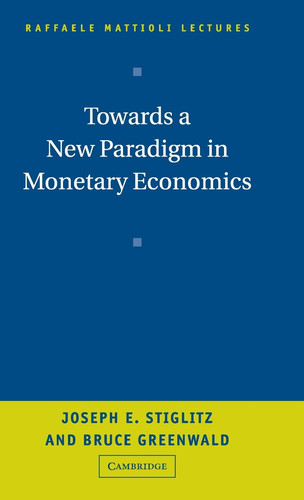
Towards a new paradigm in monetary economics

Stiglitz, Joseph E.
Expanding upon the literature of new institutional economics, the first part of this study stresses the significance of imperfections in information, bankruptcy and banks. The second part examines the policy implications of the new paradigm emphasizing loanable fund demand and supply, and demonstrates its relevance to our understanding of two recent historical episodes--the East Asian financial crisis and the 1991 U.S. recession and subsequent recovery and boom.
Cambridge University Press 2003-09-04 327 pages

Exchange rate targets and currency bands

Paul Krugman,Marcus Miller
Research programs in economics usually emerge from the intersection between a new analytical approach and a real economic problem. In the past few years, such a program has emerged in international monetary economics, which is underpinned by a theoretical framework grounded in stochastic calculus and the increasing prominence in the real world of the international monetary arrangements under which national monetary authorities attempt to keep exchange rates within bands or "target zones." This new program of research also covers switches in exchange rate regimes. This volume from the Centre for Economic Policy Research (UK) and the National Bureau of Economic Research (US) includes contributions from most of the active participants in the development of this new field, and will serve as a useful introduction to this new research program.
Cambridge University Press 1992 247 pages

The great disorder: politics, economics, and society in the German inflation, 1914-1924

Feldman, Gerald D.
This book presents a comprehensive study of the most famous and spectacular instance of inflation in modern industrial society--that in Germany during and following World War I. A broad, probing narrative, this book studies inflation as a strategy of social pacification and economic reconstruction and as a mechanism for escaping domestic and international indebtedness. The Great Disorder is a study of German society under the tension of inflation and hyperinflation, and it explores the ways in which Germany's hyperinflation and stabilization were linked to the Great Depression and the rise of National Socialism. This wide-ranging study sets German inflation within the broader issues of maintaining economic stability, social peace, and democracy and thus contributes to the general history of the twentieth century and has important implications for existing and emerging market economies facing the temptation or reality of inflation.
Oxford University Press 1993-01 1011 pages

Inside the Nixon administration: the secret diary of Arthur Burns, 1969-1974

Burns, Arthur F.
As chairman of the Federal Reserve Board in the seventies, Arthur Burns had a unique view of the Nixon administration. Burns first joined the Nixon administration as an advisor in 1969 and was privy to the dynamics of the president's coterie over the course of six tumultuous years. Now the recently released secret diary of this top-level economist offers a surprisingly candid inside look at Richard Nixon's fall. The diary tracks Burns's growing awareness of Nixon's behind-the-scenes maneuverings and worrisome behavior (such as "insane shouting") and reveals how such things undermined his respect and enthusiasm for the president. Perhaps even more telling, Burns's evaluations of his colleagues provide piercing insights into the president's inner circle, including Henry Kissinger ("a brilliant political analyst, but admittedly ignorant of economics"), George Schultz ("a no less confused amateur economist"), John Connally ("a thoroughly confused politician"), and the "vulgarians" H. R. Haldeman and John Ehrlichman-the only people he thought Nixon felt relaxed around. The Burns diary also offers rare and telling glimpses into the era's economy--particularly an account of how Nixon exerted political pressure to shape monetary policies that helped to fuel the stagflation of the 1970s. The administration sought to close the so-called gold window, an approximate valuation of dollars with gold bullion, by floating the dollar, and the consensus over many years has been that Nixon himself arranged this-speculation now confirmed by Burns's diary. It also underscores the growing pressure Burns felt to serve the needs of Nixon's reelection bid rather than the economic welfare of the nation. Sequestered for decades and unavailable until 2008, this document reveals an honest and relatively apolitical man surrounded by partisans in top administrative positions who were dishonest, inept-or both. "The President has many shortcomings," wrote Burns. "He has few convictions, but now and then he gets into a euphoric mood where he wants to persuade himself that he's a statesman. But his sycophantic advisers cannot even recognize that." Deftly annotated by distinguished historian Robert Ferrell, who provides effective historical context and perspective, the Burns diary is a potent-and poignant-testament to the Machiavellian and often Byzantine world of American presidential politics.
University Press of Kansas 2010-10-28 140 pages

Toward a new international financial architecture: a practical post-Asia agenda

Eichengreen, Barry J.
The Asian crisis and the global financial turmoil that followed it have highlighted the need to improve the way financial crises are averted and managed. This text provides a practical guide to reforming the international financial architecture. It suggests a number of limited reforms that could realistically be implemented in the short and medium run. The recommendations are based on the belief that financial markets can malfunction, creating a compelling case for a financial safety net, but at the same time creating problems of moral hazard that must be addressed.
Institute for International Economics 1999-01 189 pages