2 results for "Economics"

Men, ideas, and politics

Drucker, Peter F.
This collection of Peter F. Drucker's essays explores the intersection between society, politics, and economics. Despite this lofty goal, however, the essays themselves remain down to earth, highly readable, and full of stories and ideas that make us think differently about the business world around us. The majority of these essays were written in the 1960s, and in them Drucker specifically examines that turbulent decade, yielding conclusions that are as timeless as they are fresh. He places the merger mania of the decade in the context of business history of the twentieth century, and arrives at fundamental questions about mass market economies. He questions the personal and political values of 1960s adolescents, and ends up relating them to the concurrent rise of big complex modern institutions. He examines with equal vigor Japan's management successes, the role of politics and economics in American identity, and the "real" Kirkegaard.
Harvard Business Review Press 2010 271 pages

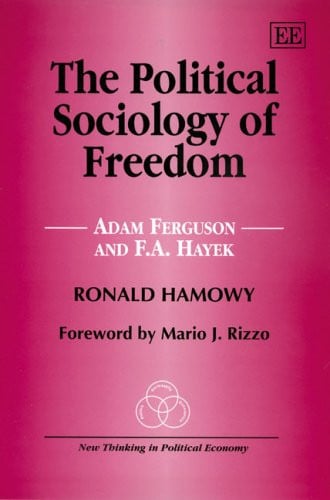
The political sociology of freedom: Adam Ferguson and F.A. Hayek

Hamowy, Ronald
Adam Ferguson and Friedrich Hayek, separated by a period of almost two hundred years, made original but similar contributions to the field of theoretical sociology. In this collection of essays, Ronald Hamowy explores the life and work of these two thinkers, giving special emphasis to their insights into the diffusion of knowledge. Ferguson, a giant of the Scottish Enlightenment, can be credited with laying the foundations of theoretical history by first proposing the idea that social institutions undergo evolutionary change. He theorized that while these institutions are formed by the actions of human beings, they are not the product of human design. Less than two centuries later, Hayek extended this insight to dealing with economic and social interaction, arguing that the knowledge requisite for structuring the social institutions under which we live is far too complex to be comprehended by any one mind or group of thinkers, and that these institutions had in fact evolved over long periods of time without deliberate design. Hayek was also the first to introduce the notion that market processes are a function of all participants contributing the limited knowledge that each possesses, out of which an orderly arrangement of enormous complexity emerges. Scholars and students of sociology, economics, history and political theory will find The Political Sociology of Freedom a unique and provocative read.
Edward Elgar 2005 265 pages