60 results for "Economics"

The Lexus And The Olive Tree

Thomas Friedman
A powerful and accessible account of globalization the new world order that has replaced the cold war by the award-winning author of From Beirut to Jerusalem. More than anything else, globalization is shaping world affairs today. We cannot interpret the day's news, or know where to invest our money, unless we understand this new system the defining force in international relations and domestic policies worldwide. The unprecedented integration of finance, markets, nation states and technology is driving change across the globe at an ever-increasing speed. And while much of the world is intent on building a better Lexus, on streamlining their societies and economies for the global marketplace, many people feel their traditional identities threatened and are reverting to elemental struggles over who owns which olive tree, which strip of land. The New York Times foreign affairs columnist has travelled the globe, interviewing everyone from Brazilian peasants to new entrepreneurs in Indonesia, to Islamic students, to the financial wizards on Wall Street and in Silicon Valley, to find out what globalization means for them, and for all of us. This ground-breaking book is essential reading for anyone who wants to know how the world really works today.
Harper Collings Publishers 2009-12-01 512 pages

The great transformation: the political and economic origins of our time

Polanyi, Karl
"In this classic work of economic history and social theory, Karl Polanyi tracks the economic and social changes brought about by the "great transformation" of the Industrial Revolution. He pays particular attention to capitalism's rise and its role in fundamentally altering life after the Industrial Revolution. This seminal analysis explains not only the deficiencies of the self-regulating market, but the potentially dire social consequences of untempered market capitalism"-- Provided by publisher.
Beacon Press 2025-07-08 360 pages

America's bitter pill: money, politics, backroom deals, and the fight to fix our broken healthcare

Brill, Steven
NEW YORK TIMES BESTSELLER • A NEW YORK TIMES NOTABLE BOOK • “A tour de force . . . a comprehensive and suitably furious guide to the political landscape of American healthcare . . . persuasive, shocking.” — The New York Times America’s Bitter Pill is Steven Brill’s acclaimed book on how the Affordable Care Act, or Obamacare, was written, how it is being implemented, and, most important, how it is changing—and failing to change—the rampant abuses in the healthcare industry. It’s a fly-on-the-wall account of the titanic fight to pass a 961-page law aimed at fixing America’s largest, most dysfunctional industry. It’s a penetrating chronicle of how the profiteering that Brill first identified in his trailblazing Time magazine cover story continues, despite Obamacare. And it is the first complete, inside account of how President Obama persevered to push through the law, but then failed to deal with the staff incompetence and turf wars that crippled its implementation. But by chance America’s Bitter Pill ends up being much more—because as Brill was completing this book, he had to undergo urgent open-heart surgery. Thus, this also becomes the story of how one patient who thinks he knows everything about healthcare “policy” rethinks it from a hospital gurney—and combines that insight with his brilliant reporting. The result: a surprising new vision of how we can fix American healthcare so that it stops draining the bank accounts of our families and our businesses, and the federal treasury. Praise for America’s Bitter Pill “An energetic, picaresque, narrative explanation of much of what has happened in the last seven years of health policy . . . [Brill] has pulled off something extraordinary.” —The New York Times Book Review “A thunderous indictment of what Brill refers to as the ‘toxicity of our profiteer-dominated healthcare system.’ ” — Los Angeles Times “A sweeping and spirited new book [that] chronicles the surprisingly juicy tale of reform.” — The Daily Beast “One of the most important books of our time.” —Walter Isaacson “Superb . . . Brill has achieved the seemingly impossible—written an exciting book about the American health system.” — The New York Review of Books
Random House 2015-08-18 528 pages

Understanding socialism

Wolff, Richard D.
"Understanding Socialism is a plainspoken text that disarms false narratives, confronts past failures, and offers a path to a fresh and modern understanding of socialism, by outlining what democracy in the workplace could look like. Wolff not only explains what socialism is and has meant to its various proponents, he also looks at the transition from feudalism to capitalism as a model to help us visualize an evolution from our current socioeconomic state. Understanding Socialism explores how socialist theory was used and applied to help shape the histories of countries such as Russia and China, and beyond. Wolff also analyzes the successes and defeats of those countries, the world's reactions to them, and how they offer important lessons for the building of a democratic, worker-controlled 21st-century socialism."--Publisher description.
Haymarket Books 2025-12-09 156 pages

Socialism: An Economic And Sociological Analysis (1951)

Mises, Ludwig Von
""Socialism: An Economic and Sociological Analysis"" is a seminal work by the Austrian economist and philosopher Ludwig von Mises. Originally published in 1922, this revised edition from 1951 offers a comprehensive critique of socialism, examining its economic and sociological implications. Mises argues that socialism, which seeks to eliminate private ownership of the means of production and replace it with collective ownership, is fundamentally flawed and cannot work in practice. He explores the reasons why socialist economies inevitably lead to inefficiency, misallocation of resources, and ultimately, economic collapse. Mises also examines the social and political implications of socialism, arguing that it leads to the destruction of individual freedom and the growth of authoritarianism. The book remains a classic in the field of economics and political philosophy, and is essential reading for anyone interested in understanding the strengths and weaknesses of socialist ideology.This scarce antiquarian book is a facsimile reprint of the old original and may contain some imperfections such as library marks and notations. Because we believe this work is culturally important, we have made it available as part of our commitment for protecting, preserving, and promoting the world's literature in affordable, high quality, modern editions, that are true to their original work.
Kessinger Publishing, LLC 2010-09-10 598 pages

The coming of post-industrial society: a venture in social forecasting

Bell, Daniel
In 1976, Daniel Bell€™s historical work predicted a vastly different society developing—one that will rely on the “economics of information€ rather than the “economics of goods.€ Bell argued that the new society would not displace the older one but rather overlie some of the previous layers just as the industrial society did not completely eradicate the agrarian sectors of our society. The post-industrial society€™s dimensions would include the spread of a knowledge class, the change from goods to services and the role of women. All of these would be dependent on the expansion of services in the economic sector and an increasing dependence on science as the means of innovating and organizing technological change.Bell prophetically stated in The Coming of the Post-Industrial Society that we should expect “ new premises and new powers, new constraints and new questions—with the difference that these are now on a scale that had
Basic Books 1973-07-12 507 pages

The spirit of green: the economics of collisions and contagions in a crowded world

Nordhaus, William D.
"From a Nobel Prize-winning pioneer in environmental economics, an innovative account of how and why "green thinking" could cure many of the world's most serious problems-from global warming to pandemics Solving the world's biggest problems-from climate catastrophe and pandemics to wildfires and corporate malfeasance-requires, more than anything else, coming up with new ways to manage the powerful interactions that surround us. For carbon emissions and other environmental damage, this means ensuring that those responsible pay their full costs rather than continuing to pass them along to others, including future generations. In The Spirit of Green, Nobel Prize-winning economist William Nordhaus describes a new way of green thinking that would help us overcome our biggest challenges without sacrificing economic prosperity, in large part by accounting for the spillover costs of economic collisions. In a discussion that ranges from the history of the environmental movement to the Green New Deal, Nordhaus explains how the spirit of green thinking provides a compelling and hopeful new perspective on modern life. At the heart of green thinking is a recognition that the globalized world is shaped not by isolated individuals but rather by innumerable interactions inside and outside the economy. He shows how rethinking economic efficiency, sustainability, politics, profits, taxes, individual ethics, corporate social responsibility, finance, and more would improve the effectiveness and equity of our society. And he offers specific solutions-on how to price carbon, how to pursue low-carbon technologies, how to design an efficient tax system, and how to foster international cooperation through climate clubs. The result is a groundbreaking new vision of how we can have our environment and our economy too"--
Princeton University Press 2021-05-18 355 pages

The three trillion dollar war: the true cost of the Iraq conflict

Stiglitz, Joseph E.
The true cost of the Iraq War is $3 trillion rather than the $50 billion projected by the White House. Apart from its tragic human toll, the Iraq War will be staggeringly expensive in financial terms. This sobering study by Nobel Prize winner Joseph E. Stiglitz and Harvard professor Linda J. Bilmes casts a spotlight on expense items that have been hidden from the U.S. taxpayer, including not only big-ticket items like replacing military equipment (being used up at six times the peacetime rate) but also the cost of caring for thousands of wounded veterans for the rest of their lives. Shifting to a global focus, the authors investigate the cost in lives and economic damage within Iraq and the region. Finally, with the chilling precision of an actuary, the authors measure what the U.S. taxpayer's money would have produced if instead it had been invested in the further growth of the U.S. economy. Written in language as simple as the details are disturbing, this book will forever change the way we think about the war.
W.W. Norton 2008-02-17 311 pages

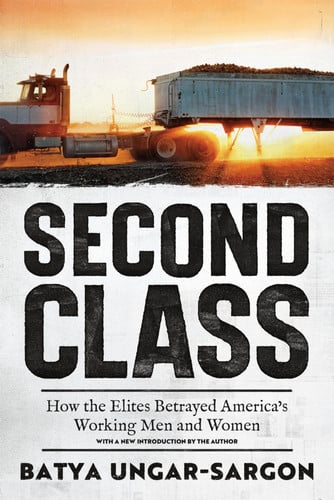
Second class: how the elite betrayed America's working men and women

Ungar-Sargon, Batya
A personal, journalistic ethnography of the modern American working class, based on the travels and interactions of the author through the American heartland. " Second Class is the most important book you will read all year. A political realignment is coming, and it's my hope that the end result will work in favor of our all-too-neglected American working class. When that realignment comes, Batya and her book will help lead the way." --Greg Lukianoff, CEO of the Foundation for Individual Rights in Education, and co-author of The Coddling of the American Mind Who is the American working class? Do they still have a fair shot at the American Dream? What do they think about their chances to secure the hallmarks of a middle-class life? While writing this book, Batya Ungar-Sargon visited states across the nation to speak with members of the American working class who are fighting tooth and nail to survive. In Second Class , working-class Americans of all races, political orientations, and occupations share their stories--cleaning ladies, health care aides, cops, truck drivers, fast food workers, electricians, and more. In their own words, these working-class Americans explain the struggles and triumphs of their increasingly precarious lives--as well as what policies they think would improve them. Second Class combines deep reporting with a look at the data and expert opinions on America's emergent class divide, in which the most basic elements of a secure and stable life are increasingly out of reach for those without a college education. America has broken its contract with its laboring class. So, how do we get back to the American Dream? How do we once again become the land of opportunity, the promised land, where hard work and commitment to family are enough to protect you from poverty? It's not that hard actually. All it would take, as this book illustrates, is for those in power to once again respect the dignity of work--and the American worker.
Encounter Books 2025 248 pages

The Road to Freedom Economics and the Good Society

Joseph E. Stiglitz
We are a nation born from the conviction that people must be free. But since the middle of the last century, that idea has been co-opted. Forces on the political Right have justified exploitation by cloaking it in the rhetoric of freedom, leading to pharmaceutical companies freely overcharging for medication, a Big Tech free from oversight, politicians free to incite rebellion, corporations free to pollute, and more. How did we get here? Whose freedom are we--and should we--be thinking about? In The Road to Freedom, Nobel prize winner Joseph E. Stiglitz dissects America's current economic system and the political ideology that created it, laying bare their twinned failure. "Free" and unfettered markets have only succeeded in delivering a series of crises: the financial crisis, the opioid crisis, and the crisis of inequality. While a small portion of the population has amassed considerable wealth, wages for most people have stagnated. Free and unfettered markets have exploited consumers, workers, and the environment alike. Such failures have fed populist movements that believe being free means abandoning any obligations citizens have to one another. As they grow in strength, these movements now pose a real threat to true economic and political freedom. As an economic advisor to presidents and as chief economist at the World Bank, Stiglitz has witnessed these profound changes firsthand. As he argues, the failures follow from the elites' unshakeable dedication to "the neoliberal experiment." Explicitly taking on giants such as Friedrich Hayek and Milton Friedman, Stiglitz exposes accepted ideas about our political and economic life for what they are: twisted visions that tear at the social fabric while they enrich the very few. The Road to Freedom breaks new ground, showing how economics--including recent advances in which Stiglitz has played such an important role--reframes how to think about freedom and the role of the state in a twenty-first century society. Drawing on the work of contemporary philosophers, Stiglitz explains a deeper, more humane way to assess freedoms--one that considers with care what to do when one person's freedom conflicts with another's. We must reimagine our existing economic and legal systems and embrace forms of collective action, including regulation and investment, if we are to create an innovative society in which everyone can flourish. The task could not be more urgent, and Stiglitz's latest book is essential reading for those committed to the American ideal of an economic and political system that delivers well-being, opportunity, and meaningful freedoms for all.
W. W. Norton, Incorporated 2026-02-24 384 pages

The Idealist Jeffrey Sachs and the Quest to End Poverty

Nina Munk
A powerful portrayal of Jeffrey Sachs's ambitious quest to end extreme global poverty, now a Signal paperback. "The poor you will always have with you," according to Matthew 26:11. But Jeffrey Sachs, economics superstar, special advisor to the Secretary General of the UN and the author of The End of Poverty , vehemently disagrees. In his view, poverty -- especially the extreme deprivation of sub-Saharan Africa -- can easily be eradicated. The vast sums spent in foreign aid over the decades has not come close to alleviating the dire subsistence problems of Africans. Sachs believed he knew the reason: the developed world simply hadn't spent enough. In 2006, Sachs, backed by tens of millions of donor dollars, launched the five-year Millennium Villages Project. Sachs would test his theories in villages in different African countries, then, with each success, scale up until until the program was continent-wide. His first village "make-over" was a small community in Sauri, Kenya, and the immediate effect was encouraging. With that first inkling of success achieved, Sachs rolled out a dozen model Millennium villages in ten countries. For the past six years, Nina Munk has reported deeply on the Project, following Sachs on official trips and listening in on conversations with heads of states, rival organisations and potential donors. And she has immersed herself in the lives of people in two of the remote villages: Ruhiira, in southwest Uganda, and Dertu, in the arid borderland between Kenya and Somalia. Accepting hospitality from these camel herders and smallhold farmers, and sharing in their struggles, Munk came to understand the on-the-ground issues challenging Sachs' one-size-fits-all approach to global poverty. The Idealist is the profound and moving story of what happened when the abstract theories of a brilliant, driven man met messy human reality.
McClelland & Stewart 2014-10-07 288 pages

In an uncertain world: tough choices from Wall Street to Washington

Rubin, Robert Edward
Publisher's description: Robert Rubin was sworn in as the seventieth U.S. Secretary of the Treasury in January 1995 in a brisk ceremony attended only by his wife and a few colleagues. As soon as the ceremony was over, he began an emergency meeting with President Bill Clinton on the financial crisis in Mexico. This was not only a harbinger of things to come during what would prove to be a rocky period in the global economy; it also captured the essence of Rubin himself--short on formality, quick to get into the nitty-gritty. From his early years in the storied arbitrage department at Goldman Sachs to his current position as chairman of the executive committee of Citigroup, Robert Rubin has been a major figure at the center of the American financial system. He was a key player in the longest economic expansion in U.S. history.
Random House 2003 427 pages

Manipulation: what it is, why it's bad, what to do about it

Sunstein, Cass R.
"New technologies are offering companies, politicians, and others unprecedented opportunity to manipulate us. Sometimes we are given the illusion of power - of freedom - through choice, yet the game is rigged, pushing us in specific directions that lead to less wealth, worse health, and weaker democracy. In, Manipulation, nudge theory pioneer and New York Times bestselling author, Cass Sunstein, offers a new definition of manipulation for the digital age, explains why it is wrong; and shows what we can do about it. He reveals how manipulation compromises freedom and personal agency, while threatening to reduce our well-being; he explains the difference between manipulation and unobjectionable forms of influence, including 'nudges'; and he lifts the lid on online manipulation and manipulation by artificial intelligence, algorithms, and generative AI, as well as threats posed by deepfakes, social media, and 'dark patterns,' which can trick people into giving up time and money. Drawing on decades of groundbreaking research in behavioral science, this landmark book outlines steps we can take to counteract manipulation in our daily lives and offers guidance to protect consumers, investors, and workers." --
Cambridge University Press 2025-08-28 219 pages

Climate justice: what rich nations owe the world - and the future

Sunstein, Cass R.
The social cost of carbon: The most important number you've never heard of—and what it means. If you’re injuring someone, you should stop—and pay for the damage you’ve caused. Why does this simple proposition, generally accepted, not apply to climate change? In Climate Justice , a bracing challenge to status quo thinking on the ethics of climate change, renowned author and legal scholar Cass Sunstein clearly frames what’s at stake and lays out the moral imperative: When it comes to climate change, everyone must be counted equally, regardless of when they live or where they live—which means that wealthy nations, which have disproportionately benefited from greenhouse gas emissions, are obliged to help future generations and people in poor nations that are particularly vulnerable.
The MIT Press 2025 195 pages

Shared prosperity in a fractured world: a new economics for the middle class, the global poor, and our climate

Rodrik, Dani
"Fighting climate change, saving democracy, and eradicating poverty are urgent global challenges, yet the world's leaders continue to pursue outdated policies that focus on one while worsening the tradeoffs between each of them. Shared Prosperity in a Fractured World shows how the nations of the world can achieve all three objectives. Dani Rodrik provides a bold new vision of globalization, one in which we accelerate the green transition to achieve a sustainable planet, shore up the middle class to restore democracy's foundations, and hasten economic revitalization in the developing world to put an end to poverty. The rising tide of authoritarianism has demonstrated our inability to alleviate economic anxieties. Economic nationalism has raised the specter of increased protectionism and deteriorating prospects for economic growth. And automation and other new technologies have undercut the advantages of low-cost, unskilled labor in manufacturing and export-oriented industrialization. Rodrik reveals how we can restore prosperity through new forms of collaborative public-private action-to promote renewables and green industries, middle-class jobs, and enhanced productivity in labor-absorbing services-even in the absence of global cooperation. He explains why this new kind of globalization must also recognize the legitimate desire of governments to pursue their economic, social, and security interests autonomously. Turning conventional economic wisdom on its head, Shared Prosperity in a Fractured World builds on practices that work while radically transforming those that don't, presenting a grounded, clear-eyed approach to tackling the problems that affect us all, at home and around the world"--
Princeton University Press 2025-11-04 269 pages

Keynes for Our Times

Skidelsky, Robert
"John Maynard Keynes (1883-1946) was arguably the most important economist of the twentieth century; his ideas have fundamentally altered the way governments approach economic policy. Exploring the enduring relevance of his ideas, Robert Skidelsky emphasizes Keynes's conception of economics as a moral science. Keynes was deeply invested in the broader societal implications of economic policies, and this book highlights his belief in economics as a tool for achieving the good life. Skidelsky sheds new light on Keynes's views on capitalism, discusses his advocacy of low interest rates, and delves into his thoughts on economic instability. He also offers fresh insight into Keynes's ideas about money, his philosophical foundations, and his unique approach to uncertainty and probability. Ultimately, Skidelsky shows how Keynes's vision of an economic policy that prioritizes the common good can be adapted to help solve our current economic and political challenges"--
Yale University Press 2026-06-23 186 pages