68 results for "Economics"

The Shock Doctrine The Rise of Disaster Capitalism

Naomi Klein
Winner of the 2009 Warwick Prize for Writing In this groundbreaking alternative history of the most dominant ideology of our time, Milton Friedman's free-market economic revolution, Naomi Klein challenges the popular myth of this movement's peaceful global victory. From Chile in 1973 to Iraq today, Klein shows how Friedman and his followers have repeatedly harnessed terrible shocks and violence to implement their radical policies. As John Gray wrote in The Guardian, "There are very few books that really help us understand the present. The Shock Doctrine is one of those books."
National Geographic Books 2008-07-29 672 pages

The Fifties

David Halberstam
The Fifties is a sweeping social, political, economic, and cultural history of the ten years that Halberstam regards as seminal in determining what our nation is today. Halberstam offers portraits of not only the titans of the age: Eisenhower Dulles, Oppenheimer, MacArthur, Hoover, and Nixon, but also of Harley Earl, who put fins on cars; Dick and Mac McDonald and Ray Kroc, who mass-produced the American hamburger; Kemmons Wilson, who placed his Holiday Inns along the nation's roadsides; U-2 pilot Gary Francis Powers; Grace Metalious, who wrote Peyton Place; and "Goody" Pincus, who led the team that invented the Pill. A NEW YORK TIMES BESTSELLER "From the Trade Paperback edition.
Random House Value Publishing 1996-04 411 pages

The Revolution was Televised From Buffy to Breaking Bad - the People and the Shows that Changed TV Drama Forever

Alan Sepinwall
In The Revolution Was Televised, celebrated TV critic Alan Sepinwall chronicles the remarkable transformation of the small screen over the past fifteen years. Focusing on twelve innovative television dramas that changed the medium and the culture at large forever, including The Sopranos, Oz, The Wire, Deadwood, The Shield, Lost, Buffy the Vampire Slayer, 24, Battlestar Galactica, Friday Night Lights, Mad Men, and Breaking Bad, Sepinwall weaves his trademark incisive criticism with highly entertaining reporting about the real-life characters and conflicts behind the scenes. Drawing on interviews with writers David Chase, David Simon, David Milch, Damon Lindelof and Carlton Cuse, and Vince Gilligan, among others, along with the network executives responsible for green-lighting these fresh shows, The Revolution Was Televised is the story of how a new golden age was born, one that's as rich with drama and thrills as the very shows themselves.
Black Incorporated 2013 388 pages

The Tastemakers Why We're Crazy for Cupcakes But Fed Up with Fondue

David Sax
Tastemaker, n. Anyone with the power to make you eat quinoa. Kale. Spicy sriracha sauce. Honeycrisp apples. Cupcakes. These days, it seems we are constantly discovering a new food that will make us healthier, happier, or even somehow cooler. Chia seeds, after a brief life as a novelty houseplant and I Love the '80s punchline, are suddenly a superfood. Not long ago, that same distinction was held by pomegranate seeds, açai berries, and the fermented drink known as kombucha. So what happened? Did these foods suddenly cease to be healthy a few years ago? And by the way, what exactly is a "superfood" again? In this eye-opening, witty work of reportage, David Sax uncovers the world of food trends: Where they come from, how they grow, and where they end up. Traveling from the South Carolina rice plot of America's premier grain guru to Chicago's gluttonous Baconfest, Sax reveals a world of influence, money, and activism that helps decide what goes on your plate. On his journey, he meets entrepreneurs, chefs, and even data analysts who have made food trends a mission and a business. The Tastemakers is full of entertaining stories and surprising truths about what we eat, how we eat it, and why.
McClelland & Stewart 2014 336 pages

Making Sense Conversations on Consciousness, Morality, and the Future of Humanity

Sam Harris
A New York Times New and Noteworthy Book From the bestselling author of Waking Up and The End of Faith, an adaptation of his wildly popular, often controversial podcast "Civilization rests on a series of successful conversations." --Sam Harris Sam Harris--neuroscientist, philosopher, and bestselling author--has been exploring some of the most important questions about the human mind, society, and current events on his podcast, Making Sense. With over one million downloads per episode, these discussions have clearly hit a nerve, frequently walking a tightrope where either host or guest--and sometimes both--lose their footing, but always in search of a greater understanding of the world in which we live. For Harris, honest conversation, no matter how difficult or controversial, represents the only path to moral and intellectual progress. This book includes a dozen of the best conversations from Making Sense, including talks with Daniel Kahneman, Timothy Snyder, Nick Bostrom, and Glenn Loury, on topics that range from the nature of consciousness and free will, to politics and extremism, to living ethically. Together they shine a light on what it means to "make sense" in the modern world.
HarperCollins Publishers 2021-08-17 464 pages

Moonshot Inside Pfizer's Nine-Month Race to Make the Impossible Possible

Albert Bourla
The exclusive, first-hand, behind-the-scenes story of how Pfizer raced to create the first Covid-19 vaccine, told by Pfizer's CEO Dr. Albert Bourla A riveting, fast-paced, inside look at one of the most incredible private sector achievements in history, Moonshot recounts the intensive nine months in 2020 when the scientists at Pfizer, under the visionary leadership of Dr. Albert Bourla, made "the impossible possible"--creating, testing, and manufacturing a safe and effective Covid-19 vaccine that previously would have taken years to develop. Dr. Bourla chronicles how the brilliant, dedicated minds at Pfizer, under the enormous strains of the global pandemic, overcame a series of crises that were compounded by social and political unrest, and reveals the doubts, decisions, obstacles, and failures they encountered. As Dr. Bourla makes clear, Pfizer's success wasn't due to luck; it was because of preparation driven by four simple values--Courage, Excellence, Equity, and Joy. Moonshot is a story of leadership under the most unprecedented circumstances--how Dr. Bourla, a Greek immigrant, a child of Holocaust survivors, and a veterinarian, became the head of one of the world's largest corporations and initiated a dramatic transformation of the organization just before a global health crisis would serve to test the organization, its scientists and its leader, like never before. Moonshot describes best practices that can be used to address the multiple, unprecedented challenges our world faces, reveals Pfizer's implementation of scientific breakthroughs at a record-breaking pace, and offers leadership lessons that can help anyone successfully manage their own seemingly unsolvable problems. As Dr. Bourla explains, "I am sharing the story of our moonshot--the challenges we faced, the lessons we learned, and the core values that allowed us to make it happen--in hopes that it might inspire and inform your own moonshot, whatever that may be."
HarperCollins Publishers Limited 2022-03-16 288 pages

The New Society: The Anatomy of Industrial Order

Drucker, Péter
In The New Society, Peter Drucker extended his previous works The Future of Industrial Man and The Concept of the Corporation into a systematic, organized analysis of the industrial society that emerged out of World War II. He analyzes large business enterprises, governments, labor unions, and the place of the individual within the social context of these institutions. Although written when the industrial society he describes was at its peak of productivity, Drucker's basic conceptual frame has well stood the test of time. Following publication of the first printing of The New Society, George G. Higgins wrote in Commonweal that "Drucker has analyzed, as brilliantly as any modem writer, the problems of industrial relations in the individual company or 'enterprise.' He is thoroughly at home in economics, political science, industrial psychology, and industrial sociology, and has succeeded admirably in harmonizing the findings of all four disciplines and applying them meaningfully to the practical problems of the 'enterprise.'" This well expresses contemporary critical opinion. Peter Drucker's new introduction places The New Society in a contemporary perspective and affirms its continual relevance to industry in the mid-1990s. Economists, political scientists, psychologists, and professionals in management and industry will find this seminal work a useful tool for understanding industry and society at large.
[distributor] Taylor & Francis, c/o Bookpoint 2017 362 pages

A functioning society

Peter F. Drucker
Peter F. Drucker may be best known as a writer on business and management, but these subjects were not his foremost intellectual concern. Drucker's primary concerns were community, in which the individual has status, and society, in which the individual has function. Here he has assembled selections from his vast writings on these subjects. This collection presents the full range of Drucker's thought on community, society, and political structure and constitutes an ideal introduction to his ideas. The volume is divided into seven parts. The selections in parts 1 and 2 were mostly written during World War Two and in the wake of the Great Depression. Part 3 deals with the limits of governmental competence in the social and economic realm. It contains some of Drucker's most influential writings concerned with the difference between big government and effective government. The chapters in part 4 explore autonomous centers of power outside government and within society. Part 5 contains chapters from Drucker's path-breaking work on the corporation as a social organization rather than merely an economic one. The rise of the so-called "knowledge industries" forms the background for part 6. The concluding part 7 is devoted entirely to Drucker's long essay "The Next Society." Drucker examines the emergence of new institutions and new theories arising from the information revolution and the social changes they are helping to bring about. In organizing these representative writings, Drucker chose to be topical rather than chronological, with each excerpt presenting a basic theme of his life's work. As is characteristic of his efforts, A Functioning Society appeals both the general reader as well as a cross-disciplinary scholarly readership.
Transaction Publishers 2011-02 242 pages

Great Society A New History

Amity Shlaes
The New York Times bestselling author of The Forgotten Man and Coolidge offers a stunning revision of our last great period of idealism, the 1960s, with burning relevance for our contemporary challenges. "Great Society is accurate history that reads like a novel, covering the high hopes and catastrophic missteps of our well-meaning leaders." --Alan Greenspan Today, a battle rages in our country. Many Americans are attracted to socialism and economic redistribution while opponents of those ideas argue for purer capitalism. In the 1960s, Americans sought the same goals many seek now: an end to poverty, higher standards of living for the middle class, a better environment and more access to health care and education. Then, too, we debated socialism and capitalism, public sector reform versus private sector advancement. Time and again, whether under John F. Kennedy, Lyndon Johnson, or Richard Nixon, the country chose the public sector. Yet the targets of our idealism proved elusive. What's more, Johnson's and Nixon's programs shackled millions of families in permanent government dependence. Ironically, Shlaes argues, the costs of entitlement commitments made a half century ago preclude the very reforms that Americans will need in coming decades. In Great Society, Shlaes offers a powerful companion to her legendary history of the 1930s, The Forgotten Man, and shows that in fact there was scant difference between two presidents we consider opposites: Johnson and Nixon. Just as technocratic military planning by "the Best and the Brightest" made failure in Vietnam inevitable, so planning by a team of the domestic best and brightest guaranteed fiasco at home. At once history and biography, Great Society sketches moving portraits of the characters in this transformative period, from U.S. Presidents to the visionary UAW leader Walter Reuther, the founders of Intel, and Federal Reserve chairmen William McChesney Martin and Arthur Burns. Great Society casts new light on other figures too, from Ronald Reagan, then governor of California, to the socialist Michael Harrington and the protest movement leader Tom Hayden. Drawing on her classic economic expertise and deep historical knowledge, Shlaes upends the traditional narrative of the era, providing a damning indictment of the consequences of thoughtless idealism with striking relevance for today. Great Society captures a dramatic contest with lessons both dark and bright for our own time.
HarperCollins Publishers 2020-11-24 528 pages

Rich Bitch A Simple 12-Step Plan for Getting Your Financial Life Together... Finally

Nicole Lapin
NEW YORK TIMES BESTSELLER In this New York Times bestseller, journalist and financial expert Nicole Lapin shows women how to take charge of their lives by taking charge of their money "You might not know this but stressing over money can harm your overall health. Let Nicole be the doctor for your financial health and you will feel better in more ways than you'd think." --Dr. Oz, host of the "Dr. Oz Show", and Lisa Oz, host of the "Lisa Oz Show" Do your eyes glaze over just thinking about the mumbo-jumbo language of finance? Do you break out into hives when faced with getting your financial life together? Well, sister, you are not alone. In Rich Bitch, money expert and financial journalist Nicole Lapin lays out a 12-Step Plan in which she shares her experiences--mistakes and all--of getting her own finances in order. She talks to you not like a lecturer but as your friend. And even though money is typically an "off-limits" conversation, nothing is off-limits here. Lapin rethinks every piece of financial "wisdom" you've ever heard and puts her own fresh, modern, sassy spin on it. Sure, there are some hard-and-fast rules about finance, but when it comes to your money, the only person who can tell you how to spend it is you. Should you invest in a 401(k)? Maybe not. Should you splurge on that morning latte? Likely yes. Instead of focusing on nickel-and-diming yourself, Nicole's advice focuses on investing in yourself so you don't have to stress over the little things. Rich Bitch rehabs whatever bad money habits you might have and provides a plan you can not only sustain, but also thrive on. You won't feel deprived but rather inspired to go after the rich life you deserve, and confident enough to call yourself a rich bitch.
HarperCollins Publishers 2019-11-05 400 pages

Supercapitalism The Transformation of Business, Democracy, and Everyday Life

Robert B. Reich
Mid-twentieth-century capitalism has turned into global capitalism, and global capitalism - turbocharged, Web-based, and able to find and make almost anything just about anywhere - has turned into supercapitalism. But as Robert B. Reich makes clear in this eye-opening book, while supercapitalism is working wonderfully well to enlarge the economic pie, democracy - charged with caring for all citizens - is becoming less and less effective under its influence. Reich explains how widening inequalities of income and wealth, heightened job insecurity, and the spreading effects of global warming are the logical outcomes of supercapitalism. He shows us why companies, fighting harder than ever to maintain their competitive positions, have become even more deeply involved in politics; and how average citizens, seeking great deals and invested in the stock market to an unprecedented degree, are increasingly loath to stand by their values if it means biting the hands that feed them. As one of America's most influential voices, Reich sets out a clear course to a vibrant capitalism and a concurrent, equally vibrant democracy.
Scribe Publications 2008 272 pages

World Without Mind

Franklin Foer
Over the past few decades there has been a revolution in terms of who controls knowledge and information. This rapid change has imperilled the way we think. Without pausing to consider the cost, the world has rushed to embrace the products and services of four titanic corporations. We shop with Amazon; socialise on Facebook; turn to Apple for entertainment; and rely on Google for information. These firms sell their efficiency and purport to make the world a better place, but what they have done instead is to enable an intoxicating level of daily convenience. As these companies have expanded, marketing themselves as champions of individuality and pluralism, their algorithms have pressed us into conformity and laid waste to privacy. They have produced an unstable and narrow culture of misinformation, and put us on a path to a world without private contemplation, autonomous thought, or solitary introspection - a world without mind. In order to restore our inner lives, we must avoid being co-opted by these gigantic companies, and understand the ideas that underpin their success. Elegantly tracing the intellectual history of computer science - from the Descartes and the enlightenment to Alan Turing to Stuart Brand and the hippie origins of today's Silicon Valley - Foer exposes the dark underpinnings of our most idealistic dreams for technology. The corporate ambitions of Google, Facebook, Apple, and Amazon, he argues, are trampling longstanding liberal values, especially intellectual property and privacy. This is a nascent stage in the total automation and homogenization of social, political, and intellectual life. By reclaiming our private authority over how we intellectually engage with the world, we have the power to stem the tide. At stake is nothing less than who we are, and what we will become. There have been monopolists in the past but today's corporate giants have far more nefarious aims. They're monopolists who want access to every facet of our identities and influence over every corner of our decision-making. Until now few have grasped the sheer scale of the threat. Foer explains not just the looming existential crisis but the imperative of resistance.
Jonathan Cape Ltd 2017-09-28 272 pages

Microtrends The Small Forces Behind Tomorrow's Big Changes

Mark Penn
The adviser to Senator Hillary Clinton, Bill Gates, and President Bill Clinton proves that small is big by identifying 75 hidden-in-plain-sight trends that are moving America, revealing that the nation is no longer a melting pot but a collection of communities with many individual tastes and lifestyles. "The ideas in his book will help you see the world in a new way." --Bill Clinton "Mark Penn has a keen mind and a fascinating sense of what makes America tick, and you see it on every page of Microtrends ." --Bill Gates In 1982, readers discovered Megatrends . In 2000, The Tipping Point entered the lexicon. Now, in Microtrends , one of the most respected and sought-after analysts in the world articulates a new way of understanding how we live. Mark Penn, the man who identified "Soccer Moms" as a crucial constituency in President Clinton's 1996 reelection campaign, is known for his ability to detect relatively small patterns of behavior in our culture-microtrends that are wielding great influence on business, politics, and our personal lives. Only one percent of the public, or three million people, is enough to launch a business or social movement. Relying on some of the best data available, Penn identifies more than 70 microtrends in religion, leisure, politics, and family life that are changing the way we live. Among them: People are retiring but continuing to work. Teens are turning to knitting. Geeks are becoming the most sociable people around. Women are driving technology. Dads are older than ever and spending more time with their kids than in the past. You have to look at and interpret data to know what's going on, and that conventional wisdom is almost always wrong and outdated. The nation is no longer a melting pot. We are a collection of communities with many individual tastes and lifestyles. Those who recognize these emerging groups will prosper. Penn shows readers how to identify the microtrends that can transform a business enterprise, tip an election, spark a movement, or change your life. In today's world, small groups can have the biggest impact.
Grand Central Publishing 2007-09 448 pages

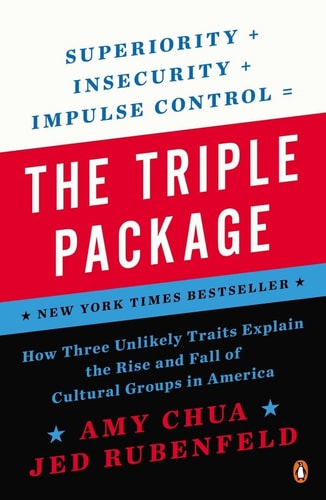
The Triple Package How Three Unlikely Traits Explain the Rise and Fall of Cultural Groups in America

Amy Chua,Jed Rubenfeld
"That certain groups do much better in America than others — as measured by income, occupational status, test scores, and so on — is difficult to talk about. In large part this is because the topic feels racially charged. The irony is that the facts actually debunk racial stereotypes. There are black and Hispanic subgroups in the United States far outperforming many white and Asian subgroups. Moreover, there’s a demonstrable arc to group success — in immigrant groups, it typically dissipates by the third generation — puncturing the notion of innate group differences and undermining the whole concept of 'model minorities.'" Mormons have recently risen to astonishing business success. Cubans in Miami climbed from poverty to prosperity in a generation. Nigerians earn doctorates at stunningly high rates. Indian and Chinese Americans have much higher incomes than other Americans; Jews may have the highest of all. Why do some groups rise? Drawing on groundbreaking original research and startling statistics, The Triple Package uncovers the secret to their success. A superiority complex, insecurity, impulse control—these are the elements of the Triple Package, the rare and potent cultural constellation that drives disproportionate group success. The Triple Package is open to anyone. America itself was once a Triple Package culture. It’s been losing that edge for a long time now. Even as headlines proclaim the death of upward mobility in America, the truth is that the old-fashioned American Dream is very much alive—but some groups have a cultural edge, which enables them to take advantage of opportunity far more than others. • Americans are taught that everyone is equal, that no group is superior to another. But remarkably, all of America’s most successful groups believe (even if they don’t say so aloud) that they’re exceptional, chosen, superior in some way. • Americans are taught that self-esteem—feeling good about yourself—is the key to a successful life. But in all of America’s most successful groups, people tend to feel insecure, inadequate, that they have to prove themselves. • America today spreads a message of immediate gratification, living for the moment. But all of America’s most successful groups cultivate heightened discipline and impulse control. But the Triple Package has a dark underside too. Each of its elements carries distinctive pathologies; when taken to an extreme, they can have truly toxic effects. Should people strive for the Triple Package? Should America? Ultimately, the authors conclude that the Triple Package is a ladder that should be climbed and then kicked away, drawing on its power but breaking free from its constraints. Provocative and profound, The Triple Package will transform the way we think about success and achievement.
Penguin 2015-01-27 352 pages

No Excuses Nine Ways Women Can Change How We Think About Power

Gloria Feldt
An invaluable guidebook, which contends that the most vexing problems facing women today isn't that doors of opportunity aren't open but that not enough women are walking through them Feminist icon Gloria Feldt pulls no punches in this new book, which argues that the most confounding problem facing women today isn't that doors of opportunity aren't open, but that not enough women are walking through them. From the boardroom to the bedroom, public office to personal relationships, she asserts that nobody is keeping women from parity-except themselves. Feldt puts women's power into an historical context, showing the ways in which women have made huge leaps forward in the past, only to pull back right when they were at the threshold. Feldt argues that there's no excuse-whether it's the way women are socialized, or pressure to conform, or work/life balance issues-for women today not to own their power. Women are still facing unequal pay, being passed over for promotions, entering public office at a much lesser rate than men, and oftentimes still struggling with traditional power dynamics in their interpersonal relationships. Feldt's solution to all these places where women face inequality is the same: we need to shift the way we think to achieve true parity with our male counterparts. No Excuses is divided into nine chapters that organized around how women can change the way they think, and therefore the way they act. These include: Know Your History and You Can Create the Future of Your Choice; Define the Terms-First; Embrace Controversy; Employ Every Medium; and other helpful ideas for using the tools and resources women already have to create the changes they want to see. No Excuses is a timely and invaluable book to help women equalize gender power in politics, work, and love.
Basic Books 2012-02-28 384 pages

Inevitable surprises: thinking ahead in a time of turbulence

Peter Schwartz
The world we live in today is more volatile than ever. The security of free nations is threatened by rogue states, the global economy is in flux, and the rapid advance of technology forces constant reevaluation of our society. With so many powerful forces at work and seemingly unpredictable events occurring, to many the future seems dark, and its possibilities frightening. Peter Schwartz disagrees. A world-renowned visionary in the field of scenario planning, Schwartz’s startling—and accurate— predictions have been employed by government agencies and major corporations for more than twenty-five years. He argues that the future is foreseeable, and that by examining the dynamics at work today we can predict the “inevitable surprises” of tomorrow. Timely and thought-provoking, Inevitable Surprises is a book that no one with an interest in business—or the future of our society—can afford to miss.
Gotham Books 2004-05-24 247 pages

Sugar Changed the World A Story of Magic, Spice, Slavery, Freedom, and Science

Marc Aronson,Marina Tamar Budhos
This globe-spanning history of sugar is "an epic story on a broad canvas that never loses sight of individual moments of human drama; a historical methodology infused with political, intellectual, cultural, and social strands; a complex sequence of cause and effect; an illuminating synthesis of primary and secondary sources; and a thoughtful marriage of words, picture, and design." (Horn Book starred review) Here is the story of how one product allows us to see the grand currents of world history in new ways. Using songs, oral histories, maps, and over 80 archival illustrations, Marc Aronson and Marina Budhos put a human face on this vast pageant. Time line, source notes, bibliography, and index included. The history of sugar runs like a bright band from religious ceremonies in India to Europe's Middle Ages, then on to Columbus, who brought the first cane cuttings to the Americas. Sugar caused the loss of countless lives, but it also planted the seeds of revolution that led to freedom in the American colonies, Haiti, and France. Cane, not cotton or tobacco, drove the bloody Atlantic slave trade and took the lives of countless Africans who toiled on vast sugar plantations under cruel overseers. And yet the very popularity of sugar gave abolitionists in England the one tool that could finally end the slave trade. Sugar moved, murdered, and freed millions; sugar changed the world.
Clarion Books 2010 166 pages