19 results for "Economics"

Common Wealth

Jeffrey D. Sachs
“Lucid, quietly urgent, and relentlessly logical . . . this is Bigthink with a capital B.” —The New York Times Book Review “Common Wealth explains the most basic economic reckoning that the world faces.” —Al Gore, winner of the 2007 Nobel Peace Prize and former vice president of the United States In Common Wealth, Jeffrey D. Sachs-one of the world's most respected economists and the author of The New York Times bestseller The End of Poverty- offers an urgent assessment of the environmental degradation, rapid population growth, and extreme poverty that threaten global peace and prosperity. Through crystalline examination of hard facts, Sachs predicts the cascade of crises that awaits this crowded planet-and presents a program of sustainable development and international cooperation that will correct this dangerous course. Few luminaries anywhere on the planet are as schooled in this daunting subject as Sachs, and this is the vital product of his experience and wisdom.
Penguin US 2008-03-18 400 pages

Stone age economics

Sahlins, Marshall David
Stone Age Economics is a classic study of anthropological economics, first published in 1974. As Marshall Sahlins stated in the first edition, "It has been inspired by the possibility of 'anthropological economics,' a perspective indebted rather to the nature of the primitive economies than to the categories of a bourgeois science." Ambitiously tackling the nature of economic life and how to study it comparatively, the book includes six studies which reflect the author's ideas on revising traditional views of the hunter-gatherer and so-called primitive societies, revealing them to be the original affluent society. The book examines notions of production, distribution and exchange in early communities and examines the link between economics and cultural and social factors. It consists of a set of detailed and closely related studies of tribal economies, of domestic production for livelihood, and of the submission of domestic production to the material and political demands of society at large. Marshall Sahlins is one of the most prominent American anthropologists of our time. He holds the title of Charles F. Grey Distinguished Service Professor of Anthropology at the University of Chicago. His most recent book is How Natives Think: About Captain Cook, for Example.
Transaction Publishers 2011 348 pages

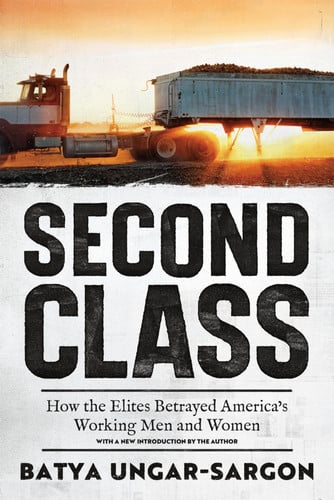
Second class: how the elite betrayed America's working men and women

Ungar-Sargon, Batya
A personal, journalistic ethnography of the modern American working class, based on the travels and interactions of the author through the American heartland. " Second Class is the most important book you will read all year. A political realignment is coming, and it's my hope that the end result will work in favor of our all-too-neglected American working class. When that realignment comes, Batya and her book will help lead the way." --Greg Lukianoff, CEO of the Foundation for Individual Rights in Education, and co-author of The Coddling of the American Mind Who is the American working class? Do they still have a fair shot at the American Dream? What do they think about their chances to secure the hallmarks of a middle-class life? While writing this book, Batya Ungar-Sargon visited states across the nation to speak with members of the American working class who are fighting tooth and nail to survive. In Second Class , working-class Americans of all races, political orientations, and occupations share their stories--cleaning ladies, health care aides, cops, truck drivers, fast food workers, electricians, and more. In their own words, these working-class Americans explain the struggles and triumphs of their increasingly precarious lives--as well as what policies they think would improve them. Second Class combines deep reporting with a look at the data and expert opinions on America's emergent class divide, in which the most basic elements of a secure and stable life are increasingly out of reach for those without a college education. America has broken its contract with its laboring class. So, how do we get back to the American Dream? How do we once again become the land of opportunity, the promised land, where hard work and commitment to family are enough to protect you from poverty? It's not that hard actually. All it would take, as this book illustrates, is for those in power to once again respect the dignity of work--and the American worker.
Encounter Books 2025 248 pages

The Idealist Jeffrey Sachs and the Quest to End Poverty

Nina Munk
A powerful portrayal of Jeffrey Sachs's ambitious quest to end extreme global poverty, now a Signal paperback. "The poor you will always have with you," according to Matthew 26:11. But Jeffrey Sachs, economics superstar, special advisor to the Secretary General of the UN and the author of The End of Poverty , vehemently disagrees. In his view, poverty -- especially the extreme deprivation of sub-Saharan Africa -- can easily be eradicated. The vast sums spent in foreign aid over the decades has not come close to alleviating the dire subsistence problems of Africans. Sachs believed he knew the reason: the developed world simply hadn't spent enough. In 2006, Sachs, backed by tens of millions of donor dollars, launched the five-year Millennium Villages Project. Sachs would test his theories in villages in different African countries, then, with each success, scale up until until the program was continent-wide. His first village "make-over" was a small community in Sauri, Kenya, and the immediate effect was encouraging. With that first inkling of success achieved, Sachs rolled out a dozen model Millennium villages in ten countries. For the past six years, Nina Munk has reported deeply on the Project, following Sachs on official trips and listening in on conversations with heads of states, rival organisations and potential donors. And she has immersed herself in the lives of people in two of the remote villages: Ruhiira, in southwest Uganda, and Dertu, in the arid borderland between Kenya and Somalia. Accepting hospitality from these camel herders and smallhold farmers, and sharing in their struggles, Munk came to understand the on-the-ground issues challenging Sachs' one-size-fits-all approach to global poverty. The Idealist is the profound and moving story of what happened when the abstract theories of a brilliant, driven man met messy human reality.
McClelland & Stewart 2014-10-07 288 pages

The Hollywood Economist 2.0

Edward Jay Epstein
A fully revised edition of the popular guide to Hollywood finances, updated to reflect even newer films and trends In a Freakonomics-meets-Hollywood saga, veteran investigative reporter Edward Jay Epstein goes undercover to explore Hollywood’s “invisible money machine,” probing the dazzlingly complicated finances behind the hits and flops, while he answers a surprisingly difficult question: How do the studiosmake their money? We also learn: + How and why the studios harvest silver from old film prints ... + Why stars do—or don’t do—their own stunts ... + The future of Netflix: Why the “next big thing” now seems in such deep trouble... + What it costs to insure Nicole Kidman’s right knee… + How Hollywood manipulates Wall Street: including the story of the acquisition of MGM… wherein a consortium of banks and hedge funds lost some $5 billion… while Hollywood made millions. + Why Arnold Schwarzenegger is considered a contract genius… + The fate of serious fare: How HBO, AMC, and Showtime have found ways to make money offer adult drama, while the Hollywood studios prefer to cater to teen audiences. + Why Lara Croft: Tomb Raider is considered a “masterpiece” of financing ...
Random House Publishing Services 2012-01-24 240 pages

On justification: economies of worth

Boltanski, Luc
A vital and underappreciated dimension of social interaction is the way individuals justify their actions to others, instinctively drawing on their experience to appeal to principles they hope will command respect. Individuals, however, often misread situations, and many disagreements can be explained by people appealing, knowingly and unknowingly, to different principles. On Justification is the first English translation of Luc Boltanski and Laurent Thévenot's ambitious theoretical examination of these phenomena, a book that has already had a huge impact on French sociology and is likely to have a similar influence in the English-speaking world. In this foundational work of post-Bourdieu sociology, the authors examine a wide range of situations where people justify their actions. The authors argue that justifications fall into six main logics exemplified by six authors: civic (Rousseau), market (Adam Smith), industrial (Saint-Simon), domestic (Bossuet), inspiration (Augustine), and fame (Hobbes). The authors show how these justifications conflict, as people compete to legitimize their views of a situation. On Justification is likely to spark important debates across the social sciences.
Princeton University Press 2006-04-16 389 pages

Martin Buber and the human sciences

Maurice Friedman,Pat Boni
The specific focus of Martin Buber and the Human Sciences is “dialogue” as the foundation of and integrating factor in the human sciences, using dialogue in the special sense which Buber has made famous: mutuality, presentness, openness, meeting the other in his or her uniqueness and not just as a content for one’s own thought categories, and knowing as deriving in the first instance from mutual contact rather than knowledge of a subject about an object. By the “human sciences” the authors/editors mean material that can be meaningfully approached in a dialogic way, hence, the humanities, education, psychology, speech communication, anthropology, history, sociology, and economics. The essays in Martin Buber and the Human Sciences demonstrate that thirty years after Buber’s death his influence is still resonating in many countries and in many fields.
State University of New York Press 1996-05-24 415 pages

Defining the age: Daniel Bell, his time and ours

Paul Starr,Julian E. Zelizer
"The sociologist Daniel Bell was an uncommonly acute observer of the structural forces transforming the United States and other advanced societies in the twentieth century. The titles of Bell's major books-The End of Ideology (1960), The Coming of Post-Industrial Society (1973), and The Cultural Contradictions of Capitalism (1976)-became hotly debated frameworks for understanding the era when they were published. In Defining the Age, Paul Starr and Julian Zelizer bring together a group of distinguished contributors to consider how well Bell's ideas captured their historical moment and continue to provide profound insights into today's world. Wide-ranging essays demonstrate how Bell's writing has informed thinking about subjects such as the history of socialism, the roots of the radical right, the emerging postindustrial society, and the role of the university. The book also examines Bell's intellectual trajectory and distinctive political stance. Calling himself "a socialist in economics, a liberal in politics, and a conservative in culture," he resisted being pigeon-holed, especially as a neoconservative. Defining the Age features essays from historians Jenny Andersson, David A. Bell, Michael Kazin, and Margaret O'Mara; sociologist Steven Brint; media scholar Fred Turner; and political theorists Jan-Werner Müller and Stefan Eich. While differing in their judgments, they agree on one premise: Bell's ideas deserve the kind of nuanced and serious attention that they finally receive in this book"--
Columbia University Press 2022 332 pages

Classical economics

Hollander, Samuel
In this unconventionial and sharply written text, Hollander introduces the work of Smith, Ricardo, and Mill, and, on specific Malthus and Marx. He leads the student through the nuances of the arguments, making clear how he agrees with or challenges recieved ideas about their writings. Attention is given to the precursors of the classics, to their immediate successors, and to the Sraffian system.
B. Blackwell 1987-09-24 485 pages

Fact and relevance: essays on historical method

Postan, M. M.
A collection of fourteen essays in which Professor Postan draws together for the first time his contributions to the debate on historical method, and discusses from a variety of different angles, the inter-relation of history and the social sciences. After making, in his first three essays, a direct statement of his point of view, the author deals with two main aspects of the subject: time sequences and theoretical relevance of facts. He then proceeds to exemplify his point of view more particularly with relation to macro-economics and to certain specific issues within economic history as well as to economic history in general. In the final two chapters, one is on Karl Marx, the other on Hugh Gaitskell, he seeks to describe the intellectual climate in which the debate on methodology was held and in which his opinions on the subject were formed. The essays contained in this book will be of interest to all those involved in the social sciences, economics and history, as well as to those specifically concerned with historical methodology.
Cambridge University Press 2008-09-11 187 pages

The path of economic growth

Lowe, Adolph
The writings on the theory of economic growth share almost without exception two characteristics - they deal exclusively with steady growth or equilibrium dynamics, and they try to predict the actual course of long-term development on the basis of greatly oversimplified behaviour assumptions. This book, first published in 1976, studies the many variants of a disequilibrium path, which growth processes pursue under the impact of major growth stimuli - changes in labour supply, in natural resources, and in technology. The study gives direction to public policies, sharply distinguishing between the requirements of market economies and of planned systems.
Cambridge University Press 1976-10-29 336 pages

Economics and sociology

Lowe, Adolph
Arguing that the disciplines of economics and sociology are inter-related and vitally important to each other, this book discusses major issues such as the effects of urbanization, population growth, and the growth of various forms of nationalism from both economic and socio-political viewpoints. In addition the significance and limits of pure economics are examined, as are the sociological factors in modern economic theory, as well as power and economic law.
Routledge 2011 158 pages

The politics of the West German trade unions: strategies of class and interest representation in growth and crisis

Markovits, Andrei S.
This book assesses the politics of the West German trade unions in the context of their larger role as major actors in the polity of a democratic Federal Republic of Germany. By focusing on the historical realities of the labour movement, the study concentrates on explaining to what extent organised labour helped solidify, yet at the same time challenged the dominant structures of politics and authority in German history's most extensive and longest-lasting democracy. Professor Markovits explains the immediate financial, legal and political framework wherein the unions operate and differentiates the various political trends that have consistently determined inter-union co-operation, as well as rivalry. An analysis of four major unions, including the vast metal workers' grouping, shows how the industrial reality of each helps to shape its political outlook and strategic thinking. Contingent factors such as personal leadership are analysed in addition to objective industrial and historical criteria. This major study concludes by cautiously gauging the future of the West German trade unions in an increasingly complex and uncertain world.
Cambridge University Press 1986-09-04 599 pages

The freedom of necessity

Bernal, J. D.
First published in 1949, The Freedom of Necessity explores various aspects of the transformation of human society in the mid-20th century. It deals with themes like man and the world; relevance of science; science and the humanities; science and the arts; organised research for peace; science in economics and politics; the atomic age; Engels and science; Engels' dialectics of nature; and a century of Marxism. This is an important historical reference verb for students of political philosophy, political theory and philosophy.
Routledge 2025-07-31 452 pages