7 results for "Educational"

Ours was the shining future: the story of the American dream

Leonhardt, David
"The stagnation of living standards for most Americans over the past few decades has been the defining trend of modern life in the United States. Wealth and educational attainment have all slowed to a crawl in the twenty first century, while life expectancy has declined, economic inequality has soared, and the Black-White wage gap is as large as it was when Harry Truman was president. How did this happen in the world's most powerful country? Drawing from decades of writing about the economy for the New York Times, as well as years spent digging through archives, Pulitzer Prize-winning writer David Leonhardt tells the story of the past century of the American economy, starting with the Great Depression and the invention of the term "American dream." UNTITLED explains how the United States built the most prosperous mass economy in history after the Depression, then examines how that economy unraveled after our postwar boom. Its central argument is that three forces, above all, have dictated the economy's rise and fall: political power through grass-roots movement, culture, and investment in making life better for the future. Filled with the clear, lucid writing for which Leonhardt is known, UNTITLED is an enlightening economic history, featuring the unforgettable figures who helped shape the American dream: Frances Perkins, Eisenhower, Cesar Chavez, Betty Friedan, Robert Kennedy, Grace Hopper, Paul Hoffman, and more"--
Random House 2023-10-24 492 pages

The last days of Europe: epitaph for an old continent

Laqueur, Walter
"The Last Days Of Europe" explores how a massive influx from Asia, Africa, and the Middle East has loaded Europe with a burgeoning population of immigrants, many of whom have no wish to be integrated into European societies but make full use of the host nations' generous free social services. One of the master historians of twentieth-century Europe, Walter Laqueur is renowned for his "gold standard" studies of fascism, terrorism, and anti-Semitism. Here he describes how unplanned immigration policies and indifference coinciding with internal political and social crises have led to a continent-wide identity crisis. "Self-ghettoization" by immigrant groups has caused serious social and political divisions and intense resentment and xenophobia among native Europeans. Worse, widespread educational failure resulting in massive youth unemployment and religious or ideological disdain for the host country have bred extremist violence, as seen in the London and Madrid bombings and the Paris riots. Laqueur urges European policy makers to maintain strict controls with regard to the abuse of democratic freedoms by preachers of hate and to promote education, productive work, and integration among the new immigrants.Written with deep concern and cool analysis by a European-born historian with a gift for explaining complex subjects, this lucid, unflinching analysis will be a must-read for anyone interested in international politics and the so-called clash of civilizations.
Thomas Dunne Books/St. Martin's Griffin 2007 247 pages

With God on our side: one man's war against an evangelical coup in America's military

Weinstein, Michael L.
One of the most elite educational institutions in the world, the Air Force Academy has, from its inception, attracted the best and the brightest, producing leaders not only in the military but throughout American society. In recent years, however, the Academy has also been producing a cadre of zealous evangelical Christians intent on creating a fundamentalist power base at the highest levels of our country. With God on Our Side is shocking exposé of life inside the United States Air Force Academy and the systematic program of indoctrination sanctioned, coordinated, and carried out by fundamentalist Christians within the U.S. military. It is also the story of Michael L. Weinstein, a proud Academy graduate and the father of two graduates and a current cadet, who single-handedly brought to light the evangelicals' utter disregard of the constitutional principle of separation of church and state that is so essential to the nation's military mission. Weinstein's war would pit him and his small band of fellow graduates, cadets, and concerned citizens against a program of Christian fundamentalist indoctrination that could transform our fighting men and women into "right-thinking" warriors more befitting a theocracy. In the process, he would come face to face with religious bigotry and at its most extreme and fight an unrelenting battle to save his beloved Academy, the ideals it stood for, and the very future of the country. An important book at a critical time in our nation's history, With God on Our Side is the story of one man's courageous struggle to thwart a creeping evangelism permeating America's military and to prevent a taxpayer-funded theocracy in which only the true believers have power.
Thomas Dunne Books 2006-10-03 258 pages

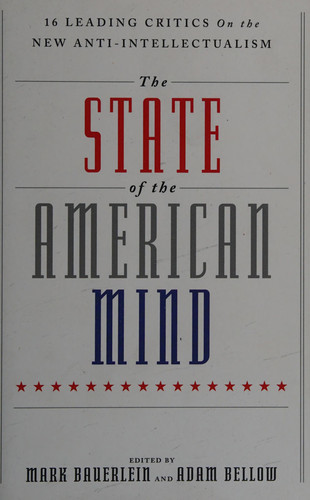
The state of the American mind: 16 leading critics on the new anti-intellectualism

Mark Bauerlein,Adam Bellow
In 1987, Allan Bloom’s The Closing of the American Mind was published; a wildly popular book that drew attention to the shift in American culture away from the tenants that made America—and Americans—unique. Bloom focused on a breakdown in the American curriculum, but many sensed that the issue affected more than education. The very essence of what it meant to be an American was disappearing. That was over twenty years ago. Since then, the United States has experienced unprecedented wealth, more youth enrolling in higher education than ever before, and technology advancements far beyond what many in the 1980s dreamed possible. And yet, the state of the American mind seems to have deteriorated further. Benjamin Franklin’s “self-made man” has become a man dependent on the state. Independence has turned into self-absorption. Liberty has been curtailed in the defense of multiculturalism. In order to fully grasp the underpinnings of this shift away from the self-reliant, well-informed American, editors Mark Bauerlein and Adam Bellow have brought together a group of cultural and educational experts to discuss the root causes of the decline of the American mind. The writers of these fifteen original essays include E. D. Hirsch, Nicholas Eberstadt, and Dennis Prager, as well as Daniel Dreisbach, Gerald Graff, Richard Arum, Robert Whitaker, David T. Z. Mindich, Maggie Jackson, Jean Twenge, Jonathan Kay, Ilya Somin, Steve Wasserman, Greg Lukianoff, and R. R. Reno. Their essays are compiled into three main categories: States of Mind: Indicators of Intellectual and Cognitive Decline These essays broach specific mental deficiencies among the population, including lagging cultural IQ, low Biblical literacy, poor writing skills, and over-medication. Personal and Cognitive Habits/Interests These essays turn to specific mental behaviors and interests, including avoidance of the news, short attention spans, narcissism, and conspiracy obsessions. National Consequences These essays examine broader trends affecting populations and institutions, including rates of entitlement claims, voting habits, and a low-performing higher education system. The State of the American Mind is both an assessment of our current state as well as a warning, foretelling what we may yet become. For anyone interested in the intellectual fate of America, The State of the American Mind offers an accessible and critical look at life in America and how our collective mind is faring.
Templeton Press 2015-06-16 260 pages

In democracy's shadow: the secret world of national security

Raskin, Marcus G.
The response to the September 11 tragedy has raised fears about the American empire abroad and the gutting of constitutional liberties at home. But the editors of this book—one of whom, Marcus Raskin, served on the National Security Council—claim that the changes in the American government since the attacks, though profound, are not necessarily new. The "National Security State" has shaped our government for at least a century, and since 1947, it has embedded itself in the attitudes of the bureaucracy, the major political parties, and the educational system. This collection of original essays—which includes such distinguished historians as Gar Alperovitz, Kai Bird, William Blum, Saul Landau, and Carolyn Eisenberg—traces those changes back to the early years of the twentieth century, and follows them step by step through the cold war to the present.
Nation Books 2005-03-22 340 pages

Jewish philosophy for the twenty-first century: personal reflections

Hava Tirosh-Samuelson,Aaron W. Hughes
Jewish Philosophy for the Twenty-First Century encourages contemporary Jewish thinkers to reflect on the meaning of Judaism in the modern world by connecting these reflections to their own personal biographies. In so doing, it reveals the complexity of Jewish thought in the present moment. The contributors reflect on a range of political, social, ethical, and educational challenges that face Jews and Judaism today and chart a path for the future. The results showcase how Jewish philosophy encompasses the methodologies and concerns of other fields such as political theory, intellectual history, theology, religious studies, anthropology, education, comparative literature, and cultural studies. By presenting how Jewish thinkers address contemporary challenges of Jewish existence, the volume makes a valuable contribution to the humanities as a whole, especially at a time when the humanities are increasingly under duress for being irrelevant.
Brill 2014 541 pages

Liberty's dilemma: America, two nations dependent/independent

Itzkoff, Seymour W.
Liberty's Dilemma is a diagnostic analysis of the falling away in the United States from the founders' vision of individual liberty and freedom of association. The founders never could have envisioned the enormous expansion of industrial and scientific power we have experienced, nor the national and international conflicts. Never could they have predicted the massive growth in power of the federal government - the kind of power they fought against in our initial struggle for independence and liberty. One significant consequence of these events for our future is the massive dependency of large portions of our present population and the consequent debilitating redistribution of the productive wealth of the independent classes. This growth of a seemingly permanent dependent class has gone largely unexplained. Liberty's Dilemma points to the declining intellectual capital in large portions of our society as cause. This is reflected in the disintegration of family life, lowering educational achievement levels, and the flight of our industrial and technological base. Until our leadership awakens to this fundamental issue of our intellectual capital deficits and their cause, the fundamental vision of liberty that was brought into reality by our Constitutional founders will have forever slipped beyond our political reach.
Peter Lang 2014 142 pages