5 results for "Educational"

The great transformation: the political and economic origins of our time

Polanyi, Karl
"In this classic work of economic history and social theory, Karl Polanyi tracks the economic and social changes brought about by the "great transformation" of the Industrial Revolution. He pays particular attention to capitalism's rise and its role in fundamentally altering life after the Industrial Revolution. This seminal analysis explains not only the deficiencies of the self-regulating market, but the potentially dire social consequences of untempered market capitalism"-- Provided by publisher.
Beacon Press 2025-07-08 360 pages

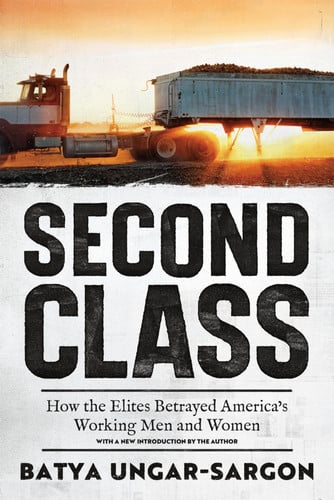
Second class: how the elite betrayed America's working men and women

Ungar-Sargon, Batya
A personal, journalistic ethnography of the modern American working class, based on the travels and interactions of the author through the American heartland. " Second Class is the most important book you will read all year. A political realignment is coming, and it's my hope that the end result will work in favor of our all-too-neglected American working class. When that realignment comes, Batya and her book will help lead the way." --Greg Lukianoff, CEO of the Foundation for Individual Rights in Education, and co-author of The Coddling of the American Mind Who is the American working class? Do they still have a fair shot at the American Dream? What do they think about their chances to secure the hallmarks of a middle-class life? While writing this book, Batya Ungar-Sargon visited states across the nation to speak with members of the American working class who are fighting tooth and nail to survive. In Second Class , working-class Americans of all races, political orientations, and occupations share their stories--cleaning ladies, health care aides, cops, truck drivers, fast food workers, electricians, and more. In their own words, these working-class Americans explain the struggles and triumphs of their increasingly precarious lives--as well as what policies they think would improve them. Second Class combines deep reporting with a look at the data and expert opinions on America's emergent class divide, in which the most basic elements of a secure and stable life are increasingly out of reach for those without a college education. America has broken its contract with its laboring class. So, how do we get back to the American Dream? How do we once again become the land of opportunity, the promised land, where hard work and commitment to family are enough to protect you from poverty? It's not that hard actually. All it would take, as this book illustrates, is for those in power to once again respect the dignity of work--and the American worker.
Encounter Books 2025 248 pages

The Adventures of the Communist Manifesto

Hal Draper
Few documents have had more of an impact on the course of history as has the Communist Manifesto. From its famous opening lines--"A specter is haunting Europe: the specter of Communism"--to its final rallying cry--"Workers of the world unite!"--the words of Marx and Engels have moved millions to join in the struggle against capitalism. But they have also inspired a legion of critics, detractors, and even a few despots to intentionally distort their meanings so as to sow confusion and justify untold horrors. According to Hal Draper, these mis-readings have, in part, been made possible by the enduring prevalence of translations from the original German that fail to accurately capture the intended meaning of certain key phrases. In this magisterial volume, Draper assembles the original German text, the first English translation, the officially authorized English translation--providing enlightening commentary throughout--as well as his own new translation of the pamphlet.
Haymarket Books 2019-12-03 366 pages

Continuity in History and Other Essays

Gerschenkron, Alexander
This collection of essays by Alexander Gerschenkron, who has been called “the doyen of economic history in the United States,” is a companion volume to the author’s highly acclaimed Economic Backwardness in Historical Perspective. The essays range over a wide variety of subjects, but the major theme, as in Gerschenkron’s previous book, is the conditions of industrial development, particularly in regard to nineteenth-century Europe. The book is divided into three parts. In Part I, Methodology, the essays are: “On the Concept of Continuity in History,” “Some Methodological Problems in Economic History,” and “Reflections on Ideology as a Methodological and Historical Problem.” Part II, Problems in Economic History, deals with “The Typology of Industrial Development as a Tool of Analysis,” “The Industrial Development of Italy: A Debate with Rosario Romeo,” “The Modernization of Entrepreneurship,” “Russia: Agrarian Policies and Industrialization, 1861–1914,” and “City Economies Then and Now.” In Part III, The Political Framework, the essays are: “Reflections on the Economic Aspects of Revolution,” “The Changeability of a Dictatorship,” and “The Stability of Dictatorships.” A series of appendices presents reviews and review articles by Gerschenkron.
Belknap Press: An Imprint of Harvard University Press 1968-01-01 560 pages

Museums: In Search of a Usable Future

Wittlin, Alma
This comprehensive study offers an analysis of the museum as a public institution, provides an account of its historical roots, and gives a forecast of its future. In the Foreword, S. Dillon Ripley, Secretary of the Smithsonian Institution, states: "Museums are becoming more and more important. For one thing, as Dr. Wittlin points out, museums provide immediate encounters with authenticity, or a reasonable simulacrum of it. They provide new ways of teaching and learning, and an introduction to processes of lifelong education, now a priority for everyone." An earlier book by Dr. Wittlin, The Museum: Its History and Its Tasks in Education, was the direct predecessor of the present work. The historical chapters have been expanded, and whereas the former volume ended with the outbreak of the Second World War, this study considers the achievements that took place in all parts of the world from 1945 up to the present time. The author's earlier work, published in England, gained international acclaim as a definitive publication in the field and was praised for its philosophical depth, historical breadth, and perceptive insights into the character of a complex institution. Museological events of a scope without precedent are today in a stage of drafting and builidng. Dr. Wittlin examines all aspects of a museum's function: from the traditional functions as a depository, a center of research, and an educational agency to the newer, perhaps peripheral, functions that the author summarizes under the term "cultural center." All these purposes, though valid, must be constantly reexamined in the light of the "extending frontiers of knowledge, rising standards of general education, and of access to new techniques based on scientific advances." In a chapter on a "Twelve-Point Program for Museum Renewal" the main, broad facets of the institution are clearly and concisely discussed. Dr. Wittlin begins with a definition of the term museum established by the International Council of Museums and describes problems of institutional identity and funding, training of personnel, and determining visitor population. She also points up the fallacies in the assumption that mere exposure to exhibits results in learning and stimulation. This book is an impressive and scholarly presentation of the museum pictured through its past and examined in its present functioning as well as what it may offer in the foreseeable future. It is also entertainingly written. The "hottest" current issue, as Dr. Wittlin calls it, is ecology, the study of the interdependence of all living things not only among themselves but with the organic environment. The museum's role in this issue is postulated and discussed. The work is amply illustrated.
Mit Pr 1974-07-15 352 pages