
6 results for "Educational"

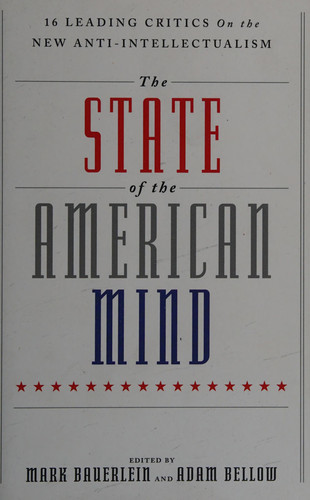
The state of the American mind: 16 leading critics on the new anti-intellectualism

Mark Bauerlein,Adam Bellow
In 1987, Allan Bloom’s The Closing of the American Mind was published; a wildly popular book that drew attention to the shift in American culture away from the tenants that made America—and Americans—unique. Bloom focused on a breakdown in the American curriculum, but many sensed that the issue affected more than education. The very essence of what it meant to be an American was disappearing. That was over twenty years ago. Since then, the United States has experienced unprecedented wealth, more youth enrolling in higher education than ever before, and technology advancements far beyond what many in the 1980s dreamed possible. And yet, the state of the American mind seems to have deteriorated further. Benjamin Franklin’s “self-made man” has become a man dependent on the state. Independence has turned into self-absorption. Liberty has been curtailed in the defense of multiculturalism. In order to fully grasp the underpinnings of this shift away from the self-reliant, well-informed American, editors Mark Bauerlein and Adam Bellow have brought together a group of cultural and educational experts to discuss the root causes of the decline of the American mind. The writers of these fifteen original essays include E. D. Hirsch, Nicholas Eberstadt, and Dennis Prager, as well as Daniel Dreisbach, Gerald Graff, Richard Arum, Robert Whitaker, David T. Z. Mindich, Maggie Jackson, Jean Twenge, Jonathan Kay, Ilya Somin, Steve Wasserman, Greg Lukianoff, and R. R. Reno. Their essays are compiled into three main categories: States of Mind: Indicators of Intellectual and Cognitive Decline These essays broach specific mental deficiencies among the population, including lagging cultural IQ, low Biblical literacy, poor writing skills, and over-medication. Personal and Cognitive Habits/Interests These essays turn to specific mental behaviors and interests, including avoidance of the news, short attention spans, narcissism, and conspiracy obsessions. National Consequences These essays examine broader trends affecting populations and institutions, including rates of entitlement claims, voting habits, and a low-performing higher education system. The State of the American Mind is both an assessment of our current state as well as a warning, foretelling what we may yet become. For anyone interested in the intellectual fate of America, The State of the American Mind offers an accessible and critical look at life in America and how our collective mind is faring.
Templeton Press 2015-06-16 260 pages

Jewish Education and Society in the High Middle Ages

Ephraim Kanarfogel
The Jews of northern France, Germany, and England, known collectively as Ashkenazic Jewry, have commanded the attention of scholars since the beginnings of modern Jewish historiography. Kanarfogel examines the educational process in Ashkenaz, exploring whether there was a developed system of education, whether compensation for Torah study was permitted and what the social status of those who taught Torah was; in the first comprehensive study of the relationship between the educational institutions, leadership, and the communities in medieval Ashkenaz.
Wayne State University Press 1992 213 pages

Portraits: a gallery of intellectuals

Shils, Edward
In these vivid portraits of prominent twentieth-century intellectuals, Edward Shils couples the sensitivity of a biographer with the profound knowledge of a highly respected scholar. Ranging as widely across various disciplines as Shils himself did, the essays gathered here share a distaste for faddists who "run with the intellectual mob" and a deep respect for intellectuals who maintain their integrity under great pressure. Highlights include an affectionate treatment of Leo Szilard, the physicist whose involvement with the development of the atomic bomb led him to work ceaselessly to address its social consequences; a discussion of the educational philosophy of Robert Maynard Hutchins, the University of Chicago's fifth and most controversial president; an appreciative account of the Polish emigre Leopold Labedz's well-informed and outspoken resistance to Communism; and an essay about the extraordinary Indian writer Nirad Chaudhuri.
University of Chicago Press 1997-06-09 255 pages

Fatherlands: state-building and nationhood in nineteenth-century Germany

Green, Abigail
Fatherlands explores the nature of identity in nineteenth-century Germany, and has crucial implications for our understanding of nationalism, German unification and the German state in the modern era. It approaches these questions from a new and important angle, that of the non national territorial state, exploring the state-building process in non-Prussian Germany. The issues covered range from railway construction and German industrialization, to the modernization of German monarchy, the emergence of a free press, the development of a modern educational system, and the role of monuments, museums and public festivities.
Cambridge University Press 2001 386 pages

The decline of intelligence in America: a strategy for national renewal

Itzkoff, Seymour W.
. . . Mr. Itzkoff places most of the blame for America's alleged intellectual decline on what he sees as an economically and intellectually elite cast of misguided liberals. They have isolated themselves from American society, he says, by their paternalistic treatment of the underclass, by discounting the importance of traditional family values and by failing to raise enough bright children to sustain national competence. The New York Times Book Review Few doubt that the United States has slipped from its longstanding eminence as the world's wealthiest and most productive nation. The problem for the past 30 years has been the diagnosis of both the decline and then the cure. Literally trillions of dollars have been expended in futile programs to stanch the hemorrhaging of our economic wealth, jobs, educational achievement, and cultural elan. Itzkoff argues that we will never stop the fall until we understand our real national dilemma. This is the decline in our national intelligence profile: fewer citizens of high intelligence, educational potential, and economic productivity. These ideas are taboo. Itzkoff, however, insists that these are the facts, and they must be examined. In this book, he lays out the available evidence for our social disintegration and suggests a rational program of policy initiatives that would begin to restore us to what we were as recently as 1955--the great hope of the world.
Praeger 1994-02-07 242 pages