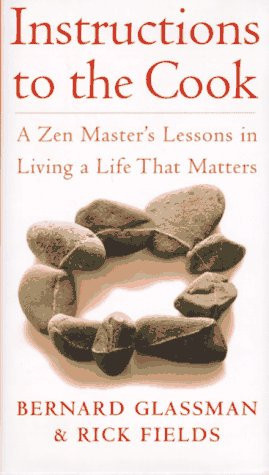
Instructions to the cook: a Zen master's lessons in living a life that matters
In Instructions to the Cook Glassman draws on the teaching of Dogen, the thirteenth-century founder of the Japanese Soto Zen tradition, to relate his own experiences as twentieth-century abbot-cum-entrepreneur. This book, written with Rick Fields, describes Glassman's vision and his work. It is the fruit of his long years of Buddhist practice and also of all the ways in which he has tried to improve the quality of life for those on the bottom rungs of society. The Greyston Foundation, which Glassman established in a poverty-stricken section of Yonkers, is a network of businesses and not-for-profits, including a gourmet bakery that provides training and jobs for the unemployed, three apartment buildings with social services for formerly homeless families, and a major facility for people with HIV/AIDS, which will open in 1997. With this book as our guide we can discern more clearly how to nourish both ourselves and others through integrating the economic, social, educational, and spiritual dimensions of every endeavor. According to Glassman, one of the most useful metaphors for life is what happens in the kitchen. Zen masters call a life that is lived fully and completely, with nothing held back, "the supreme meal." Some chefs keep their recipes and methods a secret, but others are willing to share their failures and successes so that the rest of us can learn how to cook our own "meals." Offering such precepts as "Use what you have," "Don't reject anything," and "Recognize your faults as your best ingredients," Brooklyn-born Glassman is forging a new, American brand of Buddhism, applying the principles of spirituality both in the community and in the marketplace, successfully practicing nonattachment while swimming with the sharks.