9 results for "Educational"

Bowling alone: the collapse and revival of American community

Putnam, Robert D.
Once we bowled in leagues, usually after work; but no longer. This seemingly small phenomenon symbolizes a significant social change. Drawing on surveys on Americans' changing behavior over the past twenty-five years, Putnam shows how we have become increasingly disconnected from family, friends, neighbors, and social structures, whether the PTA, church, recreation clubs, political parties, or bowling leagues. Our shrinking access to the "social capital" that is the reward of communal activity and community sharing is a serious threat to our civic and personal health. The loss of social capital is felt in critical ways : communities with less social capital have lower educational performance and more teen pregnancy, child suicide, low birth weight, and prenatal mortality. Social capital is also a strong predictor of crime rates, other measures of neighborhood quality of life, and health. America has faced this crisis before. At the turn of the last century, social capital was at low ebb, reduced by urbanization, industrialization, and vast immigration that uprooted Americans from their friends, social institutions, and families. Faced with this challenge, the country righted itself. Within a few decades, a range of organizations was created, from the Red Cross, Boy Scouts, and YWCA to Hadassah and the Knights of Columbus and the Urban League and social capital was rebuilt. Putnam calls on Americans to start the process again.
Simon & Schuster 2001 541 pages

Ours was the shining future: the story of the American dream

Leonhardt, David
"The stagnation of living standards for most Americans over the past few decades has been the defining trend of modern life in the United States. Wealth and educational attainment have all slowed to a crawl in the twenty first century, while life expectancy has declined, economic inequality has soared, and the Black-White wage gap is as large as it was when Harry Truman was president. How did this happen in the world's most powerful country? Drawing from decades of writing about the economy for the New York Times, as well as years spent digging through archives, Pulitzer Prize-winning writer David Leonhardt tells the story of the past century of the American economy, starting with the Great Depression and the invention of the term "American dream." UNTITLED explains how the United States built the most prosperous mass economy in history after the Depression, then examines how that economy unraveled after our postwar boom. Its central argument is that three forces, above all, have dictated the economy's rise and fall: political power through grass-roots movement, culture, and investment in making life better for the future. Filled with the clear, lucid writing for which Leonhardt is known, UNTITLED is an enlightening economic history, featuring the unforgettable figures who helped shape the American dream: Frances Perkins, Eisenhower, Cesar Chavez, Betty Friedan, Robert Kennedy, Grace Hopper, Paul Hoffman, and more"--
Random House 2023-10-24 492 pages

The last days of Europe: epitaph for an old continent

Laqueur, Walter
"The Last Days Of Europe" explores how a massive influx from Asia, Africa, and the Middle East has loaded Europe with a burgeoning population of immigrants, many of whom have no wish to be integrated into European societies but make full use of the host nations' generous free social services. One of the master historians of twentieth-century Europe, Walter Laqueur is renowned for his "gold standard" studies of fascism, terrorism, and anti-Semitism. Here he describes how unplanned immigration policies and indifference coinciding with internal political and social crises have led to a continent-wide identity crisis. "Self-ghettoization" by immigrant groups has caused serious social and political divisions and intense resentment and xenophobia among native Europeans. Worse, widespread educational failure resulting in massive youth unemployment and religious or ideological disdain for the host country have bred extremist violence, as seen in the London and Madrid bombings and the Paris riots. Laqueur urges European policy makers to maintain strict controls with regard to the abuse of democratic freedoms by preachers of hate and to promote education, productive work, and integration among the new immigrants.Written with deep concern and cool analysis by a European-born historian with a gift for explaining complex subjects, this lucid, unflinching analysis will be a must-read for anyone interested in international politics and the so-called clash of civilizations.
Thomas Dunne Books/St. Martin's Griffin 2007 247 pages

Howard Zinn on democratic education

Zinn, Howard
Perhaps no other historian has had a more profound and revolutionary impact on American education than Howard Zinn. This is the first book devoted to his views on education and its role in a democratic society. Howard Zinn on Democratic Education describes what is missing from school textbooks and in classrooms-and how we move beyond these deficiencies to improve student education. Critical skills of citizenship are insufficiently developed in schools, according to Zinn. Textbooks and curricula must be changed to transcend the recitation of received wisdom too common today in schools. In these respects, recent Bush Administration and educational policies of most previous US presidents have been on the wrong track in meeting educational needs. This book seeks to redefine national goals at a time when public debates over education have never been more polarised--nor higher in public visibility and contentious debate. Zinn's essays on education-many never before published--are framed in this book by a dialogue between Zinn and Donaldo Macedo, a distinguished critic of literacy and schooling, whose books with Paulo Freire, Noam Chomsky and other authors have received international acclaim.
Paradigm Publishers 2005 213 pages

The Nordic secret: a European story of beauty and freedom

Andersen, Lene
"How do societies go through major technological, economic and structural changes peacefully? The Nordic Secret explores how Denmark, Norway and Sweden went from poor feudal agricultural societies to rich industrialized democracies thanks to the German educational concept of Bildung. The book also investigates the close relationship between Bildung and contemporary developmental psychology, i.e. the concepts of "ego-development" and "transformative learning". The Nordic Secret concludes with a discussion about what we can learn from this positive transformation and how to apply it in the current global crises"-- Publisher description.
Fri Tanke 2017 504 pages

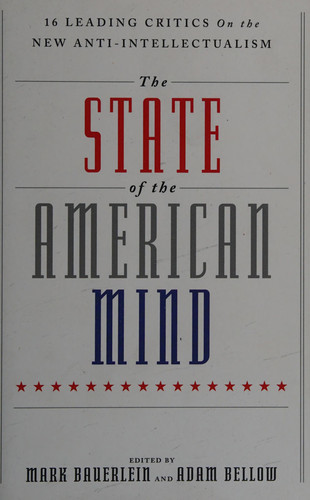
The state of the American mind: 16 leading critics on the new anti-intellectualism

Mark Bauerlein,Adam Bellow
In 1987, Allan Bloom’s The Closing of the American Mind was published; a wildly popular book that drew attention to the shift in American culture away from the tenants that made America—and Americans—unique. Bloom focused on a breakdown in the American curriculum, but many sensed that the issue affected more than education. The very essence of what it meant to be an American was disappearing. That was over twenty years ago. Since then, the United States has experienced unprecedented wealth, more youth enrolling in higher education than ever before, and technology advancements far beyond what many in the 1980s dreamed possible. And yet, the state of the American mind seems to have deteriorated further. Benjamin Franklin’s “self-made man” has become a man dependent on the state. Independence has turned into self-absorption. Liberty has been curtailed in the defense of multiculturalism. In order to fully grasp the underpinnings of this shift away from the self-reliant, well-informed American, editors Mark Bauerlein and Adam Bellow have brought together a group of cultural and educational experts to discuss the root causes of the decline of the American mind. The writers of these fifteen original essays include E. D. Hirsch, Nicholas Eberstadt, and Dennis Prager, as well as Daniel Dreisbach, Gerald Graff, Richard Arum, Robert Whitaker, David T. Z. Mindich, Maggie Jackson, Jean Twenge, Jonathan Kay, Ilya Somin, Steve Wasserman, Greg Lukianoff, and R. R. Reno. Their essays are compiled into three main categories: States of Mind: Indicators of Intellectual and Cognitive Decline These essays broach specific mental deficiencies among the population, including lagging cultural IQ, low Biblical literacy, poor writing skills, and over-medication. Personal and Cognitive Habits/Interests These essays turn to specific mental behaviors and interests, including avoidance of the news, short attention spans, narcissism, and conspiracy obsessions. National Consequences These essays examine broader trends affecting populations and institutions, including rates of entitlement claims, voting habits, and a low-performing higher education system. The State of the American Mind is both an assessment of our current state as well as a warning, foretelling what we may yet become. For anyone interested in the intellectual fate of America, The State of the American Mind offers an accessible and critical look at life in America and how our collective mind is faring.
Templeton Press 2015-06-16 260 pages

The American democracy: a commentary and an interpretation

Laski, Harold J.
This is Laski's most important book after A Grammar of Politics . It discusses, on a grand scale, every aspect of American public life. Laski surveys American traditions and the American spirit, political institutions, the entire educational, religious, economic and social scene, America as a world power, and Americanism as a principle of civilisation. Laski's unsurpassed knowledge of American constitutional, social and cultural history is set in the perspective of his deep study of comparative constitutional history and political theory. He was one of very few people to see U.S. politics from the inside, as a result of his friendships with Roosevelt, Brandeis and Oliver Wendell Holmes.
Routledge 2014-10-29 794 pages

Liberty's dilemma: America, two nations dependent/independent

Itzkoff, Seymour W.
Liberty's Dilemma is a diagnostic analysis of the falling away in the United States from the founders' vision of individual liberty and freedom of association. The founders never could have envisioned the enormous expansion of industrial and scientific power we have experienced, nor the national and international conflicts. Never could they have predicted the massive growth in power of the federal government - the kind of power they fought against in our initial struggle for independence and liberty. One significant consequence of these events for our future is the massive dependency of large portions of our present population and the consequent debilitating redistribution of the productive wealth of the independent classes. This growth of a seemingly permanent dependent class has gone largely unexplained. Liberty's Dilemma points to the declining intellectual capital in large portions of our society as cause. This is reflected in the disintegration of family life, lowering educational achievement levels, and the flight of our industrial and technological base. Until our leadership awakens to this fundamental issue of our intellectual capital deficits and their cause, the fundamental vision of liberty that was brought into reality by our Constitutional founders will have forever slipped beyond our political reach.
Peter Lang 2014 142 pages