5 results for "Engineering"

The Singularity is Near When Humans Transcend Biology

Ray Kurzweil
How Singular? How singular is the Singularity? Will it happen in an instant? Lets consider again the derivation of the word. In mathematics a singularity is a value that is beyond any limit - in essence, infinity. The Singularity as we have discussed it in this book, does not achieve infinite levels of computation, memory, as any other other measurable attribute. But it certainly achieves vast levels of all these qualities, including intelligence. With the reverse engineering of the human brain we will be able to apply the parallel, self-organizing, chaotic, algorithms of human intelligence to enormously powerful computational substrates. This intelligence will then be in a position to improve its own design, both hardware and software, in a rapidly accelerating iterative process.
Viking 2005 652 pages

Invention: care and feeding of ideas

Wiener, Norbert
Internationally honored for brilliant achievements throughout his career, author of Cybernetics, ExProdigy, and the essay God and Golem, Inc., which won the National Book Award in 1964, Norbert Wiener was no ordinary mathematician. With the ability to understand how things worked or might work at a very deep level, he linked his own mathematics to engineering and provided basic ideas for the design of all sorts of inventions, from radar to communications networks to computers to artificial limbs. Wiener had an abiding concern about the ethics guiding applications of theories he and other scientists developed. Years after he died, the manuscript for this book was discovered among his papers. The world of science has changed greatly since Wiener's day, and much of the change has been in the direction he warned against. Now published for the first time, this book can be read as a salutary corrective from the past and a chance to rethink the components of an environment that encourages inventiveness.Wiener provides an engagingly written insider's understanding of the history of discovery and invention, emphasizing the historical circumstances that foster innovations and allow their application. His message is that truly original ideas cannot be produced on an assembly line, and that their consequences are often felt only at distant times and places. The intellectual and technological environment has to be right before the idea can blossom. The best course for society is to encourage the best minds to pursue the most interesting topics, and to reward them for the insights they produce. Wiener's comments on the problem of secrecy and the importance of the "free-lance" scientist are particularly pertinent today. Steve Heims provides a brief history of Wiener's literary output and reviews his contributions to the field of invention and discovery. In addition, Heims suggests significant ways in which Wiener's ideas still apply to dilemmas facing the scientific and engineering communities of the 1990s.
MIT Press 1994 159 pages

Dogma in medieval Jewish thought: from Maimonides to Abravanel

Kellner, Menachem Marc
This essay in the history of ideas seeks to trace the development of creed formation in Judaism from its inception with Moses Maimonides (1135-1204) to the beginning of the sixteenth-century, when systematic attention to the problem disappeared from the agenda of Jewish intellectuals. Dr Kellner describes, analyses, and compares the dogmatic systems of Maimonides, Duran, Crescas, Albo, Bibado, Abravanel, among others. English translations are presented for relevant texts, which, for the most part, have never before been critically edited or translated.
Oxford University Press 1986-09-01 310 pages

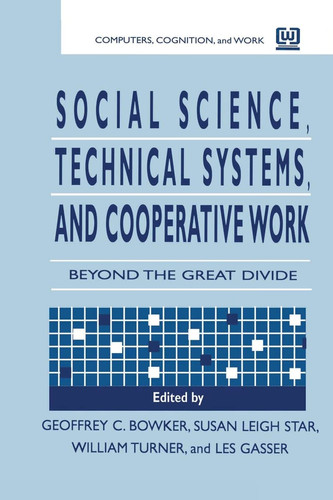
Social science, technical systems, and cooperative work: beyond the great divide

Geoffrey C. Bowker,Les Gasser,Susan Leigh Star,William Turner
This book is the first to directly address the question of how to bridge what has been termed the ""great divide"" between the approaches of systems developers and those of social scientists to computer supported cooperative work--a question that has been vigorously debated in the systems development literature. Traditionally, developers have been trained in formal methods and oriented to engineering and formal theoretical problems; many social scientists in the CSCW field come from humanistic traditions in which results are reported in a narrative mode. In spite of their differences in style,
Lawrence Erlbaum Associates 1997 470 pages

Conflict and Complexity: Countering Terrorism, Insurgency, Ethnic and Regional Violence

Philip Vos Fellman,Yaneer Bar-Yam,Ali A. Minai
Complexity science affords a number of novel tools for examining terrorism, particularly network analysis and NK-Boolean fitness landscapes as well as other tools drawn from non-linear dynamical systems modeling. This book follows the methodologies of compex adaptive systems research in their application to aaddressing the problems of terrorism, specifically terrorist networks, their structure and various methods of mapping and interdicting them as well as exploring the complex landscape of network-centric and irregular warfare.
Springer 2014-12-10 304 pages