17 results for "Environment"

Our revolution: a future to believe in

Sanders, Bernie
"When Bernie Sanders began his race for the presidency, it was considered by the political establishment and the media to be a "fringe" campaign, something not to be taken seriously. After all, he was just an independent senator from a small state with little name recognition. His campaign had no money, no political organization, and it was taking on the entire Democratic Party establishment. By the time Sanders's campaign came to a close, however, it was clear that the pundits had gotten it wrong. Bernie had run one of the most consequential campaigns in the modern history of the country. He had received more than 13 million votes in primaries and caucuses throughout the country, won twenty-two states, and more than 1.4 million people had attended his public meetings. Most important, he showed that the American people were prepared to take on the greed and irresponsibility of corporate America and the 1 percent. In Our Revolution, Sanders shares his personal experiences from the campaign trail, recounting the details of his historic primary fight and the people who made it possible. And for the millions looking to continue the political revolution, he outlines a progressive economic, environmental, racial, and social justice agenda that will create jobs, raise wages, protect the environment, and provide health care for all--and ultimately transform our country and our world for the better. For him, the political revolution has just started. The campaign may be over, but the struggle goes on"--Provided by publisher.
Thomas Dunne Books 2017-08-29 450 pages

The devil may care.\Fifty intrepid Americans and their quest for the unknown

Horwitz, Tony
Stripped naked and pursued across cactus-studded plains by a band of armed Blackfoot Indians, John Colter escaped certain death to become the one of the most durable characters in western American history. But Colter's harrowing tale was not beyond the ordinary when compared to the adventures of other American explorers. In The Devil May Care, popular historian and travel writer Tony Horwitz has culled through the American National Biography and selected fifty stirring biographies of adventurers who had no one's footsteps to follow in--and yet contributed enormously to our understanding of the world. Horwitz introduces us to fascinating individuals such as John Ledyard, the first American to see what would become the Pacific Northwest, and Elisha Kent Kane, America's first arctic hero, who stumbled upon an extremely strange remedy for scurvy while icebound off of Ellesmere Island. Having set off into the unknown many times himself as a foreign correspondent, Horwitz brings a subtle sense of humor and a reporter's eye for detail to a collection that offers a glimpse inside the lives of historic Americans who brazenly challenged danger as they pursued their wanderlust to extreme climates and forbidding environments. Beginning with a short essay, Horwitz seeks his own definition of exploration, drawing on some of his research into the voyages of Captain James Cook and considering its larger implications throughout history. Archival photographs as well as a lively and personal introduction to each story by Horwitz further enhance the appeal of a volume that winds its way through several centuries of American exploration, affirming that the best adventure stories are the true ones.
Oxford University Press 2003-10-16 283 pages

Jerusalem, Jerusalem

Hazleton, Lesley
In 1966, Lesley Hazleton went to Israel for a two-week vacation - she discovered the seductive city of Jerusalem and stayed for thirteen years. During this time Hazleton, a British Jew, became a seasoned journalist, experienced the Six Days War, and made her first pilgrimage through the Old City to the Western Wall. She left Israel in 1979, but it was like ending a passionate love affair: Hazleton could not break the intense emotional times that bound her to Jerusalem, and she returned year after year. Jerusalem, Jerusalem is set during Hazleton's "farewell" visit in 1984, and it chronicles her own personal struggle to come to terms with what this troubled country means to her. Veering between the past and present, this poignant memoir traces the political and environmental changes that have transformed Israel since the Six Days War, and addresses the ever-growing conflict between religious and secular Jews. Lesley Hazleton explores the divisions of souls - Israel's and her own - as she paints an intimate, honest, and compelling portrait of a city living on the brink of war and peace.
Atlantic Monthly Press 1986 243 pages

The next republic: the rise of a new radical majority

Guttenplan, D. D
What will the post-Trump return to democracy in America look like, and what are its historical antecedents? National political correspondent and award-winning author D. D. Guttenplan’s The Next Republic is an extraordinarily intense and wide-ranging exploration of how democracy rises and falls in America. The Next Republic introduces us to some of the organizers and politicians who are helping to bring about change in America, like new labor activist JANE McALEVEY; racial justice campaigner (and mayor of Jackson, Mississippi) CHOKWE ANTAR LUMUMBA; environmental activist (and chair of the Nebraska Democratic Party) JANE KLEEB; Chicago’s first openly gay Latino public official, CARLOS RAMIREZ-ROSA; Justice Democrats communications director WALEED SHAHID; communications director for Alexandria Ocasio-Cortez’s 2020 campaign CORBIN TRENT; and anti-corruption crusader ZEPHYR TEACHOUT. Guttenplan juxtaposes this new social movement with chapters on key transitions in our nation’s history: the Whiskey Rebellion, the Lincoln Republic, and the Roosevelt Republic. Altogether, Guttenplan deeply fathoms the great American problem that is our democracy, and the prospects for its resurgence. Both unyielding and resoundingly hopeful, The New Republic foresees the post-Trump era as one that may not only restore American values, but also see a radical new transformation of them to match the new challenges we face as a nation.
Seven Stories Press 2019-12-10 232 pages

Getting to the heart of the matter: my 36 years in the Senate

Levin, Carl
"Representing Michigan for thirty-six years in the U.S. Senate, Carl Levin, the longest-serving senator in Michigan history, was known for his dogged pursuit of the truth, his commitment to holding government accountable, and his basic decency. Getting to the Heart of the Matter: My 36 Years in the Senate is his story - from his early days in Detroit as the son of a respected lawyer to the capstone of his career as chair of both the Senate Armed Services Committee and the Senate Permanent Subcommittee on Investigations. Levin's career placed him at the center of some of our nation's most critical points in modern times: from the aftermath of the 1967 Detroit riots, to the Clinton impeachment, through 9/11 and the wars in Iraq and Afghanistan, and the 2008 financial crisis. He met with numerous world leaders, including Egypt's Anwar Sadat and China's Jiang Zemin. Getting to the Heart of the Matter recounts Levin's experiences, thoughts, and actions during these historic moments. Consisting of seventeen chapters, the book takes the reader through Levin's early life in Detroit of the 1940s, 50s, and 60s where he met his wife, started a family, practiced law and served as the first General Counsel for the newly created Michigan Civil Rights Commission and the chief appellate defender for Detroit's Legal Aid Office. Elected to the Detroit City Council in 1969, where Levin served for eight years including four as Council president, the book describes how his fight against the Department of Housing and Urban Development's devastating housing practices in the neighborhoods of Detroit led him to run for the U.S. Senate with a pledge to make government work more effectively. Winning election six times, Levin had an illustrious career in the Senate where he challenged leaders in government and the private sector for the greater good of the nation. Levin describes how, as a Democrat, throughout his time in the Senate, he worked with Republican senators who often held different policy positions in order to find common ground to achieve national goals, and how he and his Senate staff searched for creative solutions to trade issues, support for the auto industry and manufacturing sector, U.S. military action in Iraq and Afghanistan, and efforts to protect the Great Lakes and the environment, among many other issues. Levin's hope in writing this memoir is that by sharing his deeply held beliefs about the responsibility of elected officials, the book will serve as a resource for people beginning a career in, or contemplating running for, public office. Readers with an interest in politics, history, facts, and perseverance will find kinship in this book" -- provided by the publisher
Wayne State University Press 2021 338 pages

With the Weathermen: the personal journal of a revolutionary woman

Stern, Susan
Drugs. Sex. Revolutionary violence. From its first pages, Susan Stern's memoir With the Weathermen provides a candid, first-hand look at the radical politics and the social and cultural environment of the New Left during the late 1960s. The Weathermen--a U.S.-based, revolutionary splinter group of Students for a Democratic Society--advocated the overthrow of the government and capitalism, and toward that end, carried out a campaign of bombings, jailbreaks, and riots throughout the United States. In With the Weathermen Stern traces her involvement with this group, and her transformation from a shy, married graduate student into a go-go dancing, street-fighting "macho mama." In vivid and emotional language, she describes the attractions and difficulties of joining a collective radical group and in maintaining a position within it. Stern's memoir offers a rich description of the raw and rough social dynamics of this community, from its strict demands to "smash monogamy," to its sometimes enforced orgies, and to the demeaning character assassination that was led by the group's top members. She provides a distinctly personal and female perspective on the destructive social functionality and frequently contradictory attitudes toward gender roles and women's rights within the New Left. Laura Browder's masterful introduction situates Stern's memoir in its historical context, examines the circumstances of its writing and publication, and describes the book's somewhat controversial reception by the public and critics alike.
Rutgers University Press 2007 387 pages

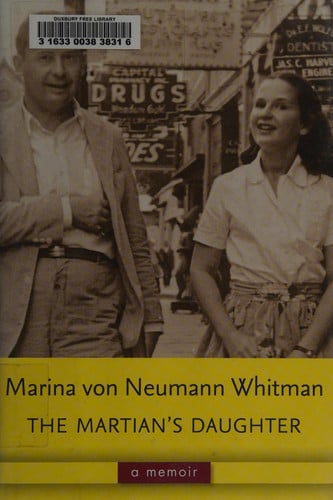
The Martian's daughter: a memoir

Whitman, Marina von Neumann
One of the five Hungarian scientific geniuses dubbed "the Martians" by their colleagues, John von Neumann is often hailed as the greatest mathematician of the twentieth century and even as the greatest scientist after Einstein. He was a key figure in the Manhattan Project; the inventor of game theory; the pioneer developer of the modern stored-program electronic computer; and an adviser to the top echelons of the American military establishment. In The Martian's Daughter , Marina von Neumann Whitman reveals intimate details about the famed scientist and explores how the cosmopolitan environment in which she was immersed, the demanding expectations of her parents, and her own struggles to emerge from the shadow of a larger-than-life parent shaped her life and work. Unfortunately, von Neumann did not live to see his daughter rise to become the first or highest-ranking woman in a variety of arenas. Whitman became a noted academic during the 1960s and '70s, casting her teaching and writing in the framework of globalization before the word had been invented; became the first woman ever to serve on the President's Council of Economic Advisers and participated actively in U.S. efforts to reshape the international monetary and financial system during the early 1970s; pioneered the role of women on the boards of leading multinational corporations; and became the highest-ranking female executive in the American auto industry in the 1980s. In her memoir, Whitman quotes from personal letters from her father and describes her interactions with such figures as Roger Smith of GM and President Nixon. She also details the difficulties she encountered as an early entrant into a world dominated by men and how she overcame the obstacles to, in her words, "have it all."
University of Michigan Press 2012-08-31 308 pages

Yippie girl: exploits in protest and defeating the FBI

Gumbo, Judy
HONORABLE MENTION, Foreword INDIES Book of the Year Award, Autobiography & Memoir! Lifelong activist Judy Gumbo, an original member of The Yippies, a 1960s anti-war satirical protest group, offers an insider feminist memoir of her involvement with the Yippies, Black Panthers, women's rights, environmental actions, and a life of activism. In 1968, a 24-year-old woman moved to Berkeley, California and immediately became enmeshed in the Youth International Party, aka The Yippies, an anti-war satirical protest group. In the next few years, Judy Gumbo (a nickname given her by Eldridge Cleaver), was soon at the center of counter-cultural activity-from protests in People's Park, to meetings at Black Panther headquarters, to running a pig for President at the raucous Democratic National Convention in Chicago, a protest that devolved into violent attacks by the police and arrests that led to the notorious Chicago Conspiracy Trial. In this historical account, Gumbo reveals intimate details of--and struggles with--her fellow radicals Jerry Rubin, Anita & Abbie Hoffman, Eldridge Cleaver, Paul Krassner, Stew Albert, and more, detailing their experiences in radical protests. This deep dive into her activism includes details of her organization of a national women's rights group, her visit to North Vietnam during the war, her travels around the globe to promote women's liberation and anti-war protest, and her environmental activism. It also includes extensive excerpts from illegal wiretaps and surveillance by the FBI. "A welcome addition to the literature of radical activism." --Kirkus Reviews "A fun read and a valuable political document, long overdue." --Counterpunch Yippie Girl explores Gumbo's life as a protester to show that, while circumstances always change, protesters can stay loyal to the causes they believe in and remain true to themselves. She also reveals how dogmatism, authoritarianism, and interpersonal conflict can damage those same just causes, offering a timeless and strategic guide for activists today protesting against injustice in all its forms.
Three Rooms Press 2022 333 pages

Marina Tsvetayeva

Feinstein, Elaine
First Edition AND Firts Printing-full number line:10 9 8 7 6 5 4 3 2 1 Paperback - Slightly used Like New condition for it's age. Illustrated with photos. No marks 220 pages. Slight signs of age and storagewear. From a non-smoking environment. FAST SHIPPING (with delivery confirmation.) Extra attention to the packaging for the protection. INTERNATIONAL Orders will be shipped via AIRMAIL. Thank You so much! Shelf .))
Penguin 1989 220 pages

Why did you do that? the autobiography of a human rights advocate

Matas, David
Why Did You Do That? is an autobiography of David Matas, an international human rights advocate. The book sets out his human rights activities and then attempts to explain why he did them. People are focused on their immediate environment, their family, their friends, their work or their neighbourhood. Why should they go to the bother of trying to address a seemingly intractable situation in order to try help those with whom superficially they have nothing in common, who may be living in a country far away to which they have never been, speaking in a language they do not understand and part of a culture which is both foreign and strange? The reason for the autobiography is an attempt to answer that question. By trying to explain why he did what he did, the author hopes to mobilize others, not to do what he did or is now doing, but rather just to do something, to shed feelings of indifference and impotence, to join the international human rights cause.
Seraphim Editions 2015 302 pages

Only in America: Al Jolson and The Jazz Singer

Bernstein, Richard
"Al Jolson, born Asa Yoelson, immigrated from his shtetl in Lithuania to the United States in 1894 after his father secured a job as a rabbi in Washington, D.C. A poor, Yiddish-speaking newcomer navigating a racially segregated and antisemitic America, young Jolson dreamed of becoming a star, and he did. Thanks to his immense talent and his knack for assimilating into new environments, by the time he reached his twenties he was the most famous and highly paid entertainer in America, making almost $5,000 a week at a time when the average American made $800 a year. Jolson's public adoration and widespread acceptance as a star marked the beginning of an enriching cultural transformation, a moment when the American mind opened up to ethnic and racial differences, widening the gap of acceptability. And yet Jolson himself, despite being ferociously ambitious and gigantically talented, was crippled by insecurity, often nervous to the point of collapse, prisoner to his many vices. Through Jolson, Bernstein simultaneously breaks open the history and legacy of the cultural sensation The Jazz Singer. Not only was The Jazz Singer the first feature length film with synchronized music and dialogue, but it was also taboo smashing in its content: The Jazz Singer is all about Jews, Orthodox and otherwise. Bernstein expounds on the making of The Jazz Singer, what the film meant then and now, introducing the many individuals involved in its production, including Samson Raphaelson, a young Jewish writer whose short story was the basis for the movie; the four Warner brothers who made a fortune off it; and George Jessel, Jolson's rival and the star of Raphaelson's stage adaptation of his short story. In the background emerges a picture of old Hollywood in the Roaring Twenties: cutthroat and greedy yet visionary and progressive. And while The Jazz Singer represented the future in many ways, it also dredged up the worst of the past, including Jolson's use of blackface, common at the time. At once a tale of the Judaizing of American culture and an acknowledgment of the challenges to come, Only in America is a glistening examination of a man at the center of a watershed moment in the arts"--
Schocken Books 2024 252 pages

Against the tide: one woman's political struggle

Keyserling, Harriet
In 1944, when New York City native Harriet Keyserling arrived in the small South Carolina town of Beaufort, she found herself in an environment that seemed foreign to her. Coming to Beaufort with her husband - a native son and local physician - she was a liberal northerner in the conservative South and a Jew in a predominantly Christian world. These religious and political differences only intensified her feelings of being an outsider - a thread that would run through much of her life and career. After successfully raising four children and professionally volunteering for most of her adult life, Keyserling became involved in state and local politics. Driven by passion for the causes she supports, she organized a chapter of the League of Women Voters, became the first woman to serve on the Beaufort County Council, and, at the age of fifty-four, was elected to the state General Assembly. She served for sixteen years before retiring in 1992, when the growing rancor and partisanship of the legislature became intolerable for her. Against the Tide tells the intensely personal story of an unconventional politician struggling to gain self-confidence, beat the odds, and make a lasting dif
University of South Carolina Press 2004 388 pages

You are not your fault and other revelations: the collected wit and wisdom of Wes "Scoop" Nisker

Nisker, Wes
Wes “Scoop” Nisker is an award-winning broadcast journalist and commentator, a renowned Buddhist meditation teacher, a best selling author and a captivating performer. In How to be an Earthling , Wes draws on his diverse experiences delivering a collection that brims with the insight, humor and wisdom he is famous for. Compiling for the first time, Wes’ best known essays as well as a selection of recent and never before published work, Wes takes readers on both a cultural journey (a tour through the sixties, through the modern environmental movement, the surge of Buddhism to the West) and a more personal one, exploring the motivation behind humanity’s search for spiritual enlightenment.
Soft Skull Press, an imprint of Counterpoint 2016-03-15 261 pages

A life spent changing places

Halprin, Lawrence
Landscape architect, urban planner, teacher, and social visionary: over the course of a sixty-year career, Lawrence Halprin (1916-2009) reshaped the spaces we inhabit and our ways of moving through them. The New York Times called him "the tribal elder of American landscape architecture" and the critic Ada Louise Huxtable credited him with creating what "may be one of the most important urban spaces since the Renaissance." His bold use of abstract imagery could evoke the landscape of the American West in a sequence of city squares and fountains, while his plan for repurposing an abandoned factory near San Francisco's Fisherman's Wharf showed how adaptive use of a historic structure could turn commercial development into urban theater. A man who deeply loved cities, he left as one of his most important legacies the five thousand acres of coastline, hedgerows, and meadows that became Sonoma County's environmentally sensitive and enormously influential Sea Ranch. Featuring more than ninety black-and-white and one hundred color reproductions of photographs, plans, and sketchbooks, A Life Spent Changing Places is Halprin's own account of how a young boy who listened to the fireside chats of FDR on the radio became the man who designed the memorial to that president in the nation's capital. It is a book about the invention and reinvention of an extraordinary man over the span of decades and how he helped to reframe the world around him.
University of Pennsylvania Press 2011-07-01 258 pages

Reporting live from the end of the world

Shukman, David
When frontline BBC news reporter David Shukman switched beat from world affairs to environment in 2003, he feared he might be in for a dull life. He couldn't have been more wrong. His new job has taken him to every corner of the earth: journeying up the fabled North West Passage in the Arctic, chasing after loggers in the Amazon and battling through plastic waste in the Pacific Ocean, getting trapped in Siberian blizzards along the way. Reporting Live from the End of the World charts Shukman's extraordinary adventures, in the process providing a fascinating eye-witness account of the state of the planet. Wonderfully written and often very funny, the book will be loved by travel, science or environment readers alike.
Profile 2010 307 pages

Historical encyclopedia of natural and mathematical sciences

Ben-Menahem, Ari
This milestone extensive work combines the essentials of history – biography, chronology, political and economic background – with the observations, theories, principles, laws and equations that constitute the specifics of science. The 5800-page Encyclopedia arises from the conviction that the optimal perspective on science is through the lens of history, setting aside traditional divisions of discipline and specialty, and rising above geopolitical boundaries. Reaching from 4,200 BCE to the 21st century CE, the Encyclopedia tells (as the author himself puts it) "not only who did it and when it was done but also precisely what was done." The author, Ari Ben-Menahem, surveys 100 generations of great thinkers, offering 2070 detailed biographies of scientists, engineers, explorers and inventors, who left their mark on the history of science and technology. The span of coverage is all-encompassing: mathematics, philosophy, logic, physical and environmental sciences (including physics, chemistry, astronomy, earth and space sciences and cosmology), life sciences (biology, medicine, physiology, botany, zoology and biochemistry), associated engineering disciplines, and the social sciences (among them economics, psychology, sociology, anthropology, linguistics and more). The six-volume Encyclopedia also includes 380 articles summarizing the time-line of ideas in the leading fields of science, technology, mathematics and philosophy, plus useful tables, figures and photos, and 20 ‘Science Progress Reports’ detailing scientific setbacks. Interspersed throughout are quotations, gathered from the wit and wisdom of sages, savants and scholars throughout the ages from antiquity to modern times.
Springer 2009-03-05 5986 pages

Moss Cass and the greening of the Australian Labor Party

Cass, Moss,Encel, Vivien,ODonnell, Anthony
In 1972, Dr Moss Cass found himself minister responsible for Australia's first Department of Environment and Conservation in Gough Whitlam's newly elected Labor government. Long-haired, bearded, unapologetically a champion of progressive causes, Cass was to face an uphill battle. Even within his own avowedly reformist party, he fought against the odds to try to save Lake Pedder, Fraser Island and Kakadu. But Cass's legacy extended beyond environmental politics. As the Minister for Media he issued 12 'experimental' radio licences that laid the basis for today's thriving community radio sector. As the inaugural medical director of the Trade Union Clinic, he helped pioneer a new model of community health care. He advocated for the reform of abortion law and the decriminalisation of homosexuality. This political biography offers an insider's account of a tumultuous time in Australian politics. Cass's story provides a compelling pre-history to many of the key issues in progressive politics today: the environment, refugees, homosexual law reform, the media, and health care.It is also a story about the transformation of the Australian Labor Party: its 'greening' both in regard to environmental politics and its accommodation of new movements for social reform.
Australian Scholarly Publishing 2017 316 pages