10 results for "Environment"

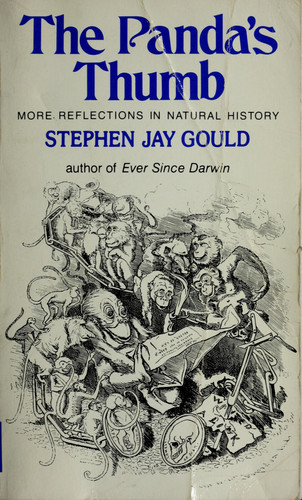
The panda's thumb: more reflections in natural history

Gould, Stephen Jay
A collection of essays by reknown scientist Jay Stephen Gould drawn from his columns in Natural History. The essays deal with topics such as: evolutionary opportunism (nature is a tinkerer, making the most of what's available in the course of adapting to the environment); new information on Darwin and his contemporaries; racism and cultural relativism; the evolutionary pattern of sudden rapid change; the origin of birds or the warm-bloodedness of dinosaurs; and, Teilhard de Chardin as a co-conspirator in the Piltdown hoax.
Norton 1980 343 pages

The Best American Science and Nature Writing 2004

Tim Folger,Steven Pinker
Since its inception in 1915, the Best American series has become the premier annual showcase for the country's finest short fiction and nonfiction. For each volume, a series editor reads pieces from hundreds of periodicals, then selects between fifty and a hundred outstanding works. That selection is pared down to the twenty or so very best pieces by a guest editor who is widely recognized as a leading writer in his or her field. This unique system has helped make the Best American series the most respected -- and most popular -- of its kind. The Best American Science and Nature Writing 2004, edited by Steven Pinker, is another "provocative and thoroughly enjoyable [collection] from start to finish" (Publishers Weekly). Here is the best and newest on science and nature: the psychology of suicide terrorism, desperate measures in surgery, the weird world of octopuses, Sex Week at Yale, the linguistics of click languages, the worst news about cloning, and much more.
Houghton Mifflin 2004 209 pages

Darwin for Beginners

Jonathan Miller,Borin Van Loon
The Beginner Books -- "Their cartoon format and irreverent wit make difficult ideas accessible and entertaining." -- Newsday aking us through the upheavals in biological thought which made The Origins of Species possible, Jonathan Miller introduces us to that odd revolutionary, Charles Darwin -- a remarkably timid man who spent most of his life in seclusion; a semi-invalid riddled with doubts, fearing the controversy his theories might unleash; yet also the man who finally undermined belief in God's creation. Along the way we meet a fascinating cast of characters: Darwin's scientific predecessors, his contemporaries (including Alfred Russell Wallace, whose anticipation of natural selection forced Darwin to publish), his opponents, and his successors whose work in modern genetics provided necessary modifications to Darwin's own work. Splendidly illustrated, this clever, witty, highly informative book is the perfect introduction to Darwin's life and thought.
National Geographic Books 2003-07-15 176 pages

Cannibals and kings: the origins of cultures

Harris, Marvin
Since time began, man has been threatened by growing populations and diminishing resources. In response, he has created idiosyncratic cultures whose forms and functions can - to the outsider - seem incomprehensible. In fascinating and at times bizarre detail a distinguished American anthropologist traces the evolution of cultures in terms not of traditionally accepted notions of the inexorable march of material progress but rather of man's supremely rational survival tactics and adaptability in a world which ever threatens him with extinction.
Fontana 1978 255 pages

Biology under the influence: dialectical essays on ecology, agriculture, and health

Lewontin, Richard C.
How do we understand the world? While some look to the heavens for intelligent design, others argue that it is determined by information encoded in DNA. Science serves as an important activity for uncovering the processes and operations of nature, but it is also immersed in a social context where ideology influences the questions we ask and how we approach the material world. Biology Under the Influence: Dialectical Essays on the Coevolution of Nature and Society breaks from the confirms of determinism, offering a dialectical analysis for comprehending a dynamic social and natural world. In Biology Under the Influence , Richard Lewontin and Richard Levins provide a devastating critique of genetic determinism and reductionism within science while exploring a broad range of issues including the nature of science, biology, evolution, the environment, pubic health, and dialectics, They dismantle the ideology that attempts to naturalize social inequalities, unveil the alienation of science and nature, and illustrate how a dialectical position serves as a basis for grappling with historical developments and a world characterized by change. Biology Under the Influence brings together the illuminating essays of two prominent scientists who work to demystify and empower the public's understanding of science and nature.
Monthly Review Press 2007-11-01 400 pages

The Hologenome Concept: Human, Animal and Plant Microbiota

Eugene Rosenberg,Ilana Zilber-Rosenberg
Groundbreaking research over the last 10 years has given rise to the hologenome concept of evolution. This concept posits that the holobiont (host plus all of its associated microorganisms) and its hologenome (sum of the genetic information of the host and its symbiotic microorganisms), acting in concert, function as a unique biological entity and therefore as a level of selection in evolution. All animals and plants harbor abundant and diverse microbiota, including viruses. Often the amount of symbiotic microorganisms and their combined genetic information far exceed that of their host. The microbiota with its microbiome, together with the host genome, can be transmitted from one generation to the next and thus propagate the unique properties of the holobiont. The microbial symbionts and the host interact in a cooperative way that affects the health of the holobiont within its environment. Beneficial microbiota protects against pathogens, provides essential nutrients, catabolizes complex polysaccharides, renders harmful chemicals inert, and contributes to the performance of the immune system. In humans and animals, the microbiota also plays a role in behavior. The sum of these cooperative interactions characterizes the holobiont as a unique biological entity. Genetic variation in the hologenome can be brought about by changes in either the host genome or the microbial population genomes (microbiome). Evolution by cooperation can occur by amplifying existing microbes, gaining novel microbiota and by acquiring microbial and viral genes. Under environmental stress, the microbiome can change more rapidly and in response to more processes than the host organism alone and thus influences the evolution of the holobiont. Prebiotics, probiotics, synbiotics and phage therapy are discussed as applied aspects of the hologenome concept.
Springer International Publishing 2016-08-27 178 pages

Life: the leading edge of evolutionary biology, genetics, anthropology, and environmental science

John Brockman
"The newest addition to John Brockman's Edge.org series explores life itself, bringing together the world's leading biologists, geneticists, and evolutionary theorists -- including Richard Dawkins, Edward O. Wilson, J. Craig Venter, and Freeman Dyson. Scientists' understanding of life is progressing more rapidly than at any point in human history, from the extraordinary decoding of DNA to the controversial emergence of biotechnology. Featuring pioneering biologists, geneticists, physicists, and science writers, Life explains just how far we've come -- and takes a brilliantly educated guess at where we're heading. Richard Dawkins and J. Craig Venter compare genes to digital information, and sketch the frontiers of genomic research. Edward O. Wilson reveals what ants can teach us about building a superorganism -- and, in turn, about how cells build an organism. Elsewhere, David Haig reports new findings on how mothers and fathers individually influence the human genome, while Kary Mullis covers cutting edge treatments for dangerous viruses. And there's much more in this fascinating volume. We may never have all the answers. But the thinkers collected in Life are asking questions that will keep us dreaming for generations."--provided by Amazon.com.
Harper Perennial 2016-04-19 367 pages