7 results for "Environment"

Women of the word: Jewish women and Jewish writing

Judith Reesa Baskin
Jewish women writers of the late nineteenth and early twentieth centuries lived with a sense of painful connection to a culture that rejected their aspirations. Raised in a Jewish environment wary of female aspirations and in a wider world that was only marginally more sympathetic to their ambitions, this diverse group often found that a life devoted to literary expression required sacrifices and painful choices. Writing, however, enabled them to reclaim and explore their Jewish heritage. Responding to a variety of Jewish women's voices in Hebrew, Yiddish, English, and Spanish, this collection of seventeen essays surveys the achievements of Jewish women writers from the Middle Ages to the present. Scholars of Jewish literature chronicle the Jewish encounter with modernity and document female strategies for constructing intellectual and emotional identities amidst the competing demands of traditional norms, familial obligations, and economic survival. The themes of repression and equivocal liberation resonate throughout, as the authors reflect on the silencing of the female voice in a traditional Jewish culture that most often denied women the education and the empowerment requisite for recording their thoughts and feelings. While individual essays reveal literary discoveries of self and forgings of identity by women rising to the opportunities and challenges of drastically altered Jewish social realities, a significant number also show the sad decline of women writers upon whom silence was reimposed. Several chapters consider how Jewish women were depicted by male writers from the Middle Ages through the mid-nineteenth century. A final essay documents the ways in which memory, testimony, and survival affect the writing of women who survived the Holocaust, a perspective frequently marginalized in studies of Holocaust literature. Women of the Word is part of an emerging effort to listen to the voices of Jewish women both past and present. Written in a period when Jewish women writers internationally are creating a wealth of diverse literary works, these essays take note of the short time during which Jewish women's writing has flourished and inspire readers with the richness of the literature that such writers have already produced.
Wayne State University Press 1994 382 pages

The affirming flame: a poetics of meaning

Friedman, Maurice S.
In a dialogue with modern literature, discusses the search for meaning through meeting with the particular. Ch. 10 (pp. 157-185), "The Shoah - Our Ultimate Confrontation, " analyzes works by Andre Schwarz-Bart, Primo Levi, Nelly Sachs, and Paul Celan on the Holocaust, which are "paradigmatic of the absurdity of our time." Schwarz-Bart's novel "The Last of the Just" portrays its protagonist as a "suffering servant" (Isaiah) who suffers voluntarily (including death in a gas chamber) for God, all Jews, and all humanity, during a period of the "eclipse of God." Levi found meaning after the Holocaust via his writing; in "Survival in Auschwitz" he wrote of an Italian civilian, Lorenzo, who represented humanity in a camp environment where there was mainly hunger, cold, and death. Sachs' poetry fused the horror of Holocaust death with a strange transcendence. Celan was torn between affirmation and negation, and "forever in exile"; in his poetry, God was both absurd and divine.
Prometheus Books 1999-03-01 252 pages

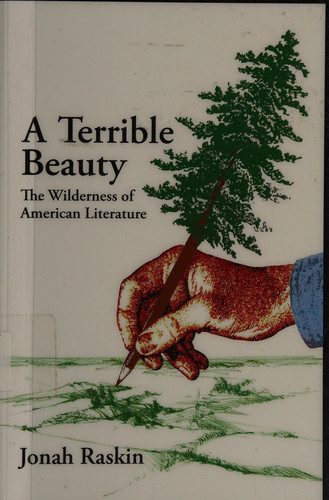
A terrible beauty: the wilderness of American literature

Raskin, Jonah
ABOUT THE BOOK Shortly before he published Walden; or Life in the Woods, Henry David Thoreau called ¿The library a wilderness of books.¿ He also noted that while Americans were ¿clearing the forest in our westward progress, we are accumulating a forest of books in our rear, as wild and unexplored as any of nature¿s primitive wildernesses.¿ In "A Terrible Beauty: the Wilderness of American Literature," Jonah Raskin takes a long close look at the forest of books that poets, novelists and essayists mapped and explored before and after Thoreau. The first work of cultural criticism to look back at writing in the United States from the perspective of the contemporary environmental crisis, Raskin offers insights for students, teachers and lovers of literature as well as for backpackers and hikers who have trekked across untrammeled forests, deserts and mountains. ABOUT THE AUTHOR Jonah Raskin, Phd, has taught American literature at Sonoma State University, the State University of New York at Stony Brook and as a Fulbright professor at the University of Antwerp and the University of Ghent in Belgium. The author of fifteen books, he earned his B.A. at Columbia College in New York, his M.A. at Columbia University and his Ph.D. at the University of Manchester, Manchester, England. He lives in northern California and has written for The San Francisco Chronicle, The L.A. Times, The Nation, The Redwood Coast Review and Catamaran.
Regent Press 2014 366 pages

On Russian music

Taruskin, Richard
Over the past four decades, Richard Taruskin's publications have redefined the field of Russian-music study. This volume gathers thirty-six essays on composers ranging from Bortnyansky in the eighteenth century to Tarnopolsky in the twenty-first, as well as all of the famous names in between. Some of these pieces, like the ones on Chaikovsky's alleged suicide and on the interpretation of Shostakovich's legacy, have won fame in their own right as decisive contributions to some of the most significant debates in contemporary musicology. An extensive introduction lays out the main issues and a justification of Taruskin's approach, seen both in the light of his intellectual development and in that of the changing intellectual environment, which has been particularly marked by the end of the cold war in Europe
University of California Press 2009 407 pages

The life of metrical and free verse in twentieth-century poetry

Silkin, Jon
In a wide-ranging and compelling account of the life of metrical and free verse in the twentieth century, poet and critic Jon Silkin deepens our understanding of the way poetry works on us. He begins from the premiss that two modes of verse, free and metrical, engage the creative energies of poetry now, creating a rich, fertile environment capable of yielding work valuable to poetry itself and to the society which has given it life. With a practitioner's empathy Silkin reads the poetry of Whitman, Hopkins, Eliot, Pound, Lawrence, Dylan Thomas, Bunting and eight British poets from the post-second World War period to illustrate how free and metrical verse create, separately or together, a poetic harmony. Additionally, he includes crucial statements on modern poetry from poets themselves, concluding with a fine memoir of Basil Bunting by Connie Pickard, published in book-form for the first time.
Macmillan 1997 423 pages

Goldstein's greatest hits: a book mostly about rock 'n' roll

Goldstein, Richard
Practical advice and real-life examples help teachers understand and apply the principles of classroom management in their own classroom situations. Comprehensive, based on the most current research, and supported through the examples of thousands of teachers already using these techniques, this popular resource helps K-12 teachers implement effective classroom management methods. The emphasis is on creating classrooms where students feel safe because they know they are respected and supported by their teacher and peers-and where classroom behavior standards have been developed with and agreed upon by students. Through detailed case studies, examples, and descriptions of specific strategies, the book also examines instructional methods that support high rates of student engagement and methods for responding effectively to minor as well as serious and ongoing situations where student behavior disrupts the learning environment. Included are numerous Pause and Consider questions and activities to help readers master and implement the methods presented. The Eleventh Edition expands its emphasis on data-driven, research-based approaches to classroom management, including a new focus on how brain research and trauma-sensitive classrooms can inform our understanding of student learning and behavior.
Prentice-Hall 1970 228 pages

Sefer ha-pardes

Jedaiah ben Abraham Bedersi
This groundbreaking new work is the first full critical edition and English translation of the Hebrew book Sefer ha-Pardes [The Book of the Orchard], written at the end of the thirteenth century by the Provençal Jewish author Jedaiah ha-Penini. It is purportedly an example of musar: a compilation of wise epigrams and meshalim [parables] that teach moral lessons on different topics, such as the service of God, friendship, the deceitfulness of the world, medicine, logic, music, magic, and poetry. However, it is in reality a compendium of sayings that reveal the author's personal views and feelings on a variety of religious topics, secular sciences, and their practitioners. David Torollo presents a fluent and illuminating English-Hebrew parallel text based on four sixteenth-century witnesses: three manuscripts and a printed edition. A rigorous study accompanies and contextualises the Hebrew work, exploring Sefer ha-Pardes's transmission and reception in different places over time; its structure and content; its place in the intellectual environment and literary tradition of Provence; and possible lines of enquiry for future research. This essential new work offers a significant contribution to scholarship in the field of Medieval Hebrew Hispano-Provencal literature.
Open Book Publishers 2022 168 pages