13 results for "Environment"

Nowhere in Africa: an autobiographical novel

Zweig, Stefanie
Nowhere in Africa is the extraordinary tale of a Jewish family who flees the Nazi regime in 1938 for a remote farm in Kenya. Abandoning their once-comfortable existence in Germany, Walter Redlich, his wife Jettel, and their five-year-old daughter, Regina, each deal with the harsh realities of their new life in different ways. Attorney Walter is resigned to working the farm as a caretaker; pampered Jettel resists adjustment at every turn; while the shy yet curious Regina immediately embraces the country—learning the local language and customs, and finding a friend in Owuor, the farm's cook. As the war rages on the other side of the world, the family’s relationships with their strange environment become increasingly complicated as Jettel grows more self-assured and Walter more haunted by the life they left behind. In 1946, with the war over, Regina's fondest dream comes true when her brother Max is born. Walter's decision, however, to return to his homeland to help rebuild a new Germany puts his family into turmoil again. Visit the Web site for the film at www.nowhereinafrica.com
Terrace Books 2004 291 pages

Assimilated Jews in the Warsaw Ghetto, 1940-1943

Person, Katarzyna
Jews in Nazi-occupied Warsaw during the 1940s were under increasing threat as they were stripped of their rights and forced to live in a guarded ghetto away from the non-Jewish Polish population. Within the ghettos, a small but distinct group existed: the assimilated, acculturated, and baptized Jews. Unwilling to integrate into the Jewish community and unable to merge with the Polish one, they formed a group of their own, remaining in a state of suspension throughout the interwar period. In 1940, with the closure of the Jewish residential quarter in Warsaw, their identity was chosen for them. Person looks at what it meant for assimilated Jews to leave their prewar neighborhoods, understood as both a physical environment and a mixed Polish Jewish cultural community, and to enter a new, Jewish neighborhood. She reveals the diversity of this group and how its members’ identity shaped their involvement in and contribution to ghetto life. In the first English-language study of this small but influential group, Person illuminates the important role of the acculturated and assimilated Jews in the history and memory of the Warsaw Ghetto.
Syracuse University Press 2014-06-30 239 pages

Jews and the new American scene

Lipset, Seymour Martin
Will American Jews survive their success? Or will the United States' uniquely hospitable environment lead inexorably to their assimilation and loss of cultural identity? This is the conundrum that Seymour Lipset and Earl Raab explore in their wise and learned book about the American Jewish experience. Jews, perhaps more than any ethnic or religious minority that has immigrated to these shores, have benefited from the country's openness, egalitarianism, and social heterogeneity. This unusually good fit, the authors argue, has as much to do with the exceptionalism of the Jewish people as with that of America. But acceptance for all ancestral groups has its downside: integration into the mainstream erodes their defining features, diluting the loyalties that sustain their members. The authors vividly illustrate this paradox as it is experienced by American Jews today--in their high rates of intermarriage, their waning observance of religious rites, their extraordinary academic and professional success, their commitment to liberalism in domestic politics, and their steadfast defense of Israel. Yet Jews view these trends with a sense of foreboding: "We feel very comfortable in America--but anti-Semitism is a serious problem"; "We would be desolate if Israel were lost--but we don't feel as close to that country as we used to"; "More of our youth are seeking some serious form of Jewish affirmation and involvement--but more of them are slipping away from Jewish life." These are the contradictions tormenting American Jews as they struggle anew with the never-dying problem of Jewish continuity. A graceful and immensely readable work, Jews and the New American Scene provides a remarkable range of scholarship, anecdote, and statistical research--the clearest, most up-to-date account available of the dilemma facing American Jews in their third century of citizenship.
Harvard University Press 1997 239 pages

The impact of the presidency of Donald Trump on American Jewry and Israel: the Jewish role in American life

Windmueller, Steven F.
"The Trump presidency has resulted in a fundamentally disruptive moment in this nation's political culture. Not only were there different policy options and directions, but the cultural artifacts of politics changed because of how this president dramatically challenged the existing norms of political behavior and action. As we have shifted from a period of American liberalism to a time of political populism, deep fissures are dividing Americans in general and Jews in particular. The Impact of the Presidency of Donald Trump on American Jewry and Israel unpacks President Donald Trump's distinctive and unique relationship with the American Jewish community and the State of Israel. Addressing the various dimensions of his personal and political connections with Jews and Israel, this publication is designed to provide an assessment of how the Trump presidency has influenced and altered American Jewish political behavior. Writers from different backgrounds and political orientations bring a broad range of perspectives designed to examine various aspects of this presidency, including Trump's particular impact on Israel-US relations, his special connection with Orthodox Jews, and his complex and uneven relationship with Jewish Republicans. For liberal American Jews, these four years represented a fundamental revolution, overturning and challenging much that a generation of activists had fought to achieve and protect. For Trump's supporters, it afforded them an opportunity to advance their priorities, while joining the forty-fifth president in changing the American political landscape. The "Trump effect" will extend well beyond his four-year tenure, creating an environment that has fomented the politics of hate and exposed a deeply embedded presence of anti-Semitism. How Americans understand this moment in time and the ways society will adapt can be reflected through the prism of the Jewish encounter with Trumpism that this volume seeks to explore"--
Purdue University Press 2021 286 pages

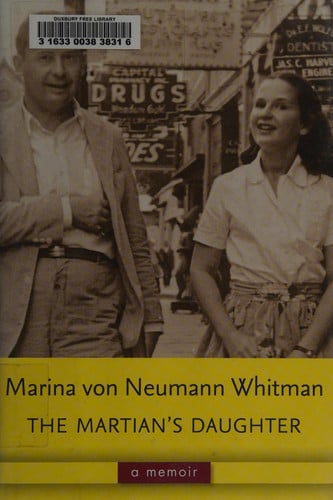
The Martian's daughter: a memoir

Whitman, Marina von Neumann
One of the five Hungarian scientific geniuses dubbed "the Martians" by their colleagues, John von Neumann is often hailed as the greatest mathematician of the twentieth century and even as the greatest scientist after Einstein. He was a key figure in the Manhattan Project; the inventor of game theory; the pioneer developer of the modern stored-program electronic computer; and an adviser to the top echelons of the American military establishment. In The Martian's Daughter , Marina von Neumann Whitman reveals intimate details about the famed scientist and explores how the cosmopolitan environment in which she was immersed, the demanding expectations of her parents, and her own struggles to emerge from the shadow of a larger-than-life parent shaped her life and work. Unfortunately, von Neumann did not live to see his daughter rise to become the first or highest-ranking woman in a variety of arenas. Whitman became a noted academic during the 1960s and '70s, casting her teaching and writing in the framework of globalization before the word had been invented; became the first woman ever to serve on the President's Council of Economic Advisers and participated actively in U.S. efforts to reshape the international monetary and financial system during the early 1970s; pioneered the role of women on the boards of leading multinational corporations; and became the highest-ranking female executive in the American auto industry in the 1980s. In her memoir, Whitman quotes from personal letters from her father and describes her interactions with such figures as Roger Smith of GM and President Nixon. She also details the difficulties she encountered as an early entrant into a world dominated by men and how she overcame the obstacles to, in her words, "have it all."
University of Michigan Press 2012-08-31 308 pages

Out of the ghetto: the social background of Jewish emancipation, 1770-1870

Katz, Jacob
Out of the Ghetto is an account of the developing interrelationship between the Jews and their Gentile environment unique in its breadth and objectivity. He presents the story of Jewish emancipation as a whole, from both Jewish and non-Jewish points of view. If the results of the Jewish emancipation process differed from country to country, the forces effecting the changes were identical—the upheaval of the French Revolution, the loosening of bonds between church and state, and the ideas of the Enlightenment. It was those humanistic ideas which made possible the Jew's transition from the ghetto to partial inclusion in society at large and which attracted Jewish intellectuals to the "secular knowledge" of languages, mathematics, philosophy, and the wider world beyond their ancient learning.
Syracuse University Press 1998-11-01 271 pages

When Sonia met Boris: an oral history of Jewish life under Stalin

Shternshis, Anna
Russian-speaking Jews from the former Soviet Union are a peculiarity in the Jewish world. After decades living in a repressive, nominally atheistic state, these Jews did manage to retain a strong sense of Jewish identity - but one that was almost completely divorced from Judaism. Today, more than ten percent of Jews speak or understand Russian, signaling the importance of an ever-vexing question: why are Russian Jews the way they are? In pursuit of an answer, Anna Shternshis's groundbreaking When Sonia Met Boris: An Oral History of Jewish Life under Stalin draws on nearly 500 oral history interviews on the Soviet Jewish experience with Soviet citizens who were adults by the 1940s. Soviet Jews lived through tumultuous times: the Great Terror, World War II, the anti-Semitic policies of the postwar period, and the collapse of the Soviet Union. But, like millions of other Soviet citizens, they married, raised children, and built careers, pursuing life as best they could in a profoundly hostile environment. One of the first scholars to record and analyze oral testimonies of Soviet Jews, Shternshis unearths heartbreaking, deeply poignant, and often funny stories of the everyday choices Jews were forced to navigate as a repressed minority living in a totalitarian regime. Shternshis reveals how ethnicity rapidly transformed into a disability, as well as a negative characteristic, for Soviet Jews in the postwar period, and shows how it was something they needed desperately to overcome in order to succeed. That sense of self has persisted well into the twenty-first century, and has impacted the Jewish identities of the children and grandchildren of Shternshis's subjects, the foundational generation of contemporary Russian Jewish culture. An illuminating work of social and cultural history, When Sonia Met Boris traces the fascinating contours of contemporary Russian Jewish identity back to their very roots.
Oxford University Press 2021 247 pages

Reassessing Jewish life in Medieval Europe

Chazan, Robert
"This book re-evaluates the prevailing notion that Jews in medieval Christian Europe lived under an appalling regime of ecclesiastical limitation, governmental exploitation and expropriation, and unceasing popular violence. Robert Chazan argues that, while Jewish life in medieval Western Christendom was indeed beset with grave difficulties, it was nevertheless an environment rich in opportunities; the Jews of medieval Europe overcame obstacles, grew in number, explored innovative economic options, and fashioned enduring new forms of Jewish living. His research also provides a reconsideration of the legacy of medieval Jewish life, which is often depicted as equally destructive and projected as the underpinning of the twentieth-century catastrophes of antisemitism and the Holocaust. Dr Chazan's research proves that, although Jewish life in the medieval West laid the foundation for much Jewish suffering in the post-medieval world, it also stimulated considerable Jewish ingenuity, which lies at the root of impressive Jewish successes in the modern West"--
Cambridge University Press 2010-09-27 270 pages

Jewish choices, Jewish voices

Elliot N. Dorff,Danya Ruttenberg,Louis E. Newman
How do we expand health care coverage to more Americans? Are hate crimes legislation and affirmative action fair? What sacrifices must we make to protect the environment? Is the death penalty morally acceptable? Contributors include Jill Jacobs, of Jewish Funds for Justice; Arthur Waskow, director of The Shalom Center; and TV commentator and UCLA law professor Laurie Levenson. Each volume in this series presents hypothetical cases on specific topics, followed by traditional and contemporary sources. Supplementing these are brief essays, written by contributors of various ages, backgrounds, and viewpoints to provoke lively thought and discussion. These voices from Jewish tradition and today’s Jewish community present us with new questions and perspectives, encouraging us to consider our own moral choices in a new light.
The Jewish Publication Society 2008 156 pages

Mediating modernity: challenges and trends in the Jewish encounter with the modern world : essays in honor of Michael A. Meyer

Lauren B. Strauss,Michael Brenner
In Mediating Modernity, contemporary Jewish scholars pay tribute to Michael A. Meyer, scholar of German-Jewish history and the history of Reform Judaism, with a collection of essays that highlight growing diversity within the discipline of Jewish studies. The occasion of Meyer's seventieth birthday has served as motivation for his colleagues Lauren B. Strauss and Michael Brenner to compile this volume, with essays by twenty-four leading academics, representing institutions in five countries. Mediating Modernity is introduced by an overview of modern Jewish historiography, largely drawing on Meyer's work in that field, delineating important connections between the writing of history and the environment in which it is written. Meyer's own areas of specialization are reflected in essays on Moses Mendelssohn, German-Jewish historiography, the religious and social practices of German Jews, Reform Judaism, and various Jewish communities in America. The volume's field of inquiry is broadened by essays that deal with gender issues, literary analysis, and the historical relationship of Israel and the Palestinians. Though other volumes have been compiled to honor Jewish historians, Mediating Modernity is unique in the personal and intellectual relationships shared by its contributors and Michael A. Meyer. Scholars of Jewish studies, German history, and religious history will appreciate this timely volume.
Wayne State University Press 2008 380 pages

American Jewry's challenge: conversations confronting the twenty-first century

Manfred Gerstenfeld
Watershed events - including the second Palestinian uprising in 2000, September 11 2001 and the Iraq war - have created major challenges for American Jewry, leading to changes in its perceptions and environment. Through conversations with some of America's most influential Jewish leaders, Manfred Gerstenfeld sheds light on the how the tumultuous events of recent years have affected and will continue to influence the American Jewish population. These include issues surrounding education, assimilation and revitalization, relationships with other religious communities, anti-Semitism and generational change. Of enormous historical value, American Jewry's Challenge serves as a time capsule capturing American Jewry at the dawn of the 21st century.
Rowman & Littlefield 2005-01-26 305 pages