29 results for "Environment"

Our revolution: a future to believe in

Sanders, Bernie
"When Bernie Sanders began his race for the presidency, it was considered by the political establishment and the media to be a "fringe" campaign, something not to be taken seriously. After all, he was just an independent senator from a small state with little name recognition. His campaign had no money, no political organization, and it was taking on the entire Democratic Party establishment. By the time Sanders's campaign came to a close, however, it was clear that the pundits had gotten it wrong. Bernie had run one of the most consequential campaigns in the modern history of the country. He had received more than 13 million votes in primaries and caucuses throughout the country, won twenty-two states, and more than 1.4 million people had attended his public meetings. Most important, he showed that the American people were prepared to take on the greed and irresponsibility of corporate America and the 1 percent. In Our Revolution, Sanders shares his personal experiences from the campaign trail, recounting the details of his historic primary fight and the people who made it possible. And for the millions looking to continue the political revolution, he outlines a progressive economic, environmental, racial, and social justice agenda that will create jobs, raise wages, protect the environment, and provide health care for all--and ultimately transform our country and our world for the better. For him, the political revolution has just started. The campaign may be over, but the struggle goes on"--Provided by publisher.
Thomas Dunne Books 2017-08-29 450 pages

On Fire The (Burning) Case for a Green New Deal

Naomi Klein
#1 New York Times and internationally bestselling author Naomi Klein makes the case for a Green New Deal in this “keenly argued, well-researched, and impassioned” manifesto ( The Washington Post ). An instant bestseller, On Fire shows Klein at her most prophetic and philosophical, investigating the climate crisis not only as a profound political challenge but also as a spiritual and imaginative one. Delving into topics ranging from the clash between ecological time and our culture of “perpetual now,” to the soaring history of humans changing and evolving rapidly in the face of grave threats, to rising white supremacy and fortressed borders as a form of “climate barbarism,” this is a rousing call to action for a planet on the brink. An expansive, far-ranging exploration that sees the battle for a greener world as indistinguishable from the fight for our lives, On Fire captures the burning urgency of the climate crisis, as well as the fiery energy of a rising political movement demanding a catalytic Green New Deal. “Naomi Klein’s work has always moved and guided me. She is the great chronicler of our age of climate emergency, an inspirer of generations.” —Greta Thunberg, climate activist "If I were a rich man, I’d buy 245 million copies of Naomi Klein’s 'On Fire' and hand-deliver them to every eligible voter in America…Klein is a skilled writer." —Jeff Goodell, The New York Times
Simon and Schuster 2020-09-01 336 pages

Where We Go from Here

Bernie Sanders
BERNIE'S BLUEPRINT FOR 2020. AN INSTANT NATIONAL BESTSELLER. In Where We Go from Here, New York Times bestselling author Bernie Sanders reveals the blueprint for his 2020 presidential run by chronicling the day-by-day struggles that he and his progressive colleagues have waged over the last two years in the fight against Donald Trump's reactionary agenda and for a government that works for all, not just wealthy campaign contributors. At home, Sanders has helped lead the fight for Medicare for all, fought for workers desperate for higher wages, and supported immigrants in the DACA program and children affected by gun violence. He has stood with the people of Puerto Rico devastated by Hurricane Maria, as well as veterans, teachers, the incarcerated, the persecuted, and all those who are too often ignored by Washington. Abroad, his voice has been clear that we need a foreign policy that strives for peace—not war—and international cooperation to address the crisis of climate change. The good news is we're making progress. People all across America are standing up to the most dishonest and reactionary president in our history. They're taking on establishment politicians who've turned a blind eye to the concerns of everyday citizens. They're fighting back against the oligarchs of Wall Street, who would happily see our children do worse than their parents so long as the Dow does better. And the general public continually demonstrates that we are more united than the media would allow us to believe, and what we agree on are largely progressive ideals. Maintaining a vibrant democracy has never been easy, and in these dangerous and unprecedented times, it has been more difficult than ever. Bernie Sanders shows, however, that we can repair the damage Trump has done—and create a nation based on the principles of economic, social, racial, and environmental justice.
St. Martin's Publishing Group 2019-09-03 288 pages

Fake President Decoding Trump's Gaslighting, Corruption, and General Bullsh*t

Mark Green,Ralph Nader
"Read Fake President ….This book can help us replace Trump with truth." —Gloria Steinem "Terrific new book . Fake President informs as it entertains." -- Laurence Tribe ​ An incisive, witty roadmap into the disinformation and betrayals of President Trump—just in time for the impeachment hearings and the 2020 election. Donald Trump was lawfully selected as the US president...but is still a "fake" president because he simply lacks the integrity, intelligence, and stability to perform the duties of the office as the Constitution intended. "If you spend so much time golfing, tweeting, and seething," write Green and Nader, "it's understandable that a POTUS doesn't get around to appointing one-third of all agency inspector generals...Might as well expect a surgeon to be an opera singer." As the House Impeachment Inquiry unfolds based on a similar premise , Fake President decodes many of his worst scandals and "twistifications" (a Jefferson coinage). And it’s bound to get even worse as the House gets closer to actual Articles of Impeachment and the Fall election approaches. Since it's nearly impossible to keep track of Trump's "daily lava of lies," two of America’s foremost public advocates do that work for you. This is your one-stop shop that explains what the Lyin' King means to our democracy. It’s a cheeky, deadly rebuke of Trump’s incorrigible "fakery"...from his dishonesty about foreign policy to blatant ignorance about the environment to his messianic narcissism. Fake President is an essential guide to help you understand the two biggest news stories of the coming year—impeachment and the 2020 presidential election.
Skyhorse 2019-12-03 304 pages

The encyclopedia of trouble and spaciousness

Solnit, Rebecca
The incomparable Rebecca Solnit, author of more than a dozen acclaimed, prizewinning books of nonfiction including Men Explain Things To Me , brings the same dazzling writing to the essays in The Encyclopedia of Trouble and Spaciousness ; hailed by the Los Angeles Times as "globally wide-ranging and topically urgent and the Boston Globe as "luminous and precise.". As the title suggests, the territory of Solnit's concerns is vast, and in her signature alchemical style she combines commentary on history, justice, war and peace, and explorations of place, art, and community, all while writing with the lyricism of a poet to achieve incandescence and wisdom. Gathered here are celebrated iconic essays along with little-known pieces that create a powerful survey of the world we live in, from the jungles of the Zapatistas in Mexico to the splendors of the Arctic. This rich collection tours places as diverse as Haiti and Iceland; movements like Occupy Wall Street and the Arab Spring; an original take on the question of who did Henry David Thoreau's laundry; and a searching look at what the hatred of country music really means. Solnit moves nimbly from Orwell to Elvis, to contemporary urban gardening to 1970s California macramé and punk rock, and on to searing questions about the environment, freedom, family, class, work, and friendship. It's no wonder she's been compared in Bookforum to Susan Sontag and Annie Dillard and in the San Francisco Chronicle to Joan Didion. The Encyclopedia of Trouble and Spaciousness proves Rebecca Solnit worthy of the accolades and honors she's received. Rarely can a reader find such penetrating critiques of our time and its failures leavened with such generous heapings of hope. Solnit looks back to history and the progress of political movements to find an antidote to despair in what many feel as lost causes. In its encyclopedic reach and its generous compassion, Solnit's collection charts a way through the thickets of our complex social and political worlds. Her essays are a beacon for readers looking for alternative ideas in these imperiled times.
Trinity University Press 2015 334 pages

Common Wealth

Jeffrey D. Sachs
“Lucid, quietly urgent, and relentlessly logical . . . this is Bigthink with a capital B.” —The New York Times Book Review “Common Wealth explains the most basic economic reckoning that the world faces.” —Al Gore, winner of the 2007 Nobel Peace Prize and former vice president of the United States In Common Wealth, Jeffrey D. Sachs-one of the world's most respected economists and the author of The New York Times bestseller The End of Poverty- offers an urgent assessment of the environmental degradation, rapid population growth, and extreme poverty that threaten global peace and prosperity. Through crystalline examination of hard facts, Sachs predicts the cascade of crises that awaits this crowded planet-and presents a program of sustainable development and international cooperation that will correct this dangerous course. Few luminaries anywhere on the planet are as schooled in this daunting subject as Sachs, and this is the vital product of his experience and wisdom.
Penguin US 2008-03-18 400 pages

Building the New American Economy Smart, Fair, and Sustainable

Jeffrey D. Sachs
In this passionate and powerful book--part manifesto, part plan of action--the renowned economist Jeffrey D. Sachs offers a practical strategy to move America, seemingly more divided than ever, toward a new consensus: sustainable development. Sustainable development is a holistic approach that emphasizes economic, social, and environmental objectives in shaping policy. In focusing too much on economic growth, the United States has neglected rising economic inequality and dire environmental threats. Now, even growth is imperiled. Sachs explores issues that have captivated the nation and political debate, including infrastructure, trade deals, energy policy, the proper size and role of government, the national debt, and income inequality. Not only does he provide illuminating and accessible explanations of the forces at work in each case, but he also presents specific policy solutions. His argument rises above the pessimism born of political paralysis, economic stagnation, and partisanship to devise a brighter way forward, achievable both individually and collectively. In Building the New American Economy , Sachs shows how the United States can find a path to renewed economic progress that is fair and environmentally sustainable.
Columbia University Press 2018-03-20 130 pages

Great Society A New History

Amity Shlaes
The New York Times bestselling author of The Forgotten Man and Coolidge offers a stunning revision of our last great period of idealism, the 1960s, with burning relevance for our contemporary challenges. "Great Society is accurate history that reads like a novel, covering the high hopes and catastrophic missteps of our well-meaning leaders." --Alan Greenspan Today, a battle rages in our country. Many Americans are attracted to socialism and economic redistribution while opponents of those ideas argue for purer capitalism. In the 1960s, Americans sought the same goals many seek now: an end to poverty, higher standards of living for the middle class, a better environment and more access to health care and education. Then, too, we debated socialism and capitalism, public sector reform versus private sector advancement. Time and again, whether under John F. Kennedy, Lyndon Johnson, or Richard Nixon, the country chose the public sector. Yet the targets of our idealism proved elusive. What's more, Johnson's and Nixon's programs shackled millions of families in permanent government dependence. Ironically, Shlaes argues, the costs of entitlement commitments made a half century ago preclude the very reforms that Americans will need in coming decades. In Great Society, Shlaes offers a powerful companion to her legendary history of the 1930s, The Forgotten Man, and shows that in fact there was scant difference between two presidents we consider opposites: Johnson and Nixon. Just as technocratic military planning by "the Best and the Brightest" made failure in Vietnam inevitable, so planning by a team of the domestic best and brightest guaranteed fiasco at home. At once history and biography, Great Society sketches moving portraits of the characters in this transformative period, from U.S. Presidents to the visionary UAW leader Walter Reuther, the founders of Intel, and Federal Reserve chairmen William McChesney Martin and Arthur Burns. Great Society casts new light on other figures too, from Ronald Reagan, then governor of California, to the socialist Michael Harrington and the protest movement leader Tom Hayden. Drawing on her classic economic expertise and deep historical knowledge, Shlaes upends the traditional narrative of the era, providing a damning indictment of the consequences of thoughtless idealism with striking relevance for today. Great Society captures a dramatic contest with lessons both dark and bright for our own time.
HarperCollins Publishers 2020-11-24 528 pages

Troubled Water What's Wrong with What We Drink

Seth M. Siegel
New York Times bestselling author Seth M. Siegel shows how our drinking water got contaminated, what it may be doing to us, and what we must do to make it safe. If you thought America’s drinking water problems started and ended in Flint, Michigan, think again. From big cities and suburbs to the rural heartland, chemicals linked to cancer, heart disease, obesity, birth defects, and lowered IQ routinely spill from our taps. Many are to blame: the EPA, Congress, a bipartisan coalition of powerful governors and mayors, chemical companies, and drinking water utilities—even NASA and the Pentagon. Meanwhile, the bottled water industry has been fanning our fears about tap water, but bottled water is often no safer. The tragedy is that existing technologies could launch a new age of clean, healthy, and safe tap water for only a few dollars a week per person. Scrupulously researched, Troubled Water is full of shocking stories about contaminated water found throughout the country and about the everyday heroes who have successfully forced changes in the quality and safety of our drinking water. And it concludes with what America must do to reverse decades of neglect and play-it-safe inaction by government at all levels in order to keep our most precious resource safe.
St. Martin's Publishing Group 2020-11-10 352 pages

Thought Reform and the Psychology of Totalism A Study of Brainwashing in China

Robert Jay Lifton
2014 Reprint of 1961 Edition. Full facsimile of the original edition, not reproduced with Optical Recognition Software. Lifton's research for the book began in 1953 with a series of interviews with American servicemen who had been held captive during the Korean War. In addition to interviews with 25 Americans, Lifton also interviewed 15 Chinese who had fled their homeland after having been subjected to indoctrination in Chinese universities. From these interviews, which in some cases occurred regularly for over a year, Lifton identified the tactics used by Chinese communists to cause drastic shifts in one's opinions and personality and "brainwash" American soldiers into making demonstrably false assertions. This work has become a classic text in the field and continues to serve as a fundamental guide in the debriefing of former cult members. Lifton's famous eight criteria for thought control are: Milieu Control. This involves the control of information and communication both within the environment and, ultimately, within the individual, resulting in a significant degree of isolation from society at large. Mystical Manipulation. There is manipulation of experiences that appear spontaneous but in fact were planned and orchestrated by the group or its leaders in order to demonstrate divine authority or spiritual advancement or some special gift or talent that will then allow the leader to reinterpret events, scripture, and experiences as he or she wishes. Demand for Purity. The world is viewed as black and white and the members are constantly exhorted to conform to the ideology of the group and strive for perfection. The induction of guilt and/or shame is a powerful control device used here. Confession. Sins, as defined by the group, are to be confessed either to a personal monitor or publicly to the group. There is no confidentiality; members' "sins," "attitudes," and "faults" are discussed and exploited by the leaders. Sacred Science. The group's doctrine or ideology is considered to be the ultimate Truth, beyond all questioning or dispute. Truth is not to be found outside the group. The leader, as the spokesperson for God or for all humanity, is likewise above criticism. Loading the Language. The group interprets or uses words and phrases in new ways so that often the outside world does not understand. This jargon consists of thought-terminating clichés, which serve to alter members' thought processes to conform to the group's way of thinking. Doctrine over person. Member's personal experiences are subordinated to the sacred science and any contrary experiences must be denied or reinterpreted to fit the ideology of the group. Dispensing of existence. The group has the prerogative to decide who has the right to exist and who does not. This is usually not literal but means that those in the outside world are not saved, unenlightened, unconscious and they must be converted to the group's ideology. If they do not join the group or are critical of the group, then they must be rejected by the members. Thus, the outside world loses all credibility. In conjunction, should any member leave the group, he or she must be rejected also.
Martino Fine Books 2014-07-24 522 pages

Does America Need a Foreign Policy?

Dr Henry A Kissinger
In a timely, lucidly written, and highly accessible examination of America's position in the world today, Henry Kissinger delves into the traditional issues of U.S. relations with Russia, China, Europe, and other regions, as well as recently emerging concerns about globalization, free trade, U.S. military involvement abroad, and the endangered environment. Focusing on current and future policy choices, Kissinger presents an eye-opening perspective on the United States' role as the world's dominate power and outlines how it can be effectively reconciled with the urgent need to achieve a world order based on consensus in the twenty-first century. The new administration's approach to foreign policy has raised many questions about where the country is headed. In a proposal that is solidly grounded and brilliantly argued, Kissinger lays out a compelling and comprehensive vision of the direction America must take in the coming decades.
Turtleback Books 2002-09

Audacity How Barack Obama Defied His Critics and Created a Legacy That Will Prevail

Jonathan Chait
An unassailable case that, in the eyes of history, Barack Obama will be viewed as one of America’s best and most accomplished presidents. Over the course of eight years, Barack Obama has amassed an array of outstanding achievements. His administration saved the American economy from collapse, expanded health insurance to millions who previously could not afford it, negotiated an historic nuclear deal with Iran, helped craft a groundbreaking international climate accord, reined in Wall Street and crafted a new vision of racial progress. He has done all of this despite a left that frequently disdained him as a sellout, and a hysterical right that did everything possible to destroy his agenda even when they agreed with what he was doing. Now, as the page turns to our next Commander in Chief, Jonathan Chait, acclaimed as one of the most incisive and meticulous political commentators in America, digs deep into Obama’s record on major policy fronts—economics, the environment, domestic reform, health care, race, foreign policy, and civil rights—to demonstrate why history will judge our forty-fourth president as among the greatest in history. Audacity does not shy away from Obama’s failures, most notably in foreign policy. Yet Chait convincingly shows that President Obama has accomplished what candidate Obama said he would, despite overwhelming opposition—and that the hopes of those who voted for him have not been dashed despite the smokescreen of extremist propaganda and the limits of short-term perspective.
HarperCollins 2017-01-24 384 pages

Managing the Global Commons The Economics of Climate Change

William D. Nordhaus
Provides a detailed analysis of the DICE model (Dynamic Integrated model of Climate and the Economy) as well as an extensive analysis of the model's results. Coping with the challenges of global warming is a daunting task for both scientists and economists, who must understand future changes, and for policy makers, who must ultimately choose policies to balance risks and costs. Managing the Global Commons presents a unique effort to encompass economic, scientific, and policy aspects of this great geophysical experiment. Managing the Global Commons provides a detailed analysis of the DICE model (Dynamic Integrated model of Climate and the Economy) as well as an extensive analysis of the model's results. DICE is the first dynamic model to include a closed-loop system that includes emissions, concentrations, climate change, damages, and emissions controls. The model is useful for estimating the costs and benefits of different paths for slowing climate change and for analyzing the impact of control strategies over time. The analysis contains a number of methodological advances and major findings - most importantly the construction of a small model to encompass the primary components of the climate and economic system within an optimization framework. Also included are new techniques and results concerning the role of uncertainty and the risk premium involved in policies to slow global warming. In addition, the analysis derives a set of uncertain representative scenarios that summarize the large number of potential outcomes into a manageable number to be used within an optimization framework and incorporated into a contingent-commodity framework. Nordhaus examines several different approaches to climate-change policy: no controls, economic optimization, geoengineering, stabilization of emissions and climate, and a ten-year delay in undertaking climate-change policies. Among these, there is a modest advantage of an efficient policy over no controls or a ten-year delay, while the three stabilization options would impose significant net costs. Overall, Nordhaus observes, the analysis reveals that even with major technological breakthroughs and stringent controls, the momentum of past greenhouse gas emissions coupled with great inertia in climate change policy will lead to an inevitable rendezvous with massive climate change.
MIT Press 1994 224 pages

Forcing the Spring The Transformation of the American Environmental Movement

Robert Gottlieb
"Forcing the Spring" challenges standard histories of the environmental movement by offering a broad and inclusive interpretation of past environmentalist thought and a sweeping redefinition of the nature of the contemporary environmental movement. Robert Gottlieb demonstrates the centrality of environmental concerns to a wide range of social movements of the past century as he explores the connections between pressures on human and natural environments and the role of these pressures in shaping society. His analysis provides fundamental new insights into the past and future of the American environmental movement by placing it within the larger context of American social history.After considering the historical roots of environmentalism from the 1890s through the 1960s, Gottlieb discusses the rise and consolidation of environmental groups in the years between Earth Day 1970 and Earth Day 1990. He examines the increasing professionalization of the major environmental organizations and the parallel rise of community-based groups over the past decade, and ends with an in-depth consideration of the role of ethnicity, gender, and class in the formation and definition of movements.
Island Press 1993 413 pages

What is politics? the activity and its study

Adrian Leftwich
What is politics? Is it a universal feature of all human societies, past and present? Is it tied to specific institutional arenas? Or is it found in all groups and organizations, large or small, formal or informal? This new textbook seeks to provide answers to these important questions. Starting with what it means to 'think politically', the book goes on to explore a wide range of meanings attributed to the concept of politics from a variety of perspectives and theoretical traditions. It offers succinct and coherent overviews by some of the foremost scholars in the field, and each invites the reader to see the activity of politics in a distinctive way. Topics covered include politics as a form of rule, feminist approaches to politics, Marxism and politics, the politics of human behaviour, environmental politics, politics as collective choice, and Islam and politics. Written with the new student in mind, this concise introduction to the study and activity of politics is essential reading for all those coming to the discipline for the first time.
Polity 2004-09-03 199 pages

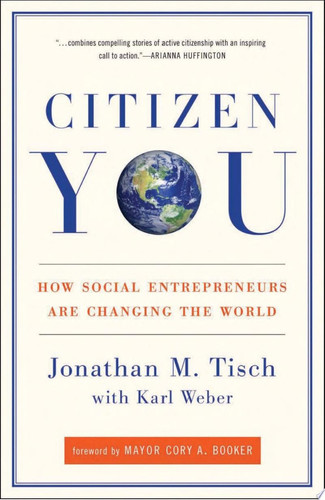
Citizen You How Social Entrepreneurs Are Changing the World

Jonathan Tisch,Karl Weber
Just when the world needs it most, a new style of social engagement is emerging: Active Citizenship. A key member of one of New York’s most civic-minded families—one that has supported many of America’s notable institutions and deserving programs—Jonathan Tisch has devoted a lifetime to “active citizenship.” It’s an idea that uses the power of practical creativity and grassroots participation to solve seemingly intractable problems. In Citizen You , Tisch challenges readers to join this movement and points the way toward making our world a better place, one person and one neighborhood at a time. Tisch has filled Citizen You with accounts of people who you’ll meet, such inspirational individuals as: Scott Harrison, who has used the networking and marketing skills he developed as a night club promoter to help over a million people in the developing world get access for the first time to clean, safe drinking water. Steffi Coplan, whose Broadway2Broadway project brought out the hidden musical talents of kids at an inner city school. Eric Schwarz, who decided to do something about America’s under-performing schools, and parlayed a single classroom mentoring project into the nationwide Citizens Schools movement. Chris Swan, who is training a new generation of “citizen engineers” to make sure that the projects they build aren’t just structurally sound but also environmentally and socially sustainable. Dave Nelson, who traded his role as an executive at IBM for a job at a struggling nonprofit that teaches kids about the power of entrepreneurship—and discovered a host of new challenges and rewards in the process. Through these and many other remarkable stories, you’ll learn how today’s active citizens are transforming thinking about social change. Rather than short-term fixes and hand-me-down charity, they’re striving to build sustainable, systemic solutions to our most challenging problems, building and empowering communities rather than fostering dependency. And they’re using a host of new tools, from online networking and private-public partnerships to corporate engagement and social entrepreneurship, to redefine how change can happen. Citizen You is a potent antidote to pessimism. At a time of unprecedented challenges on the national and world stage, when active citizenship is not a choice but a necessity, Citizen You dares us to reshape the social, political, and intellectual structures that have long confined us, and offers fresh thinking that redefines the very concept of activism. For more information and ideas about how to be an active citizen go to www.citizenyou.org
Crown 2011-05-03 288 pages

Humanity on a Tightrope Thoughts on Empathy, Family, and Big Changes for a Viable Future

Paul R. Ehrlich,Robert E. Ornstein
When we think of family, we most often think of our sisters and brothers, our cousins and grandparents, rather than our world family or even our community connections. We still identify with our differences more than our similarities, unless it's convenient to do otherwise. Here, two seasoned authors tackle the question of family and what it means to us now and how it might change to help us address the problems that affect us all. Using specific examples throughout the work, they present a unique approach to what it means to belong to one human family. Beginning with a consideration of how the family unit has begun to be defined by allegiances, by common ties and empathy, the authors then discuss the evolution of the family unit and how the "us" vs. "them" mentality gave way to a way of life that separated peoples rather than brought them together. They consider family values, how they arose, developed, were perverted or perfected to suit the family unit's needs, and the confusion that followed. Humanity on a Tightrope focuses on what families and family values are, and how they often create an "us versus them" mentality that is at the root of many of today's most crucial problems from terrorism, racism, and war to the failure of humanity to come to grips with potentially lethal global environmental problems. The book underlines a basic element for solving the human predicament - quickly spreading the domain of empathy. It takes a close look at how we can do that, building on the findings of both social and natural science and using tools ranging from brain imaging to the internet. It explains how civilization is unlikely to persist unless many more people learn to put themselves in the shoes of others to keep society balancing on the tightrope to sustainability - a tightrope suspended over the collapse of civilization.
Bloomsbury Academic 2012-03-16 210 pages

Can global capitalism endure?

Robinson, William I.
"Global capitalism is facing an unprecedented crisis. The global economy is mired in prolonged stagnation. The worldwide social fabric is in decay. Civil strife and social upheaval are tearing up political systems and, in some cases, leading to the collapse of states. The planetary ecosystem is breaking down. Millions are fleeing, displaced by climate change, transnational corporate land grabs, wars and political persecution. How far into the future can global capitalism endure? In this urgent new study, sociologist William I. Robinson presents a "big picture" snapshot of the crisis of capitalism and the battle for the future of humanity. Drawing on 30 years of scholarship and activism, Robinson applies his original theory of global capitalism to the emerging digital age. He shows how global elites have pinned their hope on economic reactivation through the application of radical new digital technologies and financial strategies to the global economy and society. The rulers will turn to enhancing a global police state to contain mass rebellion as humanity enters a season of chaos and global civil war. The capitalist class and privileged strata of humanity may be able to survive collapse for decades to come even as a majority of humanity faces desperate struggles for survival that lead many to perish in the coming years. But there is eventually a terminal point to capitalist expansion as mass extinction and the radical alteration of the natural environment make life for our species and most others impossible. The only solution is a reversal of escalating inequalities through a radical redistribution of wealth and power downward as a first step in replacing the capitalist system, with its relentless pursuit of private profit at all cost, by an ecosocialism that prioritizes social need and harmony with the rest of nature. Theoretically sophisticated and engaging, this concise study will be satisfying to scholars yet accessible to a broader public concerned with the urgent political affairs of our day"--
Clarity Press, Inc 2022-08 114 pages

Contemporary Chinese politics: new sources, methods, and field strategies

Allen Carlson,Mary E. Gallagher,Kenneth Lieberthal,Melanie Manion
"Contemporary Chinese Politics: Sources, Methods, and Field Strategies considers how new and diverse sources and methods are changing the study of Chinese politics. Contributors spanning three generations in China studies place their distinct qualitative and quantitative methodological approaches in the framework of the discipline and point to challenges or opportunities (or both) of adapting new sources and methods to the study of contemporary China. How can we more effectively use new sources and methods of data collection? How can we better integrate the study of Chinese politics into the discipline of political science, to the betterment of both? How can we more appropriately manage the logistical and ethical problems of doing political research in the challenging Chinese environment? In addressing these questions, this comprehensive methodological survey will be of immense interest to graduate students heading into the field for the first time and experienced scholars looking to keep abreast of the state of the art in the study of Chinese politics"--
Cambridge University Press 2010-07-29 315 pages