10 results for "Evolution"

The Singularity Is Nearer

Kurzweil, Ray
"This successor volume to The Singularity Is Near explores how technology will refashion the human race in the decades to come. In this entirely new book, Ray Kurzweil brings a fresh perspective to advances in the singularity-assessing the progress of many of his predictions and examining the novel advancements that, in the near future, will bring a revolution in knowledge and an expansion of human potential. Among the topics he discusses are rebuilding the world atom by atom with devices like nanobots; radical life extension beyond the current age limit of 120; reinventing intelligence by expanding biological capacity with nonbiological intelligence in the cloud; how life is improving with declines in poverty and violence; and the growth of technologies that can be applied to everything from clothes to building materials to growing human organs. He also considers the potential perils of biotechnology, nanotechnology, and artificial intelligence, including such topics as how AI will impact unemployment and the safety of autonomous cars, and "After Life" technology, which will reanimate people who have passed away through a combination of data and DNA"--
Penguin USA 2025-06-03 432 pages

The mind's own physician: a scientific dialogue with the Dalai Lama on the healing power of meditation

Kabat-Zinn, Jon
Introduction: a confluence of streams and a flowering of possibilities -- Session 1. Meditation-based clinical interventions : science, practice, and implementation. How Buddhist meditative practices can inform our understanding of pain and suffering, the potential for healing, the relief of suffering, and the underlying nature of the human mind and body / Ajahn Amaro. Some clinical applications of mindfulness meditation in medicine and psychiatry : the case of mindfulness-based stress reduction (MBSR) / Jon Kabat-Zinn. Mind-brain-body interaction and meditation / Richard J. Davidson. Session 1 dialogue -- Session 2. Possible biological substrates of meditation. Synchronization of brain rhythms as a possible mechanism for the unification of distributed mental processes / Wolf Singer. The neurobiology of the adaptive and deleterious features of stress / Robert Sapolsky. Session 2 dialogue -- Session 3. Clinical research 1 : meditation and mental health. Mindfulness-based cognitive therapy and the prevention of relapse in recurrent depression / Zindel Segal. Paths to recovery : neural substrates of cognitive and mindfulness-based interventions for the treatment of depression / Helen Mayberg. Session 3 dialogue -- Interlude preceding session 4. The Buddhist science of human flourishing / Alan Wallace. Interlude dialogue -- Session 4. Clinical research 2 : meditation and physical health. Mindfulness-based stress reduction and cardiovascular disease / David Sheps. Neural-immune interaction / John Sheridan. Session 4 dialogue -- Session 5. Integration and final reflections. Meditation and the future of health care / Ralph Snyderman. Some reflections on the evolution and nature of mind and self and their implications for humanity / Wolf Singer. Session 5 dialogue
New Harbinger Publications 2013-08-31 268 pages

The future of the brain: the promise and perils of tomorrow's neuroscience

Rose, Steven P. R.
Brain repair, smart pills, mind-reading machines--modern neuroscience promises to soon deliver a remarkable array of wonders as well as profound insight into the nature of the brain. But these exciting new breakthroughs, warns Steven Rose, will also raise troubling questions about what it means to be human. In The Future of the Brain, Rose explores just how far neuroscience may help us understand the human brain--including consciousness--and to what extent cutting edge technologies should have the power to mend or manipulate the mind. Rose first offers a panoramic look at what we now know about the brain, from its three-billion-year evolution, to its astonishingly rapid development in the embryo, to the miraculous process of infant development. More important, he shows what all this science can--and cannot--tell us about the human condition. He examines questions that still baffle scientists and he explores the potential threats and promises of new technologies and their ethical, legal, and social implications, wondering how far we should go in eliminating unwanted behavior or enhancing desired characteristics, focusing on the new "brain steroids" and on the use of Ritalin to control young children. The Future of the Brain is a remarkable look at what the brain sciences are telling us about who we are and where we came from--and where we may be headed in years to come.
Oxford University Press 2006 344 pages

The global brain: the evolution of mass mind from the big bang to the 21st century

Bloom, Howard
In this extraordinary follow-up to the critically acclaimed The Lucifer Principle, Howard Bloom--one of today's preeminent thinkers offers us a bold rewrite of the evolutionary saga. As someone who has spent forty years in psychology with a long-standing interest in evolution, I'll just assimilate Howard Bloom's accomplishment and my amazement. David Smillie, Visiting Professor of Zoology, Duke University. He shows how plants and animals (including humans) have evolved together as components of a worldwide learning machine. He describes the network of life on Earth as one that is, in fact, a complex adaptive system, a global brain in which each of us plays a sometimes conscious, sometimes unknowing role, and he reveals that the World Wide Web is just the latest step in the development of this brain. These are theories as important as they are radical. Informed by twenty years of interdisciplinary research, Bloom takes us on a spellbinding journey back to the big bang to let us see how its fires forged primordial sociality. As he brings us back via surprising routes, we see how our earliest bacterial ancestors built multitrillion-member research and development teams a full 3.5 billion years ago. We watch him unravel the previously unrecognized strands of interconnectedness woven by crowds of trilobites, hunting packs of dinosaurs, feathered flying lizards gathered in flocks, troops of baboons making communal decisions, and adventurous tribes of protohumans spreading across continents but still linked by primitive forms of information networking. We soon find ourselves reconsidering our place in the world. Along the way, Bloom offers us exhilarating insights into the strange tricks of body and mind that have organized a variety of life forms: spiny lobsters, which, during the Paleozoic age, participated in communal marching rituals; and bees, which, during the age of dinosaurs, conducted collective brainwork. This fascinating tour continues on to the sometime brutal subculture wars that have spurred the growth of human civilization since the Stone Age. Bloom shows us how culture shapes our infant brains, immersing us in a matrix of truth and mass delusion that we think of as reality. Global Brain is more than just a brilliantly original contribution to the ongoing debate on the inner workings of evolution. It is a grand vision, says the eminent evolutionary biologist David Sloan Wilson, a work that transforms our very view of who we are and why.
Wiley 2000 370 pages

Neural Darwinism: the theory of neuronal group selection

Edelman, Gerald M.
Already the subject of considerable pre-publication discussion, this magisterial work by one of the nation's leading neuroscientists presents a radically new view of the function of the brain and nervous system. Its central idea is that the nervous system in each individual operates as a selective system resembling natural selection in evolution, but operating by different mechanisms. By providing a fundamental neural basis for categorization of the things of this world it unifies perception, action, and learning. The theory also completely revises our view of memory, which it considers to be a dynamic process of recategorization rather than a replicative store of attributes. This has deep implications for the interpretation of various psychological states from attention to dreaming. Neural Darwinism ranges over many disciplines, focusing on key problems in developmental and evolutionary biology, anatomy, physiology, ethology, and psychology. This book should therefore prove indispensable to advanced undergraduate and graduate students in these fields, to students of medicine, and to those in the social sciences concerned with the relation of behavior to biology. Beyond that, this far-ranging theory of brain function is bound to stimulate renewed discussions of such philosophical issues as the mind-body problem, the origins of knowledge, and the perceptual basis of language.
Basic Books 1987-12-06 371 pages

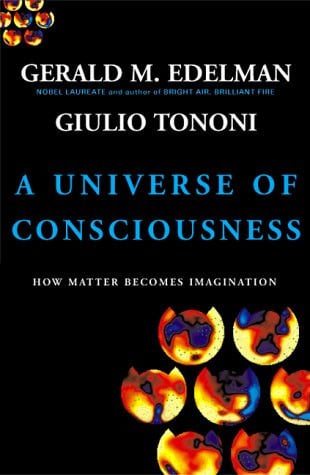
A universe of consciousness: how matter becomes imagination

Edelman, Gerald Maurice
In A Universe of Consciousness, Gerald Edelman builds on the radical ideas he introduced in his monumental trilogy-Neural Darwinism, Topobiology, and The Remembered Present-to present for the first time an empirically supported full-scale theory of consciousness. He and the neurobiolgist Giulio Tononi show how they use ingenious technology to detect the most minute brain currents and to identify the specific brain waves that correlate with particular conscious experiences. The results of this pioneering work challenge the conventional wisdom about consciousness.
Basic Books 2000 274 pages

Creativity: the human brain in the age of innovation

Goldberg, Elkhonon
Drawing on a number of cutting-edge discoveries from brain research as well as on his own insights as a neuroscientist and neuropsychologist, Goldberg presents a wide-ranging discussion of history, culture, and evolution to arrive at an original understanding of the nature of human creativity. He discusses the origins of language, the nature of several neurological disorders, animal cognition, virtual reality, and even artificial intelligence. Included are his bold predictions about the future directions of creativity and innovation in society, and how they will change the ways the human brain develops and ages
Oxford University Press 2018 274 pages