3 results for "Evolution"

The Races of Mankind

Ruth Benedict,Gene Weltfish
2020 Reprint of the 1943 Edition. Full facsimile of the original edition and not reproduced with Optical Recognition software. Published on October 25, 1943, The Races of Mankind makes the argument that all the world's humans are biologically the same. Written by anthropologists Ruth Benedict and Gene Weltfish and illustrated by Ad Reinhardt, The Races of Mankind attacked Nazi party racial policies and urged mankind to see past superficial differences and live in harmony. The pamphlet was a publication of The Public Affairs Committee, a non-profit educational organization whose purpose was "to make available in summary and inexpensive form the results of research on economic and social problems to aid in the understanding and development of American policy" (Benedict and Weltfish, 1943). The idea of scientific racial equality, however, was not met with universal agreement. When the U.S. Army ordered 55,000 copies, members of Congress labeled the pamphlet "communistic" and its use by the Army was banned. Still, the scientific pamphlet's popularity grew, and by 1945 three-quarters of a million copies were in circulation (Abraham, 2012).
Martino Fine Books 2020-04-20 36 pages

Politics in Black and White Race and Power in Los Angeles

Raphael Sonenshein
This book reaches deep into the past of the city of Los Angeles and carries through to the dramatic events that have recently received global attention--the Rodney King beating and the uprising in South Central L.A. Tracing the evolution of an extraordinary biracial coalition in Los Angeles behind Mayor Tom Bradley, Raphael Sonenshein shows how "crossover" politics and racial violence coexist in urban America. While challenging the prevailing pessimism about biracial coalitions in general, he also compares their relative successes in Los Angeles to their disheartening failures in New York City. What emerges is a probing look at a crucial issue of politics in the United States: can whites and minorities find common ground?
Princeton University Press 1993 301 pages

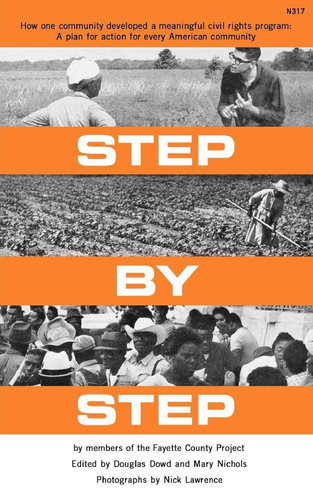
Step by Step Evolution and Operation of the Cornell Students' Civil-Rights Project in Tennessee, Summer, 1964

Douglas Dowd
The book arose out of the authors' experiences in a project which was itself unique: The Cornell-Tompkins Committee for Free and Fair Elections in Fayette County, Tennessee. The project entailed six to eight weeks of living in Fayette County by forty-five volunteers, mostly students from Cornell University, in the summer of 1964. The project was financed entirely, to an amount exceeding fifteen thousand dollars, by the contributions of students, faculty, and townspeople in and around Cornell University, and by contributions from more distant places solicited by those involved at Cornell.Of the many things learned from the Cornell project, one of the most important was how responsive a community can become when confronted with a concrete civil rights program, one with which it can identify, one small enough to be feasible and intelligible, but still compelling in terms of the needs involved.The authors believe that many thousands of Americans can find no good answer to the questions "What can I do." not because they are unwilling to do much, nor because there is little to be done, but because they lack the knowledge of what is needed where, and how and with whom one can go about responding to such needs. The book therefore undertakes, step by step, to describe and explain the development of the project at Cornell and its workings during the summer in Tennessee, and reasons that similar steps can be taken by others, with appropriate variations. It concludes with a detailed appendix listing civil rights projects and organizations desperately in need of help, whether in terms of money or volunteers or both.
W. W. Norton, Incorporated 1965-04 132 pages