5 results for "Evolution"

Doing Jewish theology: God, Torah & Israel in modern Judaism

Gillman, Neil
An Intellectually Rich and Challenging Exploration of Modern Jewish Theology "How we deal with revelation determines how we handle the issue of authority in belief and practice. How we understand authority determines how we deal with the claims of the tradition on us; how we deal with those claims determines how we shape our own Judaism. That conclusion opens the gate to a reconsideration of all of Judaism's theology, in particular how we understand God, for God is at the heart of Torah." --from the Introduction With clarity and passion, award-winning teacher, author and theologian Neil Gillman captures the power of Jewish theological claims and reveals extraordinary insights into Jewish identity, the purpose of religion, and our relationship with God. Drawing from Judaism's sacred texts as well as great thinkers such as Mordecai Kaplan, Abraham Joshua Heschel and Paul Tillich, Gillman traces his theological journey over four decades of study, beginning with his own understanding of revelation. He explores the role of symbol and myth in our understanding of the nature of God and covenant. He examines the importance of community in both determining authority and sanctifying sacred space. By charting the development of his own personal theology, Gillman explores the evolution of Jewish thought and its implications for modern Jewish religious identity today and in the future.
Jewish Lights Pub 2008 283 pages

The light of Christ: an introduction to Catholicism

White, Thomas Joseph
The Light of Christ provides an accessible presentation of Catholicism that is grounded in traditional theology, but engaged with a host of contemporary questions or objections. Inspired by the theologies of Iranaeus, Thomas Aquinas and John Henry Newman, and rooted in a post-Vatican II context, Fr. Thomas Joseph White presents major doctrines of the Christian religion in a way that is comprehensible for non-specialists: knowledge of God, the mystery of the Trinity, the Incarnation and the atonement, the sacraments and the moral life, eschatology and prayer. At the same time, The Light of Christ also addresses topics such as evolution, the modern historical study of Jesus and the Bible, and objections to Catholic moral teaching. Touching on the concerns of contemporary readers, Fr. White examines questions such as whether Christianity is compatible with the findings of the modern sciences, do historical Jesus studies disrupt or confirm the teaching of the faith, and does history confirm the antiquity of Catholic claims. This book serves as an excellent introduction for young professionals with no specialized background in theology who are interested in learning more about Catholicism, or as an introduction to Catholic theology. It will also serve as a helpful text for theology courses in a university context. As Fr. White states in the book’s introduction: “This is a book that offers itself as a companion. I do not presume to argue the reader into the truths of the Catholic faith, though I will make arguments. My goal is to make explicit in a few broad strokes the shape of Catholicism. I hope to outline its inherent intelligibility or form as a mystery that is at once visible and invisible, ancient and contemporary, mystical and reasonable.”
The Catholic University of America Press 2017-09-15 316 pages

Radical Judaism: rethinking God and tradition

Green, Arthur
How do we articulate a religious vision that embraces evolution and human authorship of Scripture? Drawing on the Jewish mystical traditions of Kabbalah and Hasidism, path-breaking Jewish scholar Arthur Green argues that a neomystical perspective can help us to reframe these realities, so they may yet be viewed as dwelling places of the sacred. In doing so, he rethinks such concepts as God, the origins and meaning of existence, human nature, and revelation to construct a new Judaism for the twenty-first century.
Yale University Press 2010 197 pages

Seek my face: a Jewish mystical theology

Green, Arthur
God and the Ways of Being --The Secret of the Sh'ma --God Above, God Within --The Two and the One --God as Y-H-W-H: "Is-was-will be" is one! --Speak my Name --Seeking God: Look First to Love --In God's Own Image: Seek My Face --Face to Face --Male and Female: An Excursus --One and Two --Creation --One God, two Ways --Creation and the Jewish Question --Creation and the Struggle for Faith --What Comes "First"? --Two Tales --The One and the Many --Who is at the Center? --Evolution: An Ongoing Process --From Aggadah to Halakhah --The First Mitzvah: Be Aware --In God's Image --Celebrating Creation: The Mitzvah of Shabbat --"To Work it and Guard it": Preserving God's World --Vegetarianism: A Kashrut for Our Age --Human Love and Human Pain --The Human Being: Bearer of Divine Compassion --Revelation --Y-H-W-H and Language --Before the Mountain --Human Understanding and Divine Speech --The Inner Mountain --Torah as the Name of God --Revelation and the Inward Journey --The Role of Covenant: A Reinterpretation --Revelation and Torah --Revelation, Will, and Law --The Personal Path: Accepting the Yoke --Sinai and Language --Sinai and Study --Sinai and Community --The Three Festivals: Sinai and the Sacred Cycle --The Word in Our Day --Redemption --The Light of the First Day --Crying Out for the Light --Redemption as Coming Home --The Bible: A Tale of Exile --Homecoming and Teshuvah --Teshuvah and the Sacred Year --The Redemptive Task: Getting to Work.
Jewish Lights 2003 269 pages

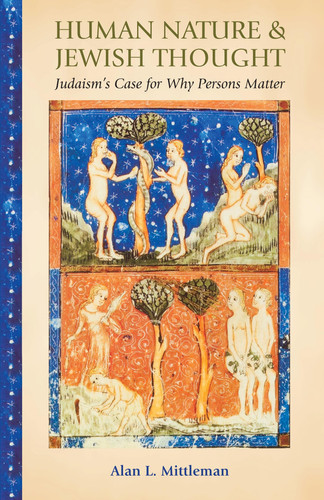
Human nature & Jewish thought: Judaism's case for why persons matter

Mittleman, Alan
This book explores one of the great questions of our time: How can we preserve our sense of what it means to be a person while at the same time accepting what science tells us to be true-namely, that human nature is continuous with the rest of nature? What, in other words, does it mean to be a person in a world of things? Alan Mittleman shows how the Jewish tradition provides rich ways of understanding human nature and personhood that preserve human dignity and distinction in a world of neuroscience, evolutionary biology, biotechnology, and pervasive scientism. These ancient resources can speak to Jewish, non-Jewish, and secular readers alike. Science may tell us what we are, Mittleman says, but it cannot tell us who we are, how we should live, or why we matter. Traditional Jewish thought, in open-minded dialogue with contemporary scientific perspectives, can help us answer these questions. Mittleman shows how, using sources ranging across the Jewish tradition, from the Hebrew Bible and the Talmud to more than a millennium of Jewish philosophy. Among the many subjects the book addresses are sexuality, birth and death, violence and evil, moral agency, and politics and economics. Throughout, Mittleman demonstrates how Jewish tradition brings new perspectives to-and challenges many current assumptions about-these central aspects of human nature. A study of human nature in Jewish thought and an original contribution to Jewish philosophy, this is a book for anyone interested in what it means to be human in a scientific age.
Princeton University Press 2015 215 pages