9 results for "Evolution"

Understanding socialism

Wolff, Richard D.
"Understanding Socialism is a plainspoken text that disarms false narratives, confronts past failures, and offers a path to a fresh and modern understanding of socialism, by outlining what democracy in the workplace could look like. Wolff not only explains what socialism is and has meant to its various proponents, he also looks at the transition from feudalism to capitalism as a model to help us visualize an evolution from our current socioeconomic state. Understanding Socialism explores how socialist theory was used and applied to help shape the histories of countries such as Russia and China, and beyond. Wolff also analyzes the successes and defeats of those countries, the world's reactions to them, and how they offer important lessons for the building of a democratic, worker-controlled 21st-century socialism."--Publisher description.
Haymarket Books 2025-12-09 156 pages

The Central Bank and the Financial System

Charles A. E. Goodhart,Charles A E Goodhart
As economic advisor to the Bank of England for many years, C. A. E. Goodhart is uniquely positioned to assess the role of the central bank in the modern financial system. This book brings together twenty-one of his previously published articles dealing with the changing functions of central banks over time, recent efforts to maintain price stability, and debates over specific financial regulation proposals in the UK. Although the current day-to-day operations of central banks are subject to continuous comment and frequent criticism, their structural role within the economic system as a whole has generally been accepted without much question, despite several attempts by economists in recent decades to challenge the value of the institution. C. A. E. Goodhart brings his knowledge of both the theoretical arguments and the actual working of central banks to bear in these essays. Part I looks at the general purposes and functions of central banks within the financial system and their evolution over time. Part II concentrates on the current objectives and operations of central banks, and the maintenance of price stability in particular. Part III analyzes the broader issues of financial regulation.
MIT Press 1995 542 pages

The self-organizing economy

Krugman, Paul R.
The Self-Organizing Economy In the last few years the concept of self-organizing systems—complex systems in which randomness and chaos seem spontaneously to evolve into unexpected order—has linked together researchers in many fields, from artificial intelligence to chemistry, from evolution to geology. Now leading economist Paul Krugman shows how principles that explain the growth of hurricanes and embryos can also explain the formation of cities and business cycles; how the same principles of “order from random growth” can explain the strangely simple rules that describe the sizes of earthquakes, meteorites, and metropolitan areas. Weaving together strands from many disciplines, from location theory to biology, The Self-Organizing Economy offers a surprising new view of how the economy structures itself in space and time.
Blackwell 1996-04-11 122 pages

Beyond the promised land: the movement and the myth

Noble, David F.
Iconoclast David F. Noble traces the evolution and eclipse of the biblical mythology of the Promised Land, the foundational story of Western Culture. Part impassioned manifesto, part masterful survey of opposed philosophical and economic schools, "Beyond the Promised Land" brings into focus the twisted template of the Western imagination and its faith-based market economy. From the first recorded versions of "the promise" saga in ancient Babylon, to the Zapatistas' rejection of promises never kept, Noble explores the connections between Judeo-Christian belief and corporate globalization. Inspiration for activists and students alike. David Noble is the author of "Progress Without People" (BTL, 1995) and "Digital Diploma Mills" (BTL, 2002). He teaches history at York University, Toronto.
Between the Lines 2005 214 pages

Hayek's modern family: classical liberalism and the evolution of social institutions

Horwitz, Steven
Scholars within the Hayekian-Austrian tradition of classical liberalism have done virtually no work on the family as an economic and social institution. In addition, there is a real paucity of scholarship on the place of the family within classical liberal and libertarian political philosophy. Hayek's Modern Family offers a classical liberal theory of the family, taking Hayekian social theory as the main analytical framework. Horwitz argues that families are social institutions that perform certain irreplaceable functions in society. These functions change as economic, political, and social circumstances change, and the family form adapts accordingly, kicking off the next wave of developments in the social structure. In Hayekian terms, the family is an evolving and undesigned social institution. Horwitz offers a non-conservative defense of the family as a social institution against the view that either the state or "the village" is able or required to take over its irreplaceable functions.
Palgrave Macmillan 2015 313 pages

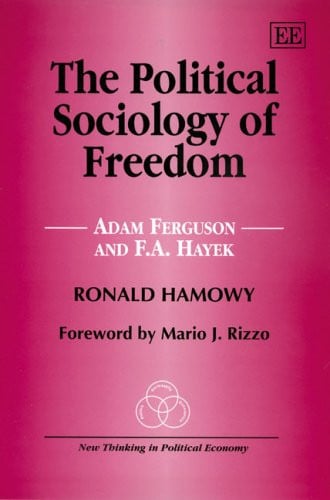
The political sociology of freedom: Adam Ferguson and F.A. Hayek

Hamowy, Ronald
Adam Ferguson and Friedrich Hayek, separated by a period of almost two hundred years, made original but similar contributions to the field of theoretical sociology. In this collection of essays, Ronald Hamowy explores the life and work of these two thinkers, giving special emphasis to their insights into the diffusion of knowledge. Ferguson, a giant of the Scottish Enlightenment, can be credited with laying the foundations of theoretical history by first proposing the idea that social institutions undergo evolutionary change. He theorized that while these institutions are formed by the actions of human beings, they are not the product of human design. Less than two centuries later, Hayek extended this insight to dealing with economic and social interaction, arguing that the knowledge requisite for structuring the social institutions under which we live is far too complex to be comprehended by any one mind or group of thinkers, and that these institutions had in fact evolved over long periods of time without deliberate design. Hayek was also the first to introduce the notion that market processes are a function of all participants contributing the limited knowledge that each possesses, out of which an orderly arrangement of enormous complexity emerges. Scholars and students of sociology, economics, history and political theory will find The Political Sociology of Freedom a unique and provocative read.
Edward Elgar 2005 265 pages

The American Federationist

SAMUEL. GOMPERS,John McBride,William Green
"The American Federationist, Volume 18" offers a comprehensive look into the activities and perspectives of the American Federation of Labor (AFL) during a pivotal period in American labor history. Featuring contributions from prominent figures such as Samuel Gompers, John McBride, and William Green, this volume provides invaluable insights into the key issues, debates, and strategies that shaped the labor movement in the early 20th century. Readers will find detailed coverage of topics ranging from workers' rights and wages to union organizing and legislative advocacy. The writings and reports included in this volume reflect the AFL's commitment to advancing the interests of American workers and promoting social and economic justice. This historical record serves as an essential resource for scholars, students, and anyone interested in understanding the evolution of labor relations in the United States. This work has been selected by scholars as being culturally important, and is part of the knowledge base of civilization as we know it. This work was reproduced from the original artifact, and remains as true to the original work as possible. Therefore, you will see the original copyright references, library stamps (as most of these works have been housed in our most important libraries around the world), and other notations in the work. This work is in the public domain in the United States of America, and possibly other nations. Within the United States, you may freely copy and distribute this work, as no entity (individual or corporate) has a copyright on the body of the work. As a reproduction of a historical artifact, this work may contain missing or blurred pages, poor pictures, errant marks, etc. Scholars believe, and we concur, that this work is important enough to be preserved, reproduced, and made generally available to the public. We appreciate your support of the preservation process, and thank you for being an important part of keeping this knowledge alive and relevant.
Creative Media Partners, LLC 2025-05-22 536 pages