86 results for "Evolution"

Extraterrestrial The First Sign of Intelligent Life Beyond Earth

Avi Loeb
New York Times Bestseller | Wall Street Journal Bestseller | Publishers Weekly Bestseller | Publishers Marketplace 2020 Buzz Book | Amazon Best Book of the Year | Longlisted for the 2022 PEN/E.O. Wilson Literary Science Writing Award Harvard's top astronomer lays out his controversial theory that our solar system was recently visited by advanced alien technology from a distant star. "Provocative and thrilling ... Loeb asks us to think big and to expect the unexpected."--Alan Lightman, New York Times bestselling author of Einstein's Dreams and Searching for Stars on an Island in Maine In late 2017, scientists at a Hawaiian observatory glimpsed an object soaring through our inner solar system, moving so quickly that it could only have come from another star. Avi Loeb, Harvard's top astronomer, showed it was not an asteroid; it was moving too fast along a strange orbit, and left no trail of gas or debris in its wake. There was only one conceivable explanation: the object was a piece of advanced technology created by a distant alien civilization. In Extraterrestrial, Loeb takes readers inside the thrilling story of the first interstellar visitor to be spotted in our solar system. He outlines his controversial theory and its profound implications: for science, for religion, and for the future of our species and our planet. A mind-bending journey through the furthest reaches of science, space-time, and the human imagination, Extraterrestrial challenges readers to aim for the stars--and to think critically about what's out there, no matter how strange it seems.
HarperCollins Publishers 2022-02-22 240 pages

The Singularity is Near When Humans Transcend Biology

Ray Kurzweil
How Singular? How singular is the Singularity? Will it happen in an instant? Lets consider again the derivation of the word. In mathematics a singularity is a value that is beyond any limit - in essence, infinity. The Singularity as we have discussed it in this book, does not achieve infinite levels of computation, memory, as any other other measurable attribute. But it certainly achieves vast levels of all these qualities, including intelligence. With the reverse engineering of the human brain we will be able to apply the parallel, self-organizing, chaotic, algorithms of human intelligence to enormously powerful computational substrates. This intelligence will then be in a position to improve its own design, both hardware and software, in a rapidly accelerating iterative process.
Viking 2005 652 pages

The Pattern Seekers How Autism Drives Human Invention

Simon Baron-Cohen
*A New York Times Editors' Choice Pick* An "ambitious work" ( Washington Post ) tracing the links between autism and ingenuity Is the ability to invent things unique to humans? In The Pattern Seekers , Cambridge University psychologist Simon Baron-Cohen argues that it is, and proposes that autistic people have played a key role in human progress for seventy to one hundred thousand years, from the first complex tools like the bow and arrow and the first musical instrument to the digital revolution. He presents the science that the same genes that contribute to autism enable a special kind of pattern seeking that is essential to our species' inventiveness. However, these abilities come at a cost for autistic people, including social and neurological challenges. Baron-Cohen calls on us to support and celebrate autistic people in both their disabilities and their talents. Ultimately, The Pattern Seekers isn't just a new theory of human evolution, but a call to reconsider how society treats those who think differently.
Basic Books 2023-01-24 272 pages

The Singularity Is Nearer

Kurzweil, Ray
"This successor volume to The Singularity Is Near explores how technology will refashion the human race in the decades to come. In this entirely new book, Ray Kurzweil brings a fresh perspective to advances in the singularity-assessing the progress of many of his predictions and examining the novel advancements that, in the near future, will bring a revolution in knowledge and an expansion of human potential. Among the topics he discusses are rebuilding the world atom by atom with devices like nanobots; radical life extension beyond the current age limit of 120; reinventing intelligence by expanding biological capacity with nonbiological intelligence in the cloud; how life is improving with declines in poverty and violence; and the growth of technologies that can be applied to everything from clothes to building materials to growing human organs. He also considers the potential perils of biotechnology, nanotechnology, and artificial intelligence, including such topics as how AI will impact unemployment and the safety of autonomous cars, and "After Life" technology, which will reanimate people who have passed away through a combination of data and DNA"--
Penguin USA 2025-06-03 432 pages

Survival of the Sickest LP

Dr. Sharon Moalem,Jonathan Prince
Joining the ranks of modern myth busters, Dr. Sharon Moalem turns our current understanding of illness on its head and challenges us to fundamentally change the way we think about our bodies, our health, and our relationship to just about every other living thing on earth, from plants and animals to insects and bacteria. So why does disease exist? Moalem proposes that most common ailments--diabetes, hemochromatosis, cystic fibrosis, sickle cell anemia--came into existence for very good reasons. At some point they helped our ancestors survive some grand challenge to their existence. Examining the evolution of man, Moalem reveals the role genetic and cultural differences have played in the health and well-being of various races, including their susceptibility to disease. With mesmerizing insight, Moalem offers groundbreaking insight into: - How diabetes may be a biproduct of a mechanism that helped humans survive the Ice Age - Why African Americans living in the north might suffer from vitamin D deficiencies, - Why Asians can't drink as much alcohol as Europeans Revelatory, utterly engaging, and timely--Moalem ponders strongN1, the emerging Avian Flu virus--Why Redheads Feel More Pain and Asians Can't Drink will irrevocably change the way we think about our bodies and ourselves.
Harper Collins 2007-05-22 372 pages

Genesis: artificial intelligence, hope, and the human spirit

Kissinger, Henry,Mundie, Craig,Schmidt, Eric,Runde, Eleanor
"As it absorbs data, gains agency, and intermediates between humans and reality, AI (artificial intelligence) will help us to address enormous crises, from climate change to geopolitical conflicts to income inequality. It might well solve some of the greatest mysteries of our universe and elevate the human spirit to unimaginable heights. But it will also pose challenges on a scale and of an intensity that we have never seen--usurping our power of independent judgment and action, testing our relationship with the divine, and perhaps even spurring a new phase in human evolution. The last book of elder statesman Henry Kissinger, written with technologists Craig Mundie and Eric Schmidt, 'Genesis' charts a course between blind faith and unjustified fear as it outlines an effective strategy for navigating the age of AI."--
Little, Brown and Company 2024-11-19 249 pages

Shadows of Forgotten Ancestors

Carl Sagan,Ann Druyan
NATIONAL BESTSELLER • “Exciting and provocative . . . A tour de force of a book that begs to be seen as well as to be read.”— The Washington Post Book World World renowned scientist Carl Sagan and acclaimed author Ann Druyan have written a Roots for the human species, a lucid and riveting account of how humans got to be the way we are. Shadows of Forgotten Ancestors is a thrilling saga that starts with the origin of the Earth. It shows with humor and drama that many of our key traits—self-awareness, technology, family ties, submission to authority, hatred for those a little different from ourselves, reason, and ethics—are rooted in the deep past, and illuminated by our kinship with other animals. Sagan and Druyan conduct a breathtaking journey through space and time, zeroing in on critical turning points in evolutionary history, and tracing the origins of sex, altruism, violence, rape, and dominance. Their book culminates in a stunningly original examination of the connection between primate and human traits. Astonishing in its scope, brilliant in its insights, and an absolutely compelling read, Shadows of Forgotten Ancestors is a triumph of popular science.
Random House Publishing Group 1993-09-07 528 pages

Why is the Penis Shaped Like That? And Other Reflections on Being Human

Jesse Bering
"Titillating and provocative essays from one of the freshest voices in science today -- Why do testicles hang the way they do? Is there an adaptive function to the female orgasm? What does it feel like to want to kill yourself? Does "free will" really exist? And why is the penis shaped like that anyway? In Why Is the Penis Shaped Like That?, the research psychologist and award-winning columnist Jesse Bering features more than thirty of his most popular essays from Scientific American and Slate, as well as two new pieces, that take readers on a bold and captivating journey through some of the most taboo issues related to evolution and human behavior. Exploring the history of cannibalism, the neurology of people who are sexually attracted to animals, the evolution of human body fluids, the science of homosexuality, and serious questions about life and death, Bering astutely covers a generous expanse of our kaleidoscope of quirks and origins. With his characteristic irreverence and trademark cheekiness, Bering leaves no topic unturned or curiosity unexamined, and he does it all with an audaciously original voice. Whether you are interested in the psychological history behind the many facets of sexual desire or the evolutionary patterns that have dictated our current mystique and phallic physique, Why Is the Penis Shaped Like That? is bound to create lively discussion and debate for years to come"--
Transworld Publishers Limited 2012 320 pages

The beak of the finch: the story of evolution in real time

Weiner, Jonathan
Following in Darwin's footsteps in the Galapagos were Peter and Rosemary Grant, who studied the features of the beaks of various species of finches and confirmed Darwin's theory of natural selection. On a desert island in the heart of the Galapagos archipelago, where Darwin received his first inklings of the theory of evolution, two scientists, Peter and Rosemary Grant, have spent twenty years proving that Darwin did not know the strength of his own theory. For among the finches of Daphne Major, natural selection is neither rare nor slow: it is taking place by the hour, and we can watch. In this dramatic story of groundbreaking scientific research, Jonathan Weiner follows these scientists as they watch Darwin's finches and come up with a new understanding of life itself. The Beak of the Finch is an elegantly written and compelling masterpiece of theory and explication in the tradition of Stephen Jay Gould. From the Trade Paperback edition.
Knopf 1994 332 pages

The trouble with testosterone: and other essays on the biology of the human predicament

Sapolsky, Robert M.
Finalist for the Los Angeles Times Book Prize From the man who Oliver Sacks hailed as “one of the best scientist/writers of our time,” a collection of sharply observed, uproariously funny essays on the biology of human culture and behavior. In the tradition of Stephen Jay Gould and Oliver Sacks, Robert Sapolsky offers a sparkling and erudite collection of essays about science, the world, and our relation to both. “The Trouble with Testosterone” explores the influence of that notorious hormone on male aggression. “Curious George’s Pharmacy” reexamines recent exciting claims that wild primates know how to medicate themselves with forest plants. “Junk Food Monkeys” relates the adventures of a troop of baboons who stumble upon a tourist garbage dump. And “Circling the Blanket for God” examines the neurobiological roots underlying religious belief. Drawing on his career as an evolutionary biologist and neurobiologist, Robert Sapolsky writes about the natural world vividly and insightfully. With candor, humor, and rich observations, these essays marry cutting-edge science with humanity, illuminating the interconnectedness of the world’s inhabitants with skill and flair.
Scribner 1997 288 pages

Unstoppable us: volume 2: why the world isn't fair

Harari, Yuval N.
Something really strange happened 10,000 years ago, and it changed everything. Why did millions of people agree to obey a few leaders? Where did kings and kingdoms come from? The answer to that is one of the strangest tales you'll ever hear. And it's a true story. Have you ever wondered how we got here? From gathering berries and hunting mammoths, to shopping at supermarkets and letting people tell us what to do? You might hear a lot of people say 'the world isn't fair'. But why isn't it? And how did it become so? In Unstoppable Us- Volume 1 , we learned how humans told stories to become rulers of the world - for good and bad. Now, in this next chapter of the incredible true tale of the Unstoppables, find out how humans learned to control animals like dogs, chicken and cows . . . And how a handful of humans learned to control everyone else. With full-colour illustrations showing the relentless rise and rise of the human race, this is history like you've never experienced it before.
Puffin Books 2024-03-07 187 pages

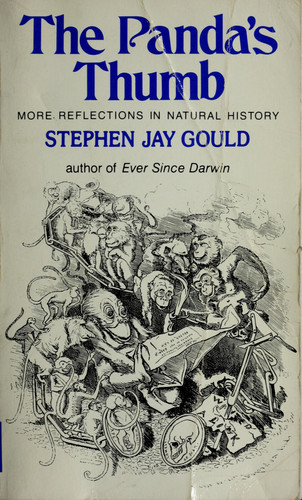
The panda's thumb: more reflections in natural history

Gould, Stephen Jay
A collection of essays by reknown scientist Jay Stephen Gould drawn from his columns in Natural History. The essays deal with topics such as: evolutionary opportunism (nature is a tinkerer, making the most of what's available in the course of adapting to the environment); new information on Darwin and his contemporaries; racism and cultural relativism; the evolutionary pattern of sudden rapid change; the origin of birds or the warm-bloodedness of dinosaurs; and, Teilhard de Chardin as a co-conspirator in the Piltdown hoax.
Norton 1980 343 pages

Ever since Darwin: reflections in natural history

Gould, Stephen Jay
More than any other modern scientists, Stephen Jay Gould has opened up to millions the wonders of evolutionary biology. His genius as an essayist lies in his unmatched ability to use his knowledge of the world, including popular culture, to illuminate the realm of science. Ever Since Darwin, Stephen Jay Gould's first book, has sold more than a quarter of a million copies. Like all succeeding collections by this unique writer, it brings the art of the scientific essay to unparalleled heights.
Norton 1979 285 pages

Dinosaurs at the Dinner Party How an Eccentric Group of Victorians Discovered Prehistoric Creatures and Accidentally Upended the World

Edward Dolnick
From the bestselling author of The Clockwork Universe and The Writing of the Gods , an “utterly delightful…hugely entertaining” ( Air Mail ) book about the eccentric Victorians who discovered dinosaur bones, leading to a whole new understanding of human history. In the early 1800s the natural world was a safe and cozy place, or so people believed. But then a twelve-year-old farm boy in Massachusetts stumbled on a row of fossilized three-toed footprints the size of dinner plates—the first dinosaur tracks ever found. Soon, in England, scientists unearthed enormous bones that reached as high as a man’s head. Outside of myths and fairy tales, no one had even imagined that creatures like three-toed giants had once lumbered across the land—nor dreamed that they could all have vanished, hundreds of millions years ago. In Dinosaurs at the Dinner Party , celebrated storyteller and historian Edward Dolnick leads us through a compelling true adventure as the paleontologists of the early 19th century puzzled their way through the fossil record to create the story of dinosaurs we know today. The tale begins with Mary Anning, a poor, uneducated woman who had a sixth sense for finding fossils buried deep inside cliffs; moves to William Buckland, an eccentric geologist who filled his home with specimens and famously pieced together a prehistoric scene from the fossil record inside a cave; and then on to the controversial Richard Owen, the era’s best-known scientist, and the one who coined the term “dinosaur.” “Exuberant” ( Kirkus Reviews ), entertaining, erudite, and featuring an unconventional cast of characters, Dinosaurs at the Dinner Party tells the story of how the accidental discovery of prehistoric creatures upended humanity’s understanding of the world and its own place within it.
Simon and Schuster 2025-08-12 352 pages

The Best American Science and Nature Writing 2004

Tim Folger,Steven Pinker
Since its inception in 1915, the Best American series has become the premier annual showcase for the country's finest short fiction and nonfiction. For each volume, a series editor reads pieces from hundreds of periodicals, then selects between fifty and a hundred outstanding works. That selection is pared down to the twenty or so very best pieces by a guest editor who is widely recognized as a leading writer in his or her field. This unique system has helped make the Best American series the most respected -- and most popular -- of its kind. The Best American Science and Nature Writing 2004, edited by Steven Pinker, is another "provocative and thoroughly enjoyable [collection] from start to finish" (Publishers Weekly). Here is the best and newest on science and nature: the psychology of suicide terrorism, desperate measures in surgery, the weird world of octopuses, Sex Week at Yale, the linguistics of click languages, the worst news about cloning, and much more.
Houghton Mifflin 2004 209 pages

Debating Darwin's Doubt A Scientific Controversy that Can No Longer be Denied

David Klinghoffer
In 2013 Stephen Meyer's book Darwin's Doubt: The Explosive Origin of Animal Life and the Case for Intelligent Design became a national bestseller, provoking a wide-ranging debate about the adequacy of Darwinian theory to explain life's history. In Debating Darwin's Doubt: A Scientific Controversy that Can No Longer Be Denied , leading scholars in the intelligent design community respond to critiques of Meyer's book and show that the core challenge posed by Meyer remains unanswered: Where did the influx of information essential to the creation of new body plans come from? In addition to ten chapters by Stephen Meyer, Debating Darwin's Doubt also includes contributions from biologists Richard Sternberg, Douglas Axe, and Ann Gauger; philosopher of biology Paul Nelson; mathematicians William Dembski and David Berlinski; and Center for Science and Culture research coordinator Casey Luskin. In forty-four chapters, these contributing authors explore topics such as orphan genes, cladistics, small shelly fossils, protein evolution, the length of the Cambrian explosion, the God-of-the-Gaps objection to intelligent design, and criticisms raised by proponents of theistic evolution. Anyone who wants to understand the cutting-edge of current scientific debates over modern Darwinian theory needs to read this book.
Discovery Institute Press 2015 350 pages

Hen's teeth and horse's toes

Gould, Stephen Jay
"Darwin relegated humanity to a species descended from apes ; Stephen Jay Gould adds that it is bound for extinction. Why all species, including our own, are destined to die out is just one of the fascinating questions addressed in this collection of essays by the author of Ever Since Darwin and The Panda's Thumb. In considering them, Stephen Jay Gould challenges the view that science is irrelevant to life. Darwinism has changed our view of the world and Gould brilliantly conveys here the active excitement of modern evolutionary theory. Fair, amusing, perceptive, eminently readable, Gould looks at facts that -- if we even know them in the first place -- we take for granted and, with a true scientist's desire for knowledge, digs beneath them to uncover their significance for evolutionary theory" -- Back cover.
Penguin 1984 413 pages