30 results for "Evolution"

The death of death: resurrection and immortality in Jewish thought

Gillman, Neil
Does death end life, or is it the passage from one stage of life to another?In The Death of Death, noted theologian Neil Gillman offers readers an original and compelling argument that Judaism, a religion often thought to pay little attention to the afterlife, not only presents us with rich ideas on this subject―but delivers a deathblow to death itself.Combining astute scholarship with keen historical, theological and liturgical insights, Gillman outlines the evolution of Jewish thought about bodily resurrection and spiritual immortality. Beginning with the near-silence of the Bible on the afterlife, he traces the development of these two doctrines through Jewish history. He also describes why today, somewhat surprisingly, more contemporary Jewish scholars―including Gillman―have unabashedly reaffirmed the notion of bodily resurrection.In this innovative and personal synthesis, Gillman creates a strikingly modern statement on resurrection and immortality.The Death of Death gives new and fascinating life to an ancient debate. This new work is an intellectual and spiritual milestone for all of us interested in the meaning of life, as well as the meaning of death.
Jewish Lights Pub 1997 318 pages

Doing Jewish theology: God, Torah & Israel in modern Judaism

Gillman, Neil
An Intellectually Rich and Challenging Exploration of Modern Jewish Theology "How we deal with revelation determines how we handle the issue of authority in belief and practice. How we understand authority determines how we deal with the claims of the tradition on us; how we deal with those claims determines how we shape our own Judaism. That conclusion opens the gate to a reconsideration of all of Judaism's theology, in particular how we understand God, for God is at the heart of Torah." --from the Introduction With clarity and passion, award-winning teacher, author and theologian Neil Gillman captures the power of Jewish theological claims and reveals extraordinary insights into Jewish identity, the purpose of religion, and our relationship with God. Drawing from Judaism's sacred texts as well as great thinkers such as Mordecai Kaplan, Abraham Joshua Heschel and Paul Tillich, Gillman traces his theological journey over four decades of study, beginning with his own understanding of revelation. He explores the role of symbol and myth in our understanding of the nature of God and covenant. He examines the importance of community in both determining authority and sanctifying sacred space. By charting the development of his own personal theology, Gillman explores the evolution of Jewish thought and its implications for modern Jewish religious identity today and in the future.
Jewish Lights Pub 2008 283 pages

The Jews Story of a People

Howard Fast
Beginning in the ancient world, this colourful, fast-paced saga enriches our understanding of the Jews and their impact on the world. With drama no fiction can match, master storyteller Howard Fast traces the evolution of a tradition powerful enough to give lasting identity to a scattered, wandering people. Bringing to life the extraordinary men and women who have shaped history-Moses, Hillel, Jesus (and many more) -- this compelling book explores the customs and philosophies that have endured persecution, emigration, and the Holocaust. Fast also probes the towering achievements of this unique and fascinating people, illustrating their important role in the origins of Western culture, Christianity and modern Europe. "The Jews" is comprehensive, enlightening and utterly readable.
ibooks, Incorporated 2006 338 pages

Jews and the American soul: human nature in the twentieth century

Heinze, Andrew R.
What do Joyce Brothers and Sigmund Freud, Rabbi Harold Kushner and philosopher Martin Buber have in common? They belong to a group of pivotal and highly influential Jewish thinkers who altered the face of modern America in ways few people recognize. So argues Andrew Heinze, who reveals in rich and unprecedented detail the extent to which Jewish values, often in tense interaction with an established Christian consensus, shaped the country's psychological and spiritual vocabulary. Jews and the American Soul is the first book to recognize the central role Jews and Jewish values have played in shaping American ideas of the inner life. It overturns the widely shared assumption that modern ideas of human nature derived simply from the nation's Protestant heritage. Heinze marshals a rich array of evidence to show how individuals ranging from Erich Fromm to Ann Landers changed the way Americans think about mind and soul. The book shows us the many ways that Jewish thinkers influenced everything from the human potential movement and pop psychology to secular spirituality. It also provides fascinating new interpretations of Sigmund Freud, Alfred Adler, and Western views of the psyche; the clash among Protestant, Catholic, and Jewish moral sensibilities in America; the origins and evolution of America's psychological and therapeutic culture; the role of Jewish women as American public moralists, and more. A must-read for anyone interested in the contribution of Jews and Jewish culture to modern America.
Princeton University Press 2007 438 pages

Jews and the American soul: human nature in the twentieth century

Heinze, Andrew R.
What do Joyce Brothers and Sigmund Freud, Rabbi Harold Kushner and philosopher Martin Buber have in common? They belong to a group of pivotal and highly influential Jewish thinkers who altered the face of modern America in ways few people recognize. So argues Andrew Heinze, who reveals in rich and unprecedented detail the extent to which Jewish values, often in tense interaction with an established Christian consensus, shaped the country's psychological and spiritual vocabulary. Jews and the American Soul is the first book to recognize the central role Jews and Jewish values have played in shaping American ideas of the inner life. It overturns the widely shared assumption that modern ideas of human nature derived simply from the nation's Protestant heritage. Heinze marshals a rich array of evidence to show how individuals ranging from Erich Fromm to Ann Landers changed the way Americans think about mind and soul. The book shows us the many ways that Jewish thinkers influenced everything from the human potential movement and pop psychology to secular spirituality. It also provides fascinating new interpretations of Sigmund Freud, Alfred Adler, and Western views of the psyche; the clash among Protestant, Catholic, and Jewish moral sensibilities in America; the origins and evolution of America's psychological and therapeutic culture; the role of Jewish women as American public moralists, and more. A must-read for anyone interested in the contribution of Jews and Jewish culture to modern America.
Princeton University Press 2004 438 pages

The Cambridge guide to Jewish history, religion, and culture

Judith R. Baskin,Kenneth Seeskin
"The Cambridge Guide to Jewish History, Religion, and Culture is a comprehensive and engaging overview of Jewish life, from its origins in the ancient Near East to its impact on contemporary popular culture. The twenty-one essays, arranged historically and thematically, and written specially for this volume by leading scholars, examine the development of Judaism and the evolution of Jewish history and culture over many centuries and in a range of locales. They emphasize the ongoing diversity and creativity of the Jewish experience. Unlike previous anthologies, which concentrate on elite groups and expressions of a male-oriented rabbinic culture, this volume also includes the range of experiences of ordinary people and looks at the lives and achievements of women in every place and era. The many illustrations, maps, timeline, and glossary of important terms enhance this book's accessibility to students and general readers"--Provided by publisher.
Cambridge University Press 2010-07-12 539 pages

JEWISH HISTORY FOR DUMMIES

Kurzweil, Arthur
"Jewish History For Dummies provides unbiased, factual history of Jewish life, culture, and history. You'll take a look at the roots of Jewish history, beginning in 2000 B.C.E. with Abraham and his descendants. Chapter by chapter, you'll trace the evolution of the Jewish people through the biblical record and other sources, learning how King David united Israel, how the Jews were exiled under Babylonian rule, and how Jewish people have adapted to life in the diaspora, from ancient times all the way up to today. Whatever era of Jewish history you're interested in, you'll find comprehensive coverage in this Dummies guide."--
JOHN WILEY 2026-04-30 334 pages

The Biblical clock: the untold secrets linking the universe and humanity with God's plan

Friedmann, Daniel
Science and religion have two seemingly opposing views of the universe's biggest questions. But what if the real story told you they were both right? Vancouver, 2009. Physics engineer and CEO Daniel Friedmann loves solving problems. When the avid scientist dives deep into scripture, he's faced with questions he feels compelled to answer: Is it possible to harmonize the scientific timeline for the development of the universe with the biblical timeline described in Genesis 1? How do the evolution of human history and prophecies surrounding the End of Days fit in?His quest for answers takes him and his nephew Seb on an incredible journey through the ages, discovering the lives and works of mystics, prophets, sages, philosophers, scientists and biblical commentators.Follow Dan and Seb as they discover answers to some of the biggest questions in science and religion, including: -Does the six-day creation account actually link with science's 13.8 billion-year timeline?- How do world history, Genesis, and the End of Days fit within the context of God's Plan in heaven?- How can the appearance of life on Earth, as depicted by the fossil record, match the sequence and timing of life on Earth described in Genesis 1?- Do Genesis and the evolution of human history reveal the events and timing for the End of Days?- Are there texts predating modern science that describe the Big Bang and contain the scientifically calculated age of the universe?- And finally, is there a secret harmony resolving the creation-versus-evolution debate?The Biblical Clock is a fascinating and entertaining read, digging deep into the universe and solving its well-kept mysteries. Order your copy today
Daniel Friedmann and Dania Sheldon 2019-04-09 382 pages

Radical Judaism: rethinking God and tradition

Green, Arthur
How do we articulate a religious vision that embraces evolution and human authorship of Scripture? Drawing on the Jewish mystical traditions of Kabbalah and Hasidism, path-breaking Jewish scholar Arthur Green argues that a neomystical perspective can help us to reframe these realities, so they may yet be viewed as dwelling places of the sacred. In doing so, he rethinks such concepts as God, the origins and meaning of existence, human nature, and revelation to construct a new Judaism for the twenty-first century.
Yale University Press 2010 197 pages

Medieval stereotypes and modern antisemitism

Chazan, Robert
A study of the 12th-century evolution of innovative anti-Jewish stereotypes and their impact on subsequent Western thought. The 12th century was a period of significant change and dislocation in the West; it witnessed the interaction of new societal circumstances and a prior ideational legacy, similar to events in the 19th-20th centuries. This interaction produced an innovative view of Jews which was fated to influence anti-Jewish perceptions up to the present. In the period of societal change, persecutory patterns emerged, directed at diverse societal outgroups, among them the Jews. The 12th-century stereotypes were permanently absorbed into the historic legacy of Christian anti-Jewish thinking. These stereotypes were based on a perception of Jewish hatred of Christianity and Christians, and that Jews commit acts of anti-Christian violence generated by this purported hatred (e.g. ritual murder, abuse of Christian symbols, moneylending abuses). The most pernicious anti-Jewish imagery involves stereotypes alleging mortal threats posed by Jews. States that every new stage in the evolution of anti-Jewish thinking is marked by dialectical interplay between a prior legacy of negative stereotypes and the realities of a new social context.
University of California Press 1997 189 pages

The Reform Judaism reader: North American documents

Michael A. Meyer,W. Gunther Plaut
This classic reference book chronicles the history of Reform Judaism. Historical documents and writings by renowned authors that reflect the on-going evolution of Reform Judaism are included. This book will aid the reader in understanding the changing issues that have occurred since its establishment. This timely book traces the development of Reform Judaism in light of the ideas contained in the Statement of Principles for Reform Judaism adopted at the 1999 Pittsburgh Convention of the Central Conference of American Rabbis. The book covers such areas as theology, social action, the Sabbath, and education. -- Ideal for high school and adult study -- Classic reference for every Reform Jewish home and library -- Each document preceded by an introduction by the authors -- Online study guide available at www.uahcpress.com
UAHC Press 2001 228 pages

The Jewish presence: essays on identity and history

Dawidowicz, Lucy S.
What does it mean to be a Jew? In the twenty essays included here, best-selling author Lucy S. Widowhood examines many aspects of modern Jewish life, concentrating on the central experiences of our era- the search for meaning of one's existence as a Jew;bridging the past and the present; reconciling tradition and the Holocaust. While she describes the evolution of American Judaism and surveys its present condition, the author also shows us the continuities between Old world and New World Judaism as she evokes the modern Jew's struggle between faith and secularism
Harcourt Brace Jovanovich 1978 308 pages

A Kabbalistic Universe

Zev ben Shimon Halevi
A Kabbalistic Universe is about how and why Existence came into being. It sets out the general scheme of the four Worlds of Emanation, Creation, Formation and Action and heir various archangelic, angelic, demonic and organic inhabitants. Drawing upon ancient, medieval and modern material this book brings the Kabbalistic tradition up to date so that the current generation can perceive what Existence is about and how they might play a conscious part in humanity's role of aiding God to behold God in the Mirror of Existence. This is a revised edition with additional graphics. These make the Divine principles involved more comprehensible. Once the terms and metaphysics are mastered, then new perceptions are possible regarding not only the structure and dynamics of Existence but also the workings of the angelics and demonics, Nature and the process of human evolution and its purpose.
KS Books Limited 2024-12-05 256 pages

Seek my face: a Jewish mystical theology

Green, Arthur
God and the Ways of Being --The Secret of the Sh'ma --God Above, God Within --The Two and the One --God as Y-H-W-H: "Is-was-will be" is one! --Speak my Name --Seeking God: Look First to Love --In God's Own Image: Seek My Face --Face to Face --Male and Female: An Excursus --One and Two --Creation --One God, two Ways --Creation and the Jewish Question --Creation and the Struggle for Faith --What Comes "First"? --Two Tales --The One and the Many --Who is at the Center? --Evolution: An Ongoing Process --From Aggadah to Halakhah --The First Mitzvah: Be Aware --In God's Image --Celebrating Creation: The Mitzvah of Shabbat --"To Work it and Guard it": Preserving God's World --Vegetarianism: A Kashrut for Our Age --Human Love and Human Pain --The Human Being: Bearer of Divine Compassion --Revelation --Y-H-W-H and Language --Before the Mountain --Human Understanding and Divine Speech --The Inner Mountain --Torah as the Name of God --Revelation and the Inward Journey --The Role of Covenant: A Reinterpretation --Revelation and Torah --Revelation, Will, and Law --The Personal Path: Accepting the Yoke --Sinai and Language --Sinai and Study --Sinai and Community --The Three Festivals: Sinai and the Sacred Cycle --The Word in Our Day --Redemption --The Light of the First Day --Crying Out for the Light --Redemption as Coming Home --The Bible: A Tale of Exile --Homecoming and Teshuvah --Teshuvah and the Sacred Year --The Redemptive Task: Getting to Work.
Jewish Lights 2003 269 pages

The Book of Words Talking Spiritual Life, Living Spiritual Talk

Lawrence Kushner
"According to the Hebrew Bible, God made the world with words. God just spoke and the world became reality. (The Aramaic for 'I create as I speak' is avara k'davara, or in magician's language, abracadabra.) ... This does not protect words from the numbing effects of overuse in any religious tradition.... We need to dust off the words, shake away the accretions, wonder again about what they originally might have meant and enable ourselves to live in the word." --from the Introduction With creativity and poetry (and occasional heresy) Kushner dusts off thirty classical Hebrew words, shakes them free of the effects of generations of overuse, "re-translates" them and liberates their ancient holy power. The result is a contemporary spiritual guide for your personal religious life. According to the Hebrew Bible, God made the world with words. God just spoke and the world came into being. Words therefore are not merely sounds signifying something else; they are instruments of creation, primary reality itself. They need only to be read, spoken and interpreted. And to know them is to know reality itself. Kushner has designed the book himself, seamlessly blending graphics and content. In doing so he evokes the aesthetics of an ancient manuscript and a vision of our power to shape the future. Each finely crafted chapter begins with a Hebrew word and Kushner's provocative English translation. At the bottom of the page is a transliteration of the Hebrew along with its more customary English rendering. In addition to his own intriguing definition, he includes a biblical citation anchoring the word, along with a more recent text showing the word's evolution. Finally, we are offered a personal, meditative exercise designed to enable you to "live in the word."
Jewish Lights Publishing 1993 142 pages

Darwin in the Jewish imagination: Jews' engagement with evolutionary theory

Langton, Daniel R.
"The development of this project has taken many years and evolved in many unexpected directions as a result of the advice and feedback from many people. The subject is Darwin's Jews, that is, those Jewish thinkers in the late nineteenth- and early twentieth-centuries who have given Darwin a legacy within Jewish history beyond the tragic account of Nazi race theory and eugenics that all too often dominates the discussion of Jews and Darwin. For this reason, as much as any other, it seemed like a worthwhile endeavour. But the identification and selection of the different species of Darwin's Jews has proven to be difficult fieldwork, since there are so many ideological niches and environments for so many varieties of religious and non-religious Jews within the tangled bank of modern Jewish identity. Fortunately, I have not been working alone, and am grateful for the opportunity now to acknowledge the work of others"--
Oxford University Press 2026-02-04 310 pages

The rabbi's wife: the rebbetzin in American Jewish life

Schwartz, Shuly Rubin
2006 National Jewish Book Award, Modern Jewish Thought Long the object of curiosity, admiration, and gossip, rabbis' wives have rarely been viewed seriously as American Jewish religious and communal leaders. We know a great deal about the important role played by rabbis in building American Jewish life in this country, but not much about the role that their wives played. The Rabbi’s Wife redresses that imbalance by highlighting the unique contributions of rebbetzins to the development of American Jewry. Tracing the careers of rebbetzins from the beginning of the twentieth century until the present, Shuly Rubin Schwartz chronicles the evolution of the role from a few individual rabbis' wives who emerged as leaders to a cohort who worked together on behalf of American Judaism. The Rabbi’s Wife reveals the ways these women succeeded in both building crucial leadership roles for themselves and becoming an important force in shaping Jewish life in America.
New York University Press 2006-01-01 312 pages

Beyond patriarchy: Jewish fathers and families

Fuchs, Lawrence H.
Is patriarchy necessary to ensure responsible fathering? Lawrence H. Fuchs, author of Family Matters, argues that the link between male dominance and fatherhood is no longer iron-clad. Analyzing the universality of patriarchy and its incentives for cultural fatherhood, Fuchs concedes that the importance of biological differences between the sexes was a possible, even plausible, basis for the evolution of patriarchy. But in this timely work he imagines a new paradigm of fatherhood for a post-patriarchal age, one inspired by the history of Jewish patriarchy. Two millennia ago the rabbis established the strategies to curb the extreme abuses of patriarchy found in all civilizations. They did so by according wives significant sexual and economic rights. In the last two centuries as Jews became more integrated into the societies in which they lived, their unique variation of patriarchy was disrupted. Fuchs argues that the Jewish story sets the precedent for fundamental change in the nature of patriarchy today, thus breaking what may have been the evolutionary connection between male dominance and incentives for fatherhood. It is Fuchs's startling conclusion that the Jewish precedent points to the next step in evolution: fathers without patriarchy.
Published by University Press of New England, Brandeis University Press 2000 216 pages

Pitching My Tent On Marriage, Motherhood, Friendship, and Other Leaps of Faith

Anita Diamant
From the bestselling author of The Red Tent and Good Harbor , a collection of intimate, autobiographical reflections on the milestones, revelations, and balancing acts of life as a wife, mother, friend, and member of a religious community. Before The Red Tent won her international literary acclaim, Anita Diamant was a columnist in Boston. Over the course of twenty years, she wrote essays that reflected the shape and evolution of her life, as well as the trends of her generation. In the end, her musings about love and marriage, birth and death, nature versus nurture, politics and religion—and everything from female friendships to quitting smoking—have created a public diary of the progress of her life that resonated deeply with her readers. Now, Pitching My Tent collects the finest columns of a writer who is a reporter by training and a storyteller by heart, all revised and enriched with new material. Personal, inspiring, and often funny, Pitching My Tent displays the warmth, humor, and wisdom that Diamant's legions of fans have come to cherish.
Scribner 2005-10-04 240 pages

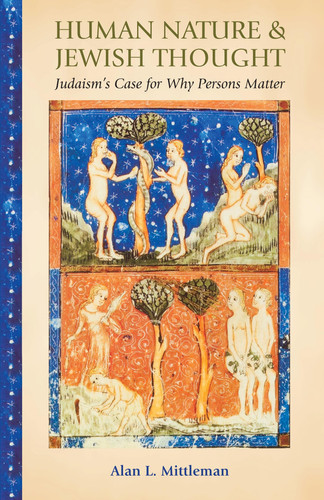
Human nature & Jewish thought: Judaism's case for why persons matter

Mittleman, Alan
This book explores one of the great questions of our time: How can we preserve our sense of what it means to be a person while at the same time accepting what science tells us to be true-namely, that human nature is continuous with the rest of nature? What, in other words, does it mean to be a person in a world of things? Alan Mittleman shows how the Jewish tradition provides rich ways of understanding human nature and personhood that preserve human dignity and distinction in a world of neuroscience, evolutionary biology, biotechnology, and pervasive scientism. These ancient resources can speak to Jewish, non-Jewish, and secular readers alike. Science may tell us what we are, Mittleman says, but it cannot tell us who we are, how we should live, or why we matter. Traditional Jewish thought, in open-minded dialogue with contemporary scientific perspectives, can help us answer these questions. Mittleman shows how, using sources ranging across the Jewish tradition, from the Hebrew Bible and the Talmud to more than a millennium of Jewish philosophy. Among the many subjects the book addresses are sexuality, birth and death, violence and evil, moral agency, and politics and economics. Throughout, Mittleman demonstrates how Jewish tradition brings new perspectives to-and challenges many current assumptions about-these central aspects of human nature. A study of human nature in Jewish thought and an original contribution to Jewish philosophy, this is a book for anyone interested in what it means to be human in a scientific age.
Princeton University Press 2015 215 pages