4 results for "Evolution"

The future of the brain: the promise and perils of tomorrow's neuroscience

Rose, Steven P. R.
Brain repair, smart pills, mind-reading machines--modern neuroscience promises to soon deliver a remarkable array of wonders as well as profound insight into the nature of the brain. But these exciting new breakthroughs, warns Steven Rose, will also raise troubling questions about what it means to be human. In The Future of the Brain, Rose explores just how far neuroscience may help us understand the human brain--including consciousness--and to what extent cutting edge technologies should have the power to mend or manipulate the mind. Rose first offers a panoramic look at what we now know about the brain, from its three-billion-year evolution, to its astonishingly rapid development in the embryo, to the miraculous process of infant development. More important, he shows what all this science can--and cannot--tell us about the human condition. He examines questions that still baffle scientists and he explores the potential threats and promises of new technologies and their ethical, legal, and social implications, wondering how far we should go in eliminating unwanted behavior or enhancing desired characteristics, focusing on the new "brain steroids" and on the use of Ritalin to control young children. The Future of the Brain is a remarkable look at what the brain sciences are telling us about who we are and where we came from--and where we may be headed in years to come.
Oxford University Press 2006 344 pages

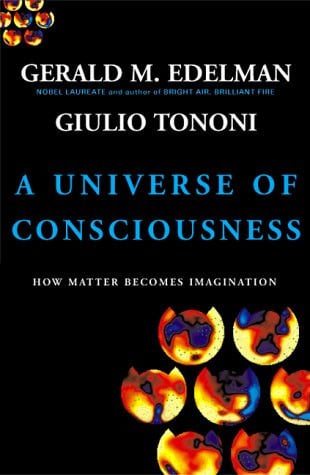
A universe of consciousness: how matter becomes imagination

Edelman, Gerald Maurice
In A Universe of Consciousness, Gerald Edelman builds on the radical ideas he introduced in his monumental trilogy-Neural Darwinism, Topobiology, and The Remembered Present-to present for the first time an empirically supported full-scale theory of consciousness. He and the neurobiolgist Giulio Tononi show how they use ingenious technology to detect the most minute brain currents and to identify the specific brain waves that correlate with particular conscious experiences. The results of this pioneering work challenge the conventional wisdom about consciousness.
Basic Books 2000 274 pages

The social neuroscience of empathy

Jean Decety
In recent decades, empathy research has blossomed into a vibrant and multidisciplinary field of study. The social neuroscience approach to the subject is premised on the idea that studying empathy at multiple levels (biological, cognitive, and social) will lead to a more comprehensive understanding of how other people's thoughts and feelings can affect our own thoughts, feelings, and behavior. In these cutting-edge contributions, leading advocates of the multilevel approach view empathy from the perspectives of social, cognitive, developmental, and clinical psychology and cognitive/affective neuroscience. Chapters include a critical examination of the various definitions of the empathy construct; surveys of major research traditions based on these differing views (including empathy as emotional contagion, as the projection of one's own thoughts and feelings, and as a fundamental aspect of social development); clinical and applied perspectives, including psychotherapy and the study of empathy for other people's pain; various neuroscience perspectives; and discussions of empathy's evolutionary and neuroanatomical histories, with a special focus on neuroanatomical continuities and differences across the phylogenetic spectrum. The new discipline of social neuroscience bridges disciplines and levels of analysis. In this volume, the contributors' state-of-the-art investigations of empathy from a social neuroscience perspective vividly illustrate the potential benefits of such cross-disciplinary integration. Contributors : C. Daniel Batson, R. J. R. Blair, Karina S. Blair, Jerold D. Bozarth, Ann Buysse, Susan F. Butler, Michael Carlin, C. Sue Carter, Kenneth D. Craig, Mirella Dapretto, Jean Decety, Mathias Dekeyser, Ap Dijksterhuis, Robert Elliott, Natalie D. Eggum, Nancy Eisenberg, Norma Deitch Feshbach, Seymour Feshbach, Liesbet Goubert, Leslie S. Greenberg, Elaine Hatfield, James Harris, William Ickes, Claus Lamm, Yen-Chi Le, Mia Leijssen, Raymond S. Nickerson, Jennifer H. Pfeifer, Stephen W. Porges, Richard L. Rapson, Simone G. Shamay-Tsoory, Rick B. van Baaren, Matthijs L. van Leeuwen, Andries van der Leij, Jeanne C. Watson Social Neuroscience series
MIT Press 2009 255 pages