
6 results for "Evolution"

The panda's thumb: more reflections in natural history

Gould, Stephen Jay
A collection of essays by reknown scientist Jay Stephen Gould drawn from his columns in Natural History. The essays deal with topics such as: evolutionary opportunism (nature is a tinkerer, making the most of what's available in the course of adapting to the environment); new information on Darwin and his contemporaries; racism and cultural relativism; the evolutionary pattern of sudden rapid change; the origin of birds or the warm-bloodedness of dinosaurs; and, Teilhard de Chardin as a co-conspirator in the Piltdown hoax.
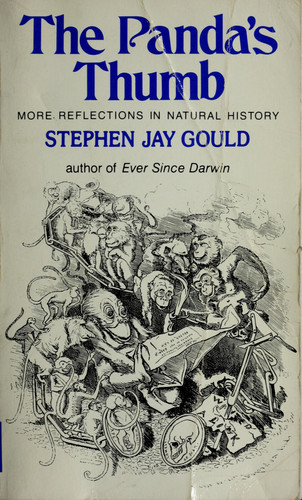
Norton 1980 343 pages

Hen's teeth and horse's toes

Gould, Stephen Jay
"Darwin relegated humanity to a species descended from apes ; Stephen Jay Gould adds that it is bound for extinction. Why all species, including our own, are destined to die out is just one of the fascinating questions addressed in this collection of essays by the author of Ever Since Darwin and The Panda's Thumb. In considering them, Stephen Jay Gould challenges the view that science is irrelevant to life. Darwinism has changed our view of the world and Gould brilliantly conveys here the active excitement of modern evolutionary theory. Fair, amusing, perceptive, eminently readable, Gould looks at facts that -- if we even know them in the first place -- we take for granted and, with a true scientist's desire for knowledge, digs beneath them to uncover their significance for evolutionary theory" -- Back cover.
Penguin 1984 413 pages

The genetic basis of evolutionary change

Lewontin, Richard
The Genetic Basis of Evolutionary Change is about the core of population genetics — the nature of genetic variation and changes in genetic variation. Topics covered include the nature of variation, the measurement of variation, multilocus dynamics and speciation. Particular attention is paid to methodological questions and to making clear the limitations of the models used. Although many of the details have been outdated by the advances of the last twenty years, particularly in molecular genetics, this is a classic of the field, and probably still required reading for population geneticists. -- Danny Yee
Columbia University Press 1974 346 pages

The possible and the actual

Jacob, François
"François Jacob is one of the world's leading scientists, a professor of the Collège de France and the Institut Pasteur, and the winner of the Nobel Prize in Medicine (with André Lwoff and Jacques Monod). He has written an extraordinarily thought-provoking and far-ranging book on evolution which, as he states in his preface, "deals with genes and men, with sex, aging, and molecules. Above all, it deals with the theory of evolution, its status as well as its content. For if the theory of evolution provides a framework without which there is little hope to understand where we come from and why we are as we are, it is important to define the limits beyond which it is used no longer as a scientific theory, but as a myth.""--Back cover.
University of Washington Press 1982 71 pages

Theoretical studies on sex ratio evolution

Karlin, Samuel
This book deals with a key area of population genetics: the ratio of the sexes in a population, or the allocation of resources to male versus female reproductive function. Samuel Karlin and Sabin Lessard establish the formal theoretical aspects of the evolution of sex ratio within the constraints of genetic mechanisms of sex determination. Their results generalize and unify existing work on the topic, strengthening previous conceptions in some cases and, in other instances, offering new directions of research. There are two main approaches to understanding the causes and effects of sex ratio. One approach focuses on the optimization and adaptive functions of sex allocation, while the other emphasizes the consequences of genetic sex determination mechanisms. In discussing the utility of these two approaches, Professors Karlin and Lessard examine the principal sex-determining mechanisms and facts involved in sex ratio representations, the various genetic and environmental factors that contribute to adaptive sex expression, and the evolution of sex determining systems and controls. From a population genetic perspective, the authors derive evolutionary properties in support of the high incidence of 1:1 sex ratio in natural populations and investigate the conditions that can explain the occurrence of biased sex ratio.
Princeton University Press 1986-07-21 313 pages