60 results for "Evolution"

The Dawn of Everything

DAVID GRAEBER
INSTANT NEW YORK TIMES BESTSELLER A dramatically new understanding of human history, challenging our most fundamental assumptions about social evolution—from the development of agriculture and cities to the origins of the state, democracy, and inequality—and revealing new possibilities for human emancipation. For generations, our remote ancestors have been cast as primitive and childlike—either free and equal innocents, or thuggish and warlike. Civilization, we are told, could be achieved only by sacrificing those original freedoms or by taming our baser instincts. In their major New York Times bestseller, The Dawn of Everything , David Graeber and David Wengrow fundamentally challenge these assumptions and recast our understanding of human history. We will never again see the past in the same way. Drawing on pathbreaking research in archaeology and anthropology, Graeber and Wengrow reveal how history becomes a far more interesting place once we learn to throw off our conceptual blinders and perceive what’s really there. If humans did not spend 95 percent of their evolutionary past in tiny bands of hunter-gatherers, what were they doing during all that time? If agriculture and cities did not mean a plunge into hierarchy and domination, then what kinds of social and economic organizations did they lead to? The answers are often unexpected, and suggest that the course of human history may be less set in stone, and more open to playful, hopeful possibilities, than we tend to assume. Destined to be a classic, The Dawn of Everything signals a paradigm shift, profoundly transforming our understanding of the human past and making space to imagine new forms of freedom, new ways of organizing society. This is a monumental book of formidable intellectual and political range, animated by curiosity, moral vision, and hopefulness.
St Martins Press 2023-04-04 692 pages

Extraterrestrial The First Sign of Intelligent Life Beyond Earth

Avi Loeb
New York Times Bestseller | Wall Street Journal Bestseller | Publishers Weekly Bestseller | Publishers Marketplace 2020 Buzz Book | Amazon Best Book of the Year | Longlisted for the 2022 PEN/E.O. Wilson Literary Science Writing Award Harvard's top astronomer lays out his controversial theory that our solar system was recently visited by advanced alien technology from a distant star. "Provocative and thrilling ... Loeb asks us to think big and to expect the unexpected."--Alan Lightman, New York Times bestselling author of Einstein's Dreams and Searching for Stars on an Island in Maine In late 2017, scientists at a Hawaiian observatory glimpsed an object soaring through our inner solar system, moving so quickly that it could only have come from another star. Avi Loeb, Harvard's top astronomer, showed it was not an asteroid; it was moving too fast along a strange orbit, and left no trail of gas or debris in its wake. There was only one conceivable explanation: the object was a piece of advanced technology created by a distant alien civilization. In Extraterrestrial, Loeb takes readers inside the thrilling story of the first interstellar visitor to be spotted in our solar system. He outlines his controversial theory and its profound implications: for science, for religion, and for the future of our species and our planet. A mind-bending journey through the furthest reaches of science, space-time, and the human imagination, Extraterrestrial challenges readers to aim for the stars--and to think critically about what's out there, no matter how strange it seems.
HarperCollins Publishers 2022-02-22 240 pages

What Darwin got wrong

Fodor, Jerry A.
With a New Afterword What Darwin Got Wrong is a remarkable book, one that dares to challenge the theory of natural selection as an explanation for how evolution works--a devastating critique not in the name of religion but in the name of good science. Combining the results of cutting-edge work in experimental biology with crystal-clear philosophical arguments, Fodor and Piattelli-Palmarini mount a reasoned and convincing assault on the central tenets of Darwin's account of the origin of species. This is a concise argument that will transform the debate about evolution and move us beyond the false dilemma of being either for natural selection or against science.
Picador/Farrar, Straus and Giroux 2011-03-01 292 pages

Mind and cosmos: why the materialist neo-Darwinian conception of nature is almost certainly false

Nagel, Thomas
The modern materialist approach to life has conspicuously failed to explain such central mind-related features of our world as consciousness, intentionality, meaning, and value. This failure to account for something so integral to nature as mind, argues philosopher Thomas Nagel, is a major problem, threatening to unravel the entire naturalistic world picture, extending to biology, evolutionary theory, and cosmology. Since minds are features of biological systems that have developed through evolution, the standard materialist version of evolutionary biology is fundamentally incomplete. And the cosmological history that led to the origin of life and the coming into existence of the conditions for evolution cannot be a merely materialist history, either. An adequate conception of nature would have to explain the appearance in the universe of materially irreducible conscious minds, as such. Nagel's skepticism is not based on religious belief or on a belief in any definite alternative. In Mind and Cosmos, he does suggest that if the materialist account is wrong, then principles of a different kind may also be at work in the history of nature, principles of the growth of order that are in their logical form teleological rather than mechanistic. In spite of the great achievements of the physical sciences, reductive materialism is a world view ripe for displacement. Nagel shows that to recognize its limits is the first step in looking for alternatives, or at least in being open to their possibility.--Publisher description.
Oxford University Press 2012-11-22 130 pages

The Columbia history of Western philosophy

Richard Henry Popkin
Richard Popkin has assembled 63 leading scholars to forge a highly approachable chronological account of the development of Western philosophical traditions. From Plato to Wittgenstein and from Aquinas to Heidegger, this volume provides lively, in-depth, and up-to-date historical analysis of all the key figures, schools, and movements of Western philosophy. The Columbia History significantly broadens the scope of Western philosophy to reveal the influence of Middle Eastern and Asian thought, the vital contributions of Jewish and Islamic philosophers, and the role of women within the tradition. Along with a wealth of new scholarship, recently discovered works in 17th- and 18th-century philosophy are considered, such as previously unpublished works by Locke that inspire a new assessment of the evolution of his ideas. Popkin also emphasizes schools and developments that have traditionally been overlooked. Sections on Aristotle and Plato are followed by a detailed presentation on Hellenic philosophy and its influence on the modern developments of materialism and scepticism. A chapter has been dedicated to Jewish and Moslem philosophical development during the Middle Ages, focusing on the critical role of figures such as Averroës and Moses Maimonides in introducing Christian thinkers to classical philosophy. Another chapter considers Renaissance philosophy and its seminal influence on the development of modern humanism and science. Turning to the modern era, contributors consider the importance of the Kaballah to Spinoza, Leibniz, and Newton and the influence of popular philosophers like Moses Mendelssohn upon the work of Kant. This volume gives equal attention to both sides of the current rift in philosophy between continental and analytic schools, charting the development of each right up to the end of the 20th century. Each chapter includes an introductory essay, and Popkin provides notes that draw connections among the separate articles. The rich bibliographic information and the indexes of names and terms make the volume a valuable resource. Combining a broad scope and penetrating analysis with a keen sense of what is relevant for the modern reader, The Columbia History of Western Philosophy will prove an accessible introduction for students and an informative overview for general readers.
Columbia University Press 1999 836 pages

Debating Darwin's Doubt A Scientific Controversy that Can No Longer be Denied

David Klinghoffer
In 2013 Stephen Meyer's book Darwin's Doubt: The Explosive Origin of Animal Life and the Case for Intelligent Design became a national bestseller, provoking a wide-ranging debate about the adequacy of Darwinian theory to explain life's history. In Debating Darwin's Doubt: A Scientific Controversy that Can No Longer Be Denied , leading scholars in the intelligent design community respond to critiques of Meyer's book and show that the core challenge posed by Meyer remains unanswered: Where did the influx of information essential to the creation of new body plans come from? In addition to ten chapters by Stephen Meyer, Debating Darwin's Doubt also includes contributions from biologists Richard Sternberg, Douglas Axe, and Ann Gauger; philosopher of biology Paul Nelson; mathematicians William Dembski and David Berlinski; and Center for Science and Culture research coordinator Casey Luskin. In forty-four chapters, these contributing authors explore topics such as orphan genes, cladistics, small shelly fossils, protein evolution, the length of the Cambrian explosion, the God-of-the-Gaps objection to intelligent design, and criticisms raised by proponents of theistic evolution. Anyone who wants to understand the cutting-edge of current scientific debates over modern Darwinian theory needs to read this book.
Discovery Institute Press 2015 350 pages

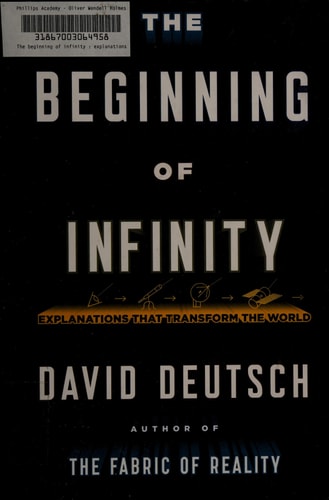
The beginning of infinity: explanations that transform the world

Deutsch, David
"A bold and all-embracing exploration of the nature and progress of knowledge from one of today's great thinkers. Throughout history, mankind has struggled to understand life's mysteries, from the mundane to the seemingly miraculous. In this important new book, David Deutsch, an award-winning pioneer in the field of quantum computation, argues that explanations have a fundamental place in the universe. They have unlimited scope and power to cause change, and the quest to improve them is the basic regulating principle not only of science but of all successful human endeavor. This stream of ever improving explanations has infinite reach, according to Deutsch: we are subject only to the laws of physics, and they impose no upper boundary to what we can eventually understand, control, and achieve. In his previous book, The Fabric of Reality, Deutsch describe the four deepest strands of existing knowledge-the theories of evolution, quantum physics, knowledge, and computation-arguing jointly they reveal a unified fabric of reality. In this new book, he applies that worldview to a wide range of issues and unsolved problems, from creativity and free will to the origin and future of the human species. Filled with startling new conclusions about human choice, optimism, scientific explanation, and the evolution of culture, The Beginning of Infinity is a groundbreaking book that will become a classic of its kind"--
Viking 2011 487 pages

Objective Knowledge An Evolutionary Approach

Karl Popper
'We are workers who are adding to the growth of objective knowledge as masons work on a cathedral.' - Karl Popper, Objective Knowledge The extent and scope of human knowledge is arguably one of humankind's greatest achievements. Since Descartes, however, the theory of human knowledge has been mainly what philosophers call subjectivist: even scientific knowledge was regarded as a special kind of human belief, but human nonetheless. In Objective Knowledge , which contains some of his most important writings on epistemology, Karl Popper breaks decisively and controversially with this view of human knowledge. A realist and a fallibilist, he argues that human knowledge, stated in human language, is no longer part of ourselves but open to objective criticism. Above all, Popper argues that human knowledge grows through a process of conjecture, testing and criticism. Such objective knowledge has significance also for us as individuals, as critical interaction with problem-situation and the constant process of trial and error playing a role in all walks of life, from philosophy and science to music and art. A brilliant exposition of Popper's theory of knowledge, this Routledge Classics edition includes a new Introduction by Jeremy Shearmur, which provides some helpful context to Objective Knowledge and Popper's philosophy in general.
Routledge, Chapman & Hall, Incorporated 2026-02-16 432 pages

The triple helix: gene, organism, and environment

Lewontin, Richard
One of our most brilliant evolutionary biologists, Richard Lewontin has also been a leading critic of those-scientists and non-scientists alike-who would misuse the science to which he has contributed so much. In The Triple Helix , Lewontin the scientist and Lewontin the critic come together to provide a concise, accessible account of what his work has taught him about biology and about its relevance to human affairs. In the process, he exposes some of the common and troubling misconceptions that misdirect and stall our understanding of biology and evolution. The central message of this book is that we will never fully understand living things if we continue to think of genes, organisms, and environments as separate entities, each with its distinct role to play in the history and operation of organic processes. Here Lewontin shows that an organism is a unique consequence of both genes and environment, of both internal and external features. Rejecting the notion that genes determine the organism, which then adapts to the environment, he explains that organisms, influenced in their development by their circumstances, in turn create, modify, and choose the environment in which they live. The Triple Helix is vintage Lewontin: brilliant, eloquent, passionate, and deeply critical. But it is neither a manifesto for a radical new methodology nor a brief for a new theory. It is instead a primer on the complexity of biological processes, a reminder to all of us that living things are never as simple as they may seem.
Harvard University Press 2000 136 pages

Left is not woke

Neiman, Susan
"If you're woke, you're left. If you're left, you're woke. We blur the terms, assuming that if you're one you must be the other. That, Susan Neiman argues, is a dangerous mistake. The intellectual roots and resources of wokeism conflict with ideas that have guided the left for more than 200 years: a commitment to universalism, a firm distinction between justice and power, and a belief in the possibility of progress. Without these ideas, Neiman argues, they will continue to undermine their own goals and drift, inexorably and unintentionally, towards the right. In the long run, they risk becoming what they despise. One of the world's leading philosophical voices, Neiman makes this case by tracing the malign influence of two titans of twentieth-century thought, Michel Foucault and Carl Schmitt, whose work undermined ideas of justice and progress and portrayed social life as an eternal struggle of us against them. A generation schooled with these voices in their heads, raised in a broader culture shaped by the ruthless ideas of neoliberalism and evolutionary psychology, has set about changing the world. It's time they thought again."--
Polity Press 2023-03-20 154 pages

Social Interest A Challenge to Mankind

Alfred Adler
2011 Reprint of 1938 Edition. Full facsimile of the original edition, not reproduced with Optical Recognition Software. Alfred Adler (1870-1937) was an Austrian medical doctor, psychotherapist, and founder of the Adlerian school of individual psychology. In collaboration with Sigmund Freud and a small group of Freud's colleagues, Adler was among the co-founders of the psychoanalytic movement and a core member of the Vienna Psychoanalytic Society. He was the first major figure to break away from psychoanalysis to form an independent school of psychotherapy and personality theory. In this late work, "Social Interest: A Challenge to Mankind", Adler turns to the subject of metaphysics. He argues his vision of society: "Social feeling means above all a struggle for a communal form that must be thought of as eternally applicable... when humanity has attained its goal of perfection... an ideal society amongst all mankind, the ultimate fulfillment of evolution." This social feeling for Adler is a community feeling whereby one feels he or she belongs with others and has also developed an ecological connection with nature (plants, animals, the crust of this earth) and the cosmos as a whole.
Martino Fine Books 2011 312 pages

The Great Partnership Science, Religion, and the Search for Meaning

Jonathan Sacks
Impassioned, erudite, thoroughly researched, and beautifully reasoned, The Great Partnership argues not only that science and religion are compatible, but that they complement each other—and that the world needs both. “Atheism deserves better than the new atheists,” states Rabbi Jonathan Sacks, “whose methodology consists of criticizing religion without understanding it, quoting texts without contexts, taking exceptions as the rule, confusing folk belief with reflective theology, abusing, ridiculing, and demonizing religious faith and holding it responsible for the great crimes against humanity. Religion has done harm; I acknowledge that. But the cure for bad religion is good religion, not no religion, just as the cure for bad science is good science, not the abandonment of science.” Rabbi Sacks’s counterargument is that religion and science are the two essential perspectives that allow us to see the universe in its three-dimensional depth. Science teaches us where we come from. Religion explains to us why we are here. Science is the search for explanation. Religion is the search for meaning. There have been times when religion tried to dominate science. And there have been times, including our own, when it is believed that we can learn all we need to know about meaning and relationships through biochemistry, neuroscience, and evolutionary psychology. In this fascinating look at the interdependence of religion and science, Rabbi Sacks explains why both views are tragically wrong. ***National Jewish Book Awards 2012, Finalist*** Dorot Foundation Award for Modern Jewish Thought and Experience
Knopf Doubleday Publishing Group 2014-09-02 384 pages

A sense of the future

Bronowski, Jacob
Jacob Bronowski truly educated an enormous number of members of that diffuse population usually referred to, with a hint of condescension, as "educated laymen" through his widely shared television series on the concepts of science and through such highly regarded books as The Identity of Man and The Ascent of Man. This volume extends the process to a further level of insight, and it may be more than suggestive that its final essay is entitled "The Fulfillment of Man." Bronowski was an extraordinary teacher precisely because he did not condescend to his audience. He did not talk down to them; he knew how to talk them up to something near his own level, however briefly. He felt that if human beings are taken seriously, they can be led to respond to serious and difficult subjects that relate to the deepest aspects of nature, both beyond and within themselves. A Sense of the Future succeeds brilliantly in this respect, in part because it is a collection of essays that can be read independently as self-contained, delimited presentations; and in part because the book is more than the sum of these individual essays—it is a unified whole in which Bronowski's most abiding concerns are interrelated, juxtaposed, and tested for consistency in various intellectual contexts. The major unifying theme of the work is the intensely creative and human nature of the scientific enterprise—its kinship, at the highest levels of individual achievement, with comparable manifestations of the artistic imagination, and its ethical imperatives, evolved within the community of scientists over the centuries, which both embody and forge the values of civilized life at large. Still, the book's diversity of topics is as striking as the unity of its aim. Among the subjects within the realm of Bronowski's mind that are presented here are the limitations of formal logic and experimental methods, the epistemology of science, the distinctive nature of human language and the human mind, and the bases of biological and cultural evolution. Bronowski also contrasts the findings of science as the "here and now" of man's understanding with the ongoing activity of science as the open-ended search for truth, and he undertakes to demonstrate that the factual, individual is and the ethical, societal ought can be derived each from the other. A mathematician by training, Bronowski published poetry as well as books on literature and intellectual history. In addition to those mentioned above, The Common Sense of Science and Science and Human Values are among the most widely read of his books. Before his death in 1974, he was for many years a Senior Fellow at the Salk Institute for Biological Studies, where his formal area of research was concerned with the questions of human specificity and uniqueness. Clearly, his interests ranged far beyond this area, and in many directions.
MIT Press 1978 286 pages

Athens & Jerusalem

Shestov, Lev
"For more than two thousand years, philosophers and theologians have wrestled with the irreconcilable opposition between Greek rationality (Athens) and biblical revelation (Jerusalem). In Athens and Jersusalem, Lev Shestov -- an inspiration for the French existentialists and the foremost interlocutor of Edmund Husserl, Martin Heidegger, and Martin Buber during the interwar years -- makes the gripping confrontation between these symbolic poles of ancient wisdom his philosophical testament, an argumentative and stylistic tour de force. Although the Russian-born Shestov is little known in the Anglophone world today, his writings influenced many twentieth-century European thinkers, such as Albert Camus, D. H. Lawrence, Thomas Mann, Czesław Miłosz, and Joseph Brodsky. Athens and Jerusalem is Shestov's final, groundbreaking work on the philosophy of religion from an existential perspective. This new, annotated edition of Bernard Martin's classic translation adds references to the cited works as well as glosses of passages from the original Greek, Latin, German, and French. Athens and Jerusalem is Shestov at his most profound and most eloquent and is the clearest expression of his thought that shaped the evolution of continental philosophy and European literature in the twentieth century. "--
Ohio University Press 2016 363 pages

The unfolding of language: an evolutionary tour of mankind's greatest invention

Deutscher, Guy
"Language is mankind's greatest invention--except, of course, that it was never invented." So begins linguist Deutscher's investigation into the genesis and evolution of language. If we started off with rudimentary utterances on the level of "man throw spear," how did we end up with sophisticated grammars, enormous vocabularies, and intricately nuanced degrees of meaning? Drawing on recent discoveries in linguistics, Deutscher exposes the elusive forces of creation at work in human communication, giving us fresh insight into how language emerges, evolves, and decays. He traces the evolution of linguistic complexity from an early "Me Tarzan" stage to such elaborate single-word constructions as the Turkish sehirlilestiremediklerimizdensiniz ("you are one of those whom we couldn't turn into a town dweller"). He shows how the processes of destruction and creation are continuously in operation, generating new words, new structures, and new meanings.--From publisher description.
Henry Holt and Company 2005 358 pages

Worlds of Labour Further Studies in the History of Labour

Eric Hobsbawm
A landmark study in the history of working class labour organisations, WORLDS OF LABOUR is a sequel to the author's widely acclaimed LABOURING MEN. WORLDS OF LABOUR is a series of studies that considers the formation and evolution of working classes in the period between the late eighteenth century and the mid-twentieth, scrutinising their 'consciousness', ways of life and the movements they generated. The emphasis throughout the study is on the way labour organisations, policies and ideas were rooted in the everyday reality of working class life. In the process, leading Marxist historian Eric Hobsbawm reveals the daily struggles of working class militants, many of whom are still unknown to the modern world. The result is a book that is expansive in scope, but fluent and clear in detail. It will serve as a valuable source of reference to those with an academic interest in the subject, and as an inspiration to those who simply wish to discover the development of working class movements.
Phoenix 2014 369 pages

The fabric of reality: the science of parallel universes-- and its implications

Deutsch, David
For David Deutsch, a young physicist of unusual originality, quantum theory contains our most fundamental knowledge of the physical world. Taken literally, it implies that there are many universes “parallel” to the one we see around us. This multiplicity of universes, according to Deutsch, turns out to be the key to achieving a new worldview, one which synthesizes the theories of evolution, computation, and knowledge with quantum physics. Considered jointly, these four strands of explanation reveal a unified fabric of reality that is both objective and comprehensible, the subject of this daring, challenging book. The Fabric of Reality explains and connects many topics at the leading edge of current research and thinking, such as quantum computers (which work by effectively collaborating with their counterparts in other universes), the physics of time travel, the comprehensibility of nature and the physical limits of virtual reality, the significance of human life, and the ultimate fate of the universe. Here, for scientist and layperson alike, for philosopher, science-fiction reader, biologist, and computer expert, is a startlingly complete and rational synthesis of disciplines, and a new, optimistic message about existence.
Allen Lane 1997 390 pages