4 results for "Evolution"

Mindblindness: an essay on autism and theory of mind

Baron-Cohen, Simon
In Mindblindness , Simon Baron-Cohen presents a model of the evolution and development of "mindreading." He argues that we mindread all the time, effortlessly, automatically, and mostly unconsciously. It is the natural way in which we interpret, predict, and participate in social behavior and communication. We ascribe mental states to people: states such as thoughts, desires, knowledge, and intentions. Building on many years of research, Baron-Cohen concludes that children with autism, suffer from "mindblindness" as a result of a selective impairment in mindreading. For these children, the world is essentially devoid of mental things. Baron-Cohen develops a theory that draws on data from comparative psychology, from developmental, and from neuropsychology. He argues that specific neurocognitive mechanisms have evolved that allow us to mindread, to make sense of actions, to interpret gazes as meaningful, and to decode "the language of the eyes." A Bradford Book
MIT 1997-01-22 171 pages

The mind doesn't work that way: the scope and limits of computational psychology

Fodor, Jerry A.
In this engaging book, Jerry Fodor argues against the widely held view that mental processes are largely computations, that the architecture of cognition is massively modular, and that the explanation of our innate mental structure is basically Darwinian. Although Fodor has praised the computational theory of mind as the best theory of cognition that we have got, he considers it to be only a fragment of the truth. In fact, he claims, cognitive scientists do not really know much yet about how the mind works (the book's title refers to Steve Pinker's How the Mind Works ). Fodor's primary aim is to explore the relationship among computational and modular theories of mind, nativism, and evolutionary psychology. Along the way, he explains how Chomsky's version of nativism differs from that of the widely received New Synthesis approach. He concludes that although we have no grounds to suppose that most of the mind is modular, we have no idea how nonmodular cognition could work. Thus, according to Fodor, cognitive science has hardly gotten started.
MIT Press 2000 126 pages

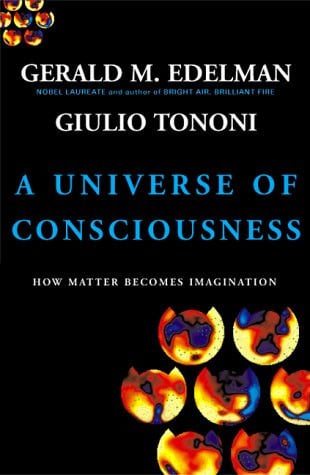
A universe of consciousness: how matter becomes imagination

Edelman, Gerald Maurice
In A Universe of Consciousness, Gerald Edelman builds on the radical ideas he introduced in his monumental trilogy-Neural Darwinism, Topobiology, and The Remembered Present-to present for the first time an empirically supported full-scale theory of consciousness. He and the neurobiolgist Giulio Tononi show how they use ingenious technology to detect the most minute brain currents and to identify the specific brain waves that correlate with particular conscious experiences. The results of this pioneering work challenge the conventional wisdom about consciousness.
Basic Books 2000 274 pages