5 results for "Evolution"

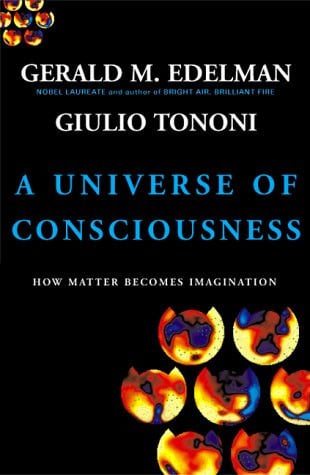
A universe of consciousness: how matter becomes imagination

Edelman, Gerald Maurice
In A Universe of Consciousness, Gerald Edelman builds on the radical ideas he introduced in his monumental trilogy-Neural Darwinism, Topobiology, and The Remembered Present-to present for the first time an empirically supported full-scale theory of consciousness. He and the neurobiolgist Giulio Tononi show how they use ingenious technology to detect the most minute brain currents and to identify the specific brain waves that correlate with particular conscious experiences. The results of this pioneering work challenge the conventional wisdom about consciousness.
Basic Books 2000 274 pages

Biological foundations of emotion

Robert Plutchik,Henry Kellerman
Biological Foundations of Emotion is a detailed account of the relations between brain structure, functions, and emotions based on the results of experimental work and theoretical modeling. A range of issues are examined, such as whether there are structures, circuits, or biochemical events in the brain that control emotional expressions or experience; the effects of lesions and electrical stimulation on emotions; and the role of genetics in the expression of emotion. Comprised of 16 chapters, this volume begins with a presentation of general models of brain functioning. The first chapter deals with the neural substrate for emotion and cites evidence showing that the conventional concept of a limbic system underlying all emotions is not adequate. The discussion then turns to ethological and evolutionary factors of emotion, with emphasis on neuroendocrine patterns of emotional response; ictal symptoms relating to the nature of affects and their cerebral substrate; the anatomy of emotions; and neural systems involved in emotion in primates. Subsequent chapters present different but overlapping brain models of aggression and examine the role of biochemistry in understanding emotions. This book will be of interest to biologists and psychologists.
Academic Press 1986 423 pages

Wider than the sky: the phenomenal gift of consciousness

Edelman, Gerald M.
A neuroscientist demystifies the subject of consciousness in this up-to-date discussion of mind-body connections. How does the firing of neurons give rise to subjective sensations, thoughts, and emotions? How can the disparate domains of mind and body be reconciled? The quest for a scientifically based understanding of consciousness has attracted study and speculation across the ages. In this direct and non-technical discussion of consciousness, Dr. Gerald M. Edelman draws on a lifetime of scientific inquiry into the workings of the brain to formulate answers to the mind-body questions that intrigue every thinking person. Concise and understandable, the book explains pertinent findings of modern neuroscience and describes how consciousness arises in complex brains. Edelman explores the relation of consciousness to causation, to evolution, to the development of the self, and to the origins of feelings, learning, and memory. His analysis of the brain activities underlying consciousness is based on recent remarkable advances in biochemistry, immunology, medical imaging, neuroscience, and evolutionary biology, yet the implications of his book extend farther--beyond the worlds of science and medicine into virtually every area of human inquiry.
Yale University Press 2004-01-01 201 pages

Human nature explored

Mandler, George
What exactly is "human nature"? Are we correct in accepting ourselves as unchangeable, determined by biology, or is this idea an obstacle to our cognitive, emotional, and evolutionary development? George Mandler explores these questions from a fresh evolutionary and social perspective. He examines the burgeoning field of evolutionary psychology and suggests a mid-course correction. Topics are approached from a variety of backgrounds, drawing on relevant literature and Mandler's own research. He begins with what we know about evolution and gene expression, then moves on to the complex phenomena of consciuosness and emotion. The constraints of both nature and nurture are discussed as limiting forces on human development, and natural selection is considered in the context of our social fabric, which draws on both psychological and anthropological knowledge. Mandler considers human difference, particularly in regard to intelligence and gender, and discusses the nature of human values, including our need for morality and freedom. The book concludes with an appraisal of human cognition and language.
Oxford University Press 1997-09-04 208 pages