29 results for "Evolution"

Reconstruction: America's unfinished revolution, 1863-1877

Foner, Eric
Historian Eric Foner chronicles the way in which Americans -- black and white -- responded to the unprecedented changes unleashed by the war and the end of slavery. He addresses the quest of emancipated slaves searching for economic autonomy and equal citizenship, and describes the remodeling of Southern society, the evolution of racial attitudes and patterns of race relations, and the emergence of a national state possessing vastly expanded authority and committed, for a time, to the principle of equal rights for all Americans.
HarperPerennial 2014-12-02 690 pages

What It Took to Win A History of the Democratic Party

Michael Kazin
A New York Times Book Review Editors’ Choice A most anticipated book of 2022 at Vulture and Kirkus Reviews A leading historian tells the story of the United States’ most enduring political party and its long, imperfect, and newly invigorated quest for “moral capitalism,” from Andrew Jackson to Joseph Biden. The Democratic Party is the world’s oldest mass political organization. But what has the party stood for through the centuries, and how has it managed to succeed in elections and govern? In What It Took to Win , the eminent historian Michael Kazin tells the story of the party’s longtime commitment to promoting “moral capitalism,” a system that mixes entrepreneurial freedom with the welfare of workers. Yet the party that championed the rights of the white working man also vigorously protected or furthered the causes of slavery, segregation, and Native American removal. With its evolution toward a more inclusive, egalitarian vision, the party won durable victories for Americans of all backgrounds. But it has also struggled to hold together a majority coalition and advance a persuasive agenda. Kazin traces the party’s fortunes through vivid character sketches of its key thinkers and doers, from William Jennings Bryan to Eleanor Roosevelt to Barack Obama. Throughout, Kazin reveals the rich interplay of personality, belief, strategy, and policy that defines the life of the Democratic Party and outlines the core components of a political legacy that President Joe Biden and his co-partisans rely on today as they seek to revitalize the American political experiment.
Picador 2023-02-28 432 pages

Churchill and the Jews

Martin Gilbert
Visiting Israel in 1972, Gilbert discussed Winston Churchill’s influence on the evolution of the Zionist ideal with the Israeli leader, David Ben-Gurion, at whose last meeting with Churchill in 1960, Churchill declared: “You are a wise leader of a brave people.” Born into a British class and society that was far from well-disposed towards Jews, Churchill rejected anti-Semitic attitudes. In the early 1920s, as a senior member of the British government, Churchill took a lead in securing for the Jews a National Home in Palestine that would be open to Jewish immigration from all over the world. In 1948, Churchill urged immediate recognition of the State of Israel, and, in 1951, strongly supported Israel’s right — denied by Egypt — of free passage through the Suez Canal. The book also details acts of rescue initiated by Churchill on behalf of European Jewry during the Second World War. When Churchill was asked to bomb the railway lines leading to Auschwitz, his response was immediate: “Get anything out of the air force you can.” Gilbert follows this story to its unexpected conclusion, and the saving of more than 100,000 Jewish lives. Many times during fifty years of public life, Churchill was called upon by the Jews of Britain to intervene on their behalf both nationally and internationally. His responses made it clear to them that he was, as he once expressed it, “their friend.”
McClelland & Stewart 2007 359 pages

Audience of One Trump, Television, and the Fracturing of America

James Poniewozik
New York Times chief television critic James Poniewozik offers a “darkly entertaining” (Carlos Lozada, Washington Post ) history of mass media from the early 1980s to today, demonstrating how a volcanic, camera-hogging antihero merged with America’s most powerful medium to become our forty-fifth president. In charting the seismic evolution of television from a monolithic mass medium into today’s fractious confederation of spite-and-insult media subcultures, Poniewozik reveals how Donald Trump took advantage of these historic changes by constantly reinventing himself: from a boastful cartoon zillionaire; to 1990s self-parodic sitcom fixture; to The Apprentice reality-TV star; and finally to Twitter-mad, culture-warring demagogue. Already lauded as a “brilliant and daring” (Annalisa Quinn, NPR) work that defines a generation, Audience of One emerges as a classic in cultural criticism.
National Geographic Books 2020-09-15 304 pages

Matters of Principle An Insider's Account of America's Rejection of Robert Bork's Nomination to the Supreme Court

Mark Gitenstein
In his bestseller The Tempting of America , Robert Bork portrayed himself as someone whose views are in the American mainstream, and has said that the failure of the Senate to approve him was an aberration. On the contrary, Matters of Principle shows that with the rejection of Bork, Americans emphatically reaffirmed one of the enduring virtues of our national character—a fervent belief in individual rights. In the end, Americans rejected the cramped vision of Robert Bork and the Right. Matters of Principle is a lively, provocative, and thoughtful first-hand account of this tumultuous battle for control of the Supreme Court, a battle that continues to make news but whose strategy was shaped largely behind closed doors. For Joseph Biden, Chairman of the Senate Judiciary Committee, it would prove to be a watershed moment. Biden wanted to be President and was in the middle of a campaign for the Democratic nomination when the process began. Robert Bork’s ambition was to serve on the Supreme Court. Both saw their dreams die amid constant pressures from political action groups, other senators, editorial boards, and the President. The goal for Biden was to make the American public interested in a battle over judicial philosophy without being perceived as a political opportunist. Bork’s aim was to become the standard-bearer of the Reagan Revolution, to project himself as a moderate, while his judicial decisions and his writings showed otherwise. The inner proceedings provide a fascinating look at the players in this event, from the editorial boards of The New York Times and The Washington Post to the Senate chambers of Biden, Thurmond, Kennedy, et al., to the White House, where President Reagan erred enormously, first by choosing Bork, then by adopting faulty strategy to help him, and finally by apparently abandoning Bork and leaving him without strong support. Perhaps most important, Matters of Principle is a story about the clash of judicial ideas and ideals. Mark Gitenstein traces the evolution of Bork’s legal philosophy from his days at Yale through his time in the Nixon Administration, finally offering a portrait of a man far from the mainstream of American beliefs.
Simon & Schuster 2018-11-24 384 pages

The Opposite of Hate A Field Guide to Repairing Our Humanity

Sally Kohn
“Brilliantly illustrates the immense and disarming power of changing course and driving not toward division, but toward civility and mutual respect.” -- Ms . magazine As a progressive commentator on Fox News and now CNN, Sally Kohn has made a career out of bridging intractable political differences. In this age of dangerous partisan resentment and rising bigotry, she decided to investigate hate itself--to better consider how we can stop it. With her trademark humor and humanity, Kohn introduces us to leading researchers and scientists who are exploring the evolutionary and cultural roots of hate. She travels to Rwanda, to the Middle East, and across the United States, talking with former terrorists and reformed white supremacists, and even sitting down with some of her own Twitter trolls. What she discovers is surprising: All of us harbor hate but the powerful acknowledgment that we are all in this together can lead us out of the wilderness. The opposite of hate is connection .
Algonquin Books 2019-03-26 272 pages

Democracy and populism: fear & hatred

Lukacs, John
This intensely interesting—and troubling—book is the product of a lifetime of reflection and study of democracy. In it, John Lukacs addresses the questions of how our democracy has changed and why we have become vulnerable to the shallowest possible demagoguery. Lukacs contrasts the political systems, movements, and ideologies that have bedeviled the twentieth century: democracy, Liberalism, nationalism, fascism, Bolshevism, National Socialism, populism. Reflecting on American democracy, Lukacs describes its evolution from the eighteenth century to its current form—a dangerous and possibly irreversible populism. This involves, among other things, the predominance of popular sentiment over what used to be public opinion. This devolution has happened through the gigantic machinery of publicity, substituting propaganda—and entertainment—for knowledge, and ideology for a sense of history. It is a kind of populism that relies on nationalism and militarism to hold society together. Lukacs's observations are original, biting, timely, sure to inspire lively debate about the precarious state of American democracy today.
Yale University Press 2005-03-08 248 pages

Worlds of Labour Further Studies in the History of Labour

Eric Hobsbawm
A landmark study in the history of working class labour organisations, WORLDS OF LABOUR is a sequel to the author's widely acclaimed LABOURING MEN. WORLDS OF LABOUR is a series of studies that considers the formation and evolution of working classes in the period between the late eighteenth century and the mid-twentieth, scrutinising their 'consciousness', ways of life and the movements they generated. The emphasis throughout the study is on the way labour organisations, policies and ideas were rooted in the everyday reality of working class life. In the process, leading Marxist historian Eric Hobsbawm reveals the daily struggles of working class militants, many of whom are still unknown to the modern world. The result is a book that is expansive in scope, but fluent and clear in detail. It will serve as a valuable source of reference to those with an academic interest in the subject, and as an inspiration to those who simply wish to discover the development of working class movements.
Phoenix 2014 369 pages

Humanity on a Tightrope Thoughts on Empathy, Family, and Big Changes for a Viable Future

Paul R. Ehrlich,Robert E. Ornstein
When we think of family, we most often think of our sisters and brothers, our cousins and grandparents, rather than our world family or even our community connections. We still identify with our differences more than our similarities, unless it's convenient to do otherwise. Here, two seasoned authors tackle the question of family and what it means to us now and how it might change to help us address the problems that affect us all. Using specific examples throughout the work, they present a unique approach to what it means to belong to one human family. Beginning with a consideration of how the family unit has begun to be defined by allegiances, by common ties and empathy, the authors then discuss the evolution of the family unit and how the "us" vs. "them" mentality gave way to a way of life that separated peoples rather than brought them together. They consider family values, how they arose, developed, were perverted or perfected to suit the family unit's needs, and the confusion that followed. Humanity on a Tightrope focuses on what families and family values are, and how they often create an "us versus them" mentality that is at the root of many of today's most crucial problems from terrorism, racism, and war to the failure of humanity to come to grips with potentially lethal global environmental problems. The book underlines a basic element for solving the human predicament - quickly spreading the domain of empathy. It takes a close look at how we can do that, building on the findings of both social and natural science and using tools ranging from brain imaging to the internet. It explains how civilization is unlikely to persist unless many more people learn to put themselves in the shoes of others to keep society balancing on the tightrope to sustainability - a tightrope suspended over the collapse of civilization.
Bloomsbury Academic 2012-03-16 210 pages

A discipline divided: schools and sects in political science

Almond, Gabriel A.
In this collection of essays, eminent scholar Gabriel Almond describes the ways in which the discipline of political science has become divided against itself. "The various schools and sects of political science," writes Almond, "now sit at separate tables, each with its own conception of proper political science, but each protecting some secret island of vulnerability." In his overview, Almond examines the "hard" versus "soft" science approaches, as applied by scholars of both the left and the right. In Part I, he explores the history of model-fitting in communism studies, the strengths and weaknesses of the rational choice movement, and the historical forces and processes that have shaped political culture theory. In Part II, Almond addresses the problem of the transmission of methods and findings within the discipline. He discusses the current emphasis on pluralism among political theorists in Communist countries while a corresponding devaluation of this concept is occurring in the West. He concludes with an evaluation of the neo-statist movement and the evolution of political development studies. With this book, Professor Almond crowns a lifetime achievement, and makes final his case for the study of political culture. "It is a most interesting book. For what it′s worth, I think this book will be a successful one. This is not because of the talent and eminence of the author, but because I think there are lots of political scientists who will enjoy reading about these continuing struggles. In sum, I think the book will be a hit." --Aaron Wildavsky, University of California, Berkeley "Judged by the breadth of his professional knowledge and the depth of his command of the literature, Gabriel A. Almond is the most learned political scientist of today. In these wise and erudite essays he provides careful documentation of where the discipline is and what those who went before really said. Hereafter, no graduate student should feel prepared for general examinations in any field of political science without carefully reading A Discipline Divided, and taking to heart its lesson that getting the record straight is a necessary foundation for advancing social science knowledge." --Lucian W. Pye, Massachusetts Institute of Technology "Who better to provide a prospect and retrospect on the social sciences than a 1938 University of Chicago Ph.D.; a pupil of Frank Knight, Harold Lasswell, and G. H. Mead; and a fellow graduate student with Herbert Simon, George Stigler, Edward Shils, V.O. Key, and others? This book shows that he is still a pioneer in the social sciences, and even prepared to explore ideas that are nowadays fresh because they have been around so long that they are forgotten. The result is a book that is of interest to every social scientist." --Journal of Public Policy
Sage Publications 1990 348 pages

Interpreting Ethiopia Observations of Five Decades

Donald N. Levine
About the Book: In this remarkable collection, internationally renowned Ethiopianist Donald Levine has assembled interpretive vignettes-some never before published-spanning more than half a century. Thanks to his unique experiences living among peasants of Northern Shoa, visiting historic monasteries, and enjoying personal connections with modernizing Ethiopians from all political viewpoints, these essays offer acute glimpses into everything from local life-worlds to historic perspectives spanning two millennia. Catching diverse ways in which Ethiopians construct their own narratives is one of the distinctive features of this work. This includes stunning interpretations of Ethiopia's national epic, Kibre Negest; different ways in which Oromos construct their own narratives; and the clash of perspectives among protagonists in the 2005 political crisis, between the ruling party and the main opposition party at that time. The book also includes important political documents such as Levine's first-hand account of the December 1960 coup; his 1976 testimony for the U.S. Senate Subcommittee on Africa concerning the Derg; and his thoughtful plea regarding the 1993 Eritrean referendum. The book climaxes with broad interpretive sketches, including the renowned essay on Ethiopia and Japan in comparative civilizational perspective, and Levine's revised interpretation of the evolution of Ethiopia as a historic multi-ethnic society. In addition to historic and cultural forays, Interpreting Ethiopia includes a number of chapters devoted to current domestic challenges, such as the problem of chronic hunger and overpopulation; the problems posed by the exponential growth of an Ethiopian Diaspora after 1974; and the obstacles and opportunities faced by Ethiopians in their effort to create a national public. Reviews: Professor Levine's essays savor like a fine cup of Ethiopian coffee. It is a blend of the earthy taste of ethnography, the subtle aroma of social theory, and the spices of history! -Eloi Ficquet, co-editor of Understanding Contemporary Ethiopia: Monarchy, Revolution and the Legacy of Meles Zenawi The breadth, depth and commitment of Levine's work on Ethiopia spanning fifty years has finally been woven together in this unique and inspiring collection that links profound insights across disciplines from anthropology and archaeology through sociology to history, political science and peace-making. Interpreting Ethiopia is required reading for anyone interested in Ethiopian studies. -Alula Pankhurst, co-editor of Moving People: Displacement, Development and the State in Ethiopia and Country Director of Young Lives Ethiopia This outstanding collection of work by Donald Levine from 1959 through 2014 demonstrates why he is unquestionably one of the world's leading scholars on Ethiopia. -David Shinn, Adjunct Professor of International Affairs at the George Washington University and the Former United States Ambassador to Ethiopia About the Author: DONALD N. LEVINE, is the Peter B. Ritzma Professor of Sociology and former dean of the College at the University of Chicago. For nearly half a century he has been devoted to Ethiopia-as a scholar, in university teaching, in providing expert assistance to various government bodies, and in community service on behalf of Ethiopians at home and abroad. Levine's publications on Ethiopia include dozens of articles, parts of The Flight from Ambiguity: Essays in Social and Cultural Theory (1985), and two books, Wax and Gold: Tradition and Innovation in Ethiopian Culture (1965), now reprinted by Tsehai Publishers and Greater Ethiopia: The Evolution of a Multiethnic Society (1974), a second edition of which, with a new preface was published, in 2001.
Tsehai Publishers 2014 526 pages

The Oslo Syndrome Delusions of a People Under Siege

Kenneth Levin
In the 1993 Oslo accords, Israel embraced Yasser Arafat as its "peace partner." It then installed him in Gaza and the West Bank as head of a nascent Palestinian government, allowed him to bring with him some 7,000 of his loyalist gunmen, and provided the gunmen with weapons, even as Arafat continued to support terrorist attacks on Israelis and to assure Palestinians and other Arabs his goal remained Israel's destruction.Why did Israel pursue the path of Oslo? Why did it persist on that path when, in the wake of the initial Oslo agreements, the Palestinians unleashed an unprecedented wave of anti-Israel terror? Palestinian leaders also routinely called for holy war against Israel and compared Oslo to the Treaty of Hudaibiya, which Mohammed had signed in 628 and abandoned when his forces became strong enough to overwhelm his adversaries. Arafat and his subordinates told Arab audiences that Oslo was a step in the PLO's 1974 "plan of phases," a strategy of acquiring whatever land could be won by negotiations and using that territory as a base for pursuing Israel's annihilation. Yet Israel responded with additional concessions. What psychological, historical and communal forces spawned policies that undermined Israel's security and even threatened its survival? Dr. Levin's original and powerfully persuasive analysis relates Israeli diplomacy of the nineteen-nineties to psychological responses common among chronically besieged populations, whether minorities subjected to defamation, discrimination and assault or small nations under chronic attack by their neighbors. More particularly, he demonstrates links between the evolution of Oslo and the long history of Diaspora Jews being subjected to persistent abuse. The reaction of many enduring such abuse was to seek to improve their predicament by endorsing elements of the surrounding societies' bigoted indictments and embracing delusions of salvation through self-effacement and concessions. This case study in the psychology of a community under chronic attack takes on broader significance at a time when even traditionally safe and secure societies such as the United States are confronting the psychological challenges posed by terrorist assaults.
Smith and Kraus 2005 599 pages

Concepts of justice

Raphael, D. D.
In this fascinating exploration of justice, eminent philosopher D. D. Raphael presents the culmination of a lifetime's study of its evolution, from ancient times to the late twentieth century. His aim is not just historical but philosophical: to illuminate our true understanding of justice. His unique approach examines not only classic texts by such philosophers as Plato, Aristotle, Hume, Mill, and Rawls but also the Bible and Greek tragedy, as well as some neglected but important thought from the modern era. Lucid and stimulating, this work can be enjoyed by anyone interested in moral and political thought, even by those with little to no knowledge of political theory or philosophy.
Clarendon Press 2001-01 256 pages

Politics in Black and White Race and Power in Los Angeles

Raphael Sonenshein
This book reaches deep into the past of the city of Los Angeles and carries through to the dramatic events that have recently received global attention--the Rodney King beating and the uprising in South Central L.A. Tracing the evolution of an extraordinary biracial coalition in Los Angeles behind Mayor Tom Bradley, Raphael Sonenshein shows how "crossover" politics and racial violence coexist in urban America. While challenging the prevailing pessimism about biracial coalitions in general, he also compares their relative successes in Los Angeles to their disheartening failures in New York City. What emerges is a probing look at a crucial issue of politics in the United States: can whites and minorities find common ground?
Princeton University Press 1993 301 pages

Formative Writings (Routledge Revivals)

Simone Weil
This volume, first published in English in 1987 makes available an important part of Weil’s early writings. Although primarily known as a religious thinker, she devoted enormous energy in her formative years to her work as a political activist and as a philosopher/teacher. This book reveals these other sides of Weil and demonstrates the lines of continuity underlying her whole thought. Written between 1929 and 1941 the book covers a crucial and transitional period in Weil’s life. Taken together they represent invaluable primary source material on the evolution of Weil’s life and on her chosen method of abstracting elements from her personal experience and transmuting that experience into considered thought. Even when highly theoretical, her writing was always concerned with the application of her intelligence to concrete problems of human existence.
Routledge 2009-12-17 294 pages

White Protestant Nation The Rise of the American Conservative Movement

Allan J. Lichtman
Spanning nearly one hundred years of American political history, and abounding with outsize characters—from Lindbergh to Goldwater to Gingrich to Abramoff— White Protestant Nation offers a penetrating look at the origins, evolution, and triumph (at times) of modern conservatism. Lichtman is both a professor of political history at American University and a veteran journalist, and after ten years of prodigious research, he has produced what may be the definitive history of the modern conservative movement in America. He brings to life a gallery of dynamic right-wing personalities, from luminaries such as Strom Thurmond, Phyllis Schlafly, and Bill Kristol to indispensable inside operators like financiers Frank Gannett and J. Howard Pew. He explodes the conventional wisdom that modern conservative politics began with Goldwater and instead traces the roots of today's movement to the 1920s. And he lays bare the tactics that conservatives have used for generations to put their slant on policy and culture; to choke the growth of the liberal state; and to build the most powerful media, fundraising, and intellectual network in the history of representative government. White Protestant Nation is entertaining, provocative, enlightening, and essential reading for anyone who cares about modern American politics and its history.
Grove Press 2008 598 pages

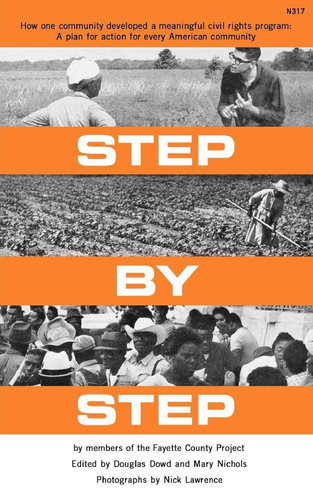
Step by Step Evolution and Operation of the Cornell Students' Civil-Rights Project in Tennessee, Summer, 1964

Douglas Dowd
The book arose out of the authors' experiences in a project which was itself unique: The Cornell-Tompkins Committee for Free and Fair Elections in Fayette County, Tennessee. The project entailed six to eight weeks of living in Fayette County by forty-five volunteers, mostly students from Cornell University, in the summer of 1964. The project was financed entirely, to an amount exceeding fifteen thousand dollars, by the contributions of students, faculty, and townspeople in and around Cornell University, and by contributions from more distant places solicited by those involved at Cornell.Of the many things learned from the Cornell project, one of the most important was how responsive a community can become when confronted with a concrete civil rights program, one with which it can identify, one small enough to be feasible and intelligible, but still compelling in terms of the needs involved.The authors believe that many thousands of Americans can find no good answer to the questions "What can I do." not because they are unwilling to do much, nor because there is little to be done, but because they lack the knowledge of what is needed where, and how and with whom one can go about responding to such needs. The book therefore undertakes, step by step, to describe and explain the development of the project at Cornell and its workings during the summer in Tennessee, and reasons that similar steps can be taken by others, with appropriate variations. It concludes with a detailed appendix listing civil rights projects and organizations desperately in need of help, whether in terms of money or volunteers or both.
W. W. Norton, Incorporated 1965-04 132 pages

For Rulers Priming Political Leaders for Saving Humanity from Itself

Yehezkel Dror
In this striking book, Yehezkel Dror bravely goes where few authors dare, offering a big-picture view of the fateful choices facing the human species. He urges humankind to adopt unconventional survival and thriving strategies, including elevating the future of humanity above state interests, limiting the production and spread of dangerous knowledge and tools, and strengthening humanity's collective deliberative capacity. The author confronts the evolutionary trap of science and technology ensnaring unprepared humankind by providing it with awesome future-shaping power, which contemporary values and institutions are unable to handle. Dror warns that tribal and nationalist values, the inability to learn from history, and mediocre leadership will catastrophically endanger the future of human life, making radical, even painful, innovations essential. According to Dror, the prevailing form of politics is obsolete. Instead, he argues urgently for a new type of political leader - "Homo Sapiens Governors" - willing and able to fulfill the daunting mission to save humanity from itself. Recognizing that the tyrannical status quo will try to prevent essential transformations, Dror predicts new crises making what is still unthinkable clearly compelling - and that humankind will have to choose: learn rapidly to survive and thrive, or perish. YEHEZKEL DROR is professor emeritus at the Hebrew University of Jerusalem. Recognized as a founder of modern policy studies, he integrates multi-disciplinary scholarship with extensive personal experience as a global advisor into a novel paradigm on alternative evolutionary futures of humanity - as shaped by fateful choices humanity has never before faced.
Amazon Digital Services LLC - Kdp 2017-08-18 116 pages