19 results for "Evolution"

War of the Worldviews

Chopra, Deepak,Mlodinow, Leonard
Two bestselling authors first met in a televised Caltech debate on “the future of God,” one an articulate advocate for spirituality, the other a prominent physicist. This remarkable book is the product of that serendipitous encounter and the contentious—but respectful—clash of worldviews that grew along with their friendship. In War of the Worldviews these two great thinkers battle over the cosmos, evolution and life, the human brain, and God, probing the fundamental questions that define the human experience. How did the universe emerge? What is the nature of time? What is life? Did Darwin go wrong? What makes us human? What is the connection between mind and brain? Is God an illusion? This extraordinary book will fascinate millions of readers of science and spirituality alike, as well as anyone who has ever asked themselves, What does it mean that I am alive?
Crown Publishing Group 2012-10-02 352 pages

The Jews Story of a People

Howard Fast
Beginning in the ancient world, this colourful, fast-paced saga enriches our understanding of the Jews and their impact on the world. With drama no fiction can match, master storyteller Howard Fast traces the evolution of a tradition powerful enough to give lasting identity to a scattered, wandering people. Bringing to life the extraordinary men and women who have shaped history-Moses, Hillel, Jesus (and many more) -- this compelling book explores the customs and philosophies that have endured persecution, emigration, and the Holocaust. Fast also probes the towering achievements of this unique and fascinating people, illustrating their important role in the origins of Western culture, Christianity and modern Europe. "The Jews" is comprehensive, enlightening and utterly readable.
ibooks, Incorporated 2006 338 pages

What it means to be moral: why religion is not necessary for living an ethical life

Zuckerman, Phil
“A thoughtful perspective on humans' capacity for moral behavior.” — Kirkus Reviews “A comprehensive introduction to religious skepticism.” — Publishers Weekly In What It Means to Be Moral: Why Religion Is Not Necessary for Living an Ethical Life , Phil Zuckerman argues that morality does not come from God. Rather, it comes from us: our brains, our evolutionary past, our ongoing cultural development, our social experiences, and our ability to reason, reflect, and be sensitive to the suffering of others. By deconstructing religious arguments for God–based morality and guiding readers through the premises and promises of secular morality, Zuckerman argues that the major challenges facing the world today—from global warming and growing inequality to religious support for unethical political policies to gun violence and terrorism—are best approached from a nonreligious ethical framework. In short, we need to look to our fellow humans and within ourselves for moral progress and ethical action. “In this brilliant, provocative, and timely book, Phil Zuckerman breaks down the myth that our morality comes from religion—compellingly making the case that when it comes to the biggest challenges we face today, a secular approach is the only truly moral one.” —Ali A. Rizvi, author of The Atheist Muslim
Counterpoint Press 2019 360 pages

The Great Partnership Science, Religion, and the Search for Meaning

Jonathan Sacks
Impassioned, erudite, thoroughly researched, and beautifully reasoned, The Great Partnership argues not only that science and religion are compatible, but that they complement each other—and that the world needs both. “Atheism deserves better than the new atheists,” states Rabbi Jonathan Sacks, “whose methodology consists of criticizing religion without understanding it, quoting texts without contexts, taking exceptions as the rule, confusing folk belief with reflective theology, abusing, ridiculing, and demonizing religious faith and holding it responsible for the great crimes against humanity. Religion has done harm; I acknowledge that. But the cure for bad religion is good religion, not no religion, just as the cure for bad science is good science, not the abandonment of science.” Rabbi Sacks’s counterargument is that religion and science are the two essential perspectives that allow us to see the universe in its three-dimensional depth. Science teaches us where we come from. Religion explains to us why we are here. Science is the search for explanation. Religion is the search for meaning. There have been times when religion tried to dominate science. And there have been times, including our own, when it is believed that we can learn all we need to know about meaning and relationships through biochemistry, neuroscience, and evolutionary psychology. In this fascinating look at the interdependence of religion and science, Rabbi Sacks explains why both views are tragically wrong. ***National Jewish Book Awards 2012, Finalist*** Dorot Foundation Award for Modern Jewish Thought and Experience
Knopf Doubleday Publishing Group 2014-09-02 384 pages

Athens & Jerusalem

Shestov, Lev
"For more than two thousand years, philosophers and theologians have wrestled with the irreconcilable opposition between Greek rationality (Athens) and biblical revelation (Jerusalem). In Athens and Jersusalem, Lev Shestov -- an inspiration for the French existentialists and the foremost interlocutor of Edmund Husserl, Martin Heidegger, and Martin Buber during the interwar years -- makes the gripping confrontation between these symbolic poles of ancient wisdom his philosophical testament, an argumentative and stylistic tour de force. Although the Russian-born Shestov is little known in the Anglophone world today, his writings influenced many twentieth-century European thinkers, such as Albert Camus, D. H. Lawrence, Thomas Mann, Czesław Miłosz, and Joseph Brodsky. Athens and Jerusalem is Shestov's final, groundbreaking work on the philosophy of religion from an existential perspective. This new, annotated edition of Bernard Martin's classic translation adds references to the cited works as well as glosses of passages from the original Greek, Latin, German, and French. Athens and Jerusalem is Shestov at his most profound and most eloquent and is the clearest expression of his thought that shaped the evolution of continental philosophy and European literature in the twentieth century. "--
Ohio University Press 2016 363 pages

Who Wrote the Dead Sea Scrolls? The Search for the Secret of Qumran

Norman Golb
A compelling new interpretation of the origin and meaning of the Dead Sea Scrolls. Golb fundamentally challenges those who argue that the writings discovered at Qumran belonged to a small, desert-dwelling fringe sect. Instead, he shows why the scrolls must have been the work of many groups in ancient Judaism, kept in libraries in Jerusalem and smuggled out of the capital just before the Romans attacked in A.D. 70. He describes the scrolls' rich diversity of ideas, and offers a new interpretation of their significance for the evolution of both Judaism and Christianity. maps and illustrations.
DIANE Publishing Company 1998-12 446 pages

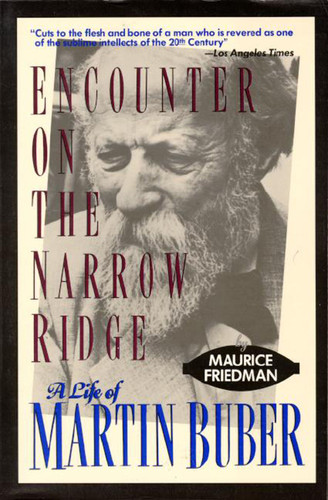
Encounter on the Narrow Ridge A Life of Martin Buber

Maurice Friedman
Martin Buber's stature as the most significant Jewish religious philosopher of the twentieth century is reinforced by his accomplishments and renown in areas as diverse as Hasidism, psychotherapy, education, folklore, and politics. His classic, I and Thou, is known and studied all over the world. In this complete and masterful biography, Maurice Friedman traces the interweaving of Buber's wholehearted engagement with world events and crises and the evolution of his unique and influential philosophy. We see the impact of World War I on the young thinker; his work in education, community, and politics between the wars; his leadership of the spiritual resistance to the Nazis in Hitler's Germany; and his more than forty years of fighting for Jewish-Arab understanding. In addition, we see Buber interact with Heidegger, Sartre, Jung, Ben Gurion, Hesse, Rosenzweig, and Hammarskjold. Through his close relationship with Buber and recent access to forty-five thousand unpublished letters, Maurice Friedman recreates Buber's vitality, his philosophy of dialogue, and his spirituality based on a personal relationship with God. Encounter on the Narrow Ridge delivers the essential spontaneity of a great man who saw in every encounter a focal point for human growth.
Paragon House 1998-06-15 496 pages

Formative Writings (Routledge Revivals)

Simone Weil
This volume, first published in English in 1987 makes available an important part of Weil’s early writings. Although primarily known as a religious thinker, she devoted enormous energy in her formative years to her work as a political activist and as a philosopher/teacher. This book reveals these other sides of Weil and demonstrates the lines of continuity underlying her whole thought. Written between 1929 and 1941 the book covers a crucial and transitional period in Weil’s life. Taken together they represent invaluable primary source material on the evolution of Weil’s life and on her chosen method of abstracting elements from her personal experience and transmuting that experience into considered thought. Even when highly theoretical, her writing was always concerned with the application of her intelligence to concrete problems of human existence.
Routledge 2009-12-17 294 pages

From Empathy to Denial Arab Responses to the Holocaust

Meir Litvak,Esther Webman
Based on years of research conducted mostly in Arabic sources, Meir Litvak and Ester Webman track the evolution of post-World War II perceptions of the Holocaust and their parallel emergence in the wake of the Arab-Israeli conflict of 1948. Following the establishment of the State of Israel, Arab attitudes toward the Holocaust became entangled with broader anti-Zionist and anti-Semitic sentiments. Litvak and Webman track this discourse through the work of leading intellectuals and turn to representations of the Holocaust in the media and culture of Egypt, Lebanon, Jordan, and among the Palestinian people. Their chronological history, which spans sixty years, provides a remarkable perspective on the origins, development, and tenaciousness of anti-Holocaust belief. From Empathy to Denial is the first comprehensive investigation of Holocaust denial in the Arab world, and is based on years of painstaking historical research of mostly Arabic language sources. The authors explore how Holocaust denial emerged after the Second World War, how it paralleled the wider Arab-Israeli conflict after the establishment of the State of Israel in 1948 and how it subsequently became entangled with broader anti-Zionist and anti-Semitic sentiment. In particular Litvak and Webman look at the role of leading intellectuals, the media and other cultural forms in Egypt, Lebanon, Jordan and among the Palestinians and how their representation of the Holocaust has evolved in the last sixty years.
Oxford University Press 2011-04-19 416 pages

The Book of Words Talking Spiritual Life, Living Spiritual Talk

Lawrence Kushner
"According to the Hebrew Bible, God made the world with words. God just spoke and the world became reality. (The Aramaic for 'I create as I speak' is avara k'davara, or in magician's language, abracadabra.) ... This does not protect words from the numbing effects of overuse in any religious tradition.... We need to dust off the words, shake away the accretions, wonder again about what they originally might have meant and enable ourselves to live in the word." --from the Introduction With creativity and poetry (and occasional heresy) Kushner dusts off thirty classical Hebrew words, shakes them free of the effects of generations of overuse, "re-translates" them and liberates their ancient holy power. The result is a contemporary spiritual guide for your personal religious life. According to the Hebrew Bible, God made the world with words. God just spoke and the world came into being. Words therefore are not merely sounds signifying something else; they are instruments of creation, primary reality itself. They need only to be read, spoken and interpreted. And to know them is to know reality itself. Kushner has designed the book himself, seamlessly blending graphics and content. In doing so he evokes the aesthetics of an ancient manuscript and a vision of our power to shape the future. Each finely crafted chapter begins with a Hebrew word and Kushner's provocative English translation. At the bottom of the page is a transliteration of the Hebrew along with its more customary English rendering. In addition to his own intriguing definition, he includes a biblical citation anchoring the word, along with a more recent text showing the word's evolution. Finally, we are offered a personal, meditative exercise designed to enable you to "live in the word."
Jewish Lights Publishing 1993 142 pages

The cultural gradient: the transmission of ideas in Europe, 1789-1991

Catherine Evtuhov,Stephen Kotkin
Is there a sharp dividing line that separates Europe into "East" and "West"? This volume brings together prominent scholars from the United States, Canada, France, Poland, and Russia to examine the evolution of the concept of Europe in the two centuries between the French Revolution and the collapse of the Soviet Union. Inspired by the ideas of Martin Malia, the contributors take a flexible view of the "cultural gradient"-the emergence, interaction, and reception of ideas across Europe. The essays address three dimensions of the gradient-the history of ideas, regimes and political practices, and the contemporary political and intellectual scene. In exploring the movement of ideas throughout Europe, The Cultural Gradient brings a new historical perspective to the field of European studies.
Rowman & Littlefield Publishers 2003 324 pages

Radiant truths: essential dispatches, reports, confessions, & other essays on American belief

Jeff Sharlet
"Beginning with Walt Whitman singing hymns at a wounded soldier's bedside during the Civil War, this surprising and vivid anthology ranges straight through to the twenty-first century to end with Francine Prose crying tears of complicated joy at the sight of Whitman's words in Zuccotti Park during the brief days of the Occupy movement. The first anthology of its kind, Radiant Truths gathers an exquisite selection of writings by both well-known and forgotten American authors and thinkers, each engaged in the challenges of writing about religion, of documenting "things unseen." Their contributions to the genre of literary journalism-the telling of factual stories using the techniques of fiction and poetry-make this volume one of the most exciting anthologies of creative nonfiction to have emerged in years. Jeff Sharlet presents an evocative selection of writings that illuminate the evolution of the American genre of documentary prose. Each entry may be savored separately, but together the works enrich one another, engaging in an implicit and continuing conversation that reaches across time and generations. Including works by: Walt Whitman - Henry David Thoreau - Mark Twain - Meridel Le Sueur - Zora Neale Hurston - Mary McCarthy - James Baldwin - Norman Mailer - Ellen Willis Anne Fadiman - John Jeremiah Sullivan - Francine Prose - Garry Wills - "and many others"--
Yale University Press 2014-04-29 408 pages

Pitching My Tent On Marriage, Motherhood, Friendship, and Other Leaps of Faith

Anita Diamant
From the bestselling author of The Red Tent and Good Harbor , a collection of intimate, autobiographical reflections on the milestones, revelations, and balancing acts of life as a wife, mother, friend, and member of a religious community. Before The Red Tent won her international literary acclaim, Anita Diamant was a columnist in Boston. Over the course of twenty years, she wrote essays that reflected the shape and evolution of her life, as well as the trends of her generation. In the end, her musings about love and marriage, birth and death, nature versus nurture, politics and religion—and everything from female friendships to quitting smoking—have created a public diary of the progress of her life that resonated deeply with her readers. Now, Pitching My Tent collects the finest columns of a writer who is a reporter by training and a storyteller by heart, all revised and enriched with new material. Personal, inspiring, and often funny, Pitching My Tent displays the warmth, humor, and wisdom that Diamant's legions of fans have come to cherish.
Scribner 2005-10-04 240 pages

Personhood of God Biblical Theology, Human Faith and the Divine Image

Yochanan Muffs
A fascinating exploration of the many faces of God and what they reveal about our own humanity. He was a whole pantheon in Himself.... He constantly appeared in many and ever-changing roles lest He be frozen and converted into the dumb idols He Himself despised. God was a polyvalent personality who, by mirroring to man His many faces, provided the models that man so needed to survive and flourish. This is the true humanity of God. --from the Introduction In scholarly but accessible terms, with many startling and controversial insights, renowned Bible scholar Dr. Yochanan Muffs examines the anthropomorphic evolution of the Divine Image--from creator of the cosmos to God the father, God the husband, God the king, God the "chess-player," God the ultimate master--and how these different images of God have shaped our faith and world view. Muffs also examines how expressions of divine power, divine will and divine love throughout the Bible have helped develop the contemporary human condition and our enriching dialectic between faith and doubt.
Jewish Lights Publishing 2009-03 242 pages

Open Secret Postmessianic Messianism and the Mystical Revision of Menahem Mendel Schneerson

Elliot R. Wolfson
Menaḥem Mendel Schneerson (1902-1994) was the seventh and seemingly last Rebbe of the Habad-Lubavitch dynasty. Marked by conflicting tendencies, Schneerson was a radical messianic visionary who promoted a conservative political agenda, a reclusive contemplative who built a hasidic sect into an international movement, and a man dedicated to the exposition of mysteries who nevertheless harbored many secrets. Schneerson astutely masked views that might be deemed heterodox by the canons of orthodoxy while engineering a fundamentalist ideology that could subvert traditional gender hierarchy, the halakhic distinction between permissible and forbidden, and the social-anthropological division between Jew and Gentile. While most literature on the Rebbe focuses on whether or not he identified with the role of Messiah, Elliot R. Wolfson, a leading scholar of Jewish mysticism and the phenomenology of religious experience, concentrates instead on Schneerson's apocalyptic sensibility and his promotion of a mystical consciousness that undermines all discrimination. For Schneerson, the ploy of secrecy is crucial to the dissemination of the messianic secret. To be enlightened messianically is to be delivered from all conceptual limitations, even the very notion of becoming emancipated from limitation. The ultimate liberation, or true and complete redemption, fuses the believer into an infinite essence beyond all duality, even the duality of being emancipated and not emancipated--an emancipation, in other words, that emancipates one from the bind of emancipation. At its deepest level, Schneerson's eschatological orientation discerned that a spiritual master, if he be true, must dispose of the mask of mastery. Situating Habad's thought within the evolution of kabbalistic mysticism, the history of Western philosophy, and Mahayana Buddhism, Wolfson articulates Schneerson's rich theology and profound philosophy, concentrating on the nature of apophatic embodiment, semiotic materiality, hypernomian transvaluation, nondifferentiated alterity, and atemporal temporality.
Columbia University Press 2012 452 pages

Religion From Tolstoy To Camus

Walter Arnold Kaufmann
Religion From Tolstoy To Camus is a comprehensive book written by Walter Arnold Kaufmann that explores the evolution of religious thought and philosophy from the 19th to the 20th century. The book is divided into two parts, with the first part focusing on the religious ideas of Leo Tolstoy, S������ren Kierkegaard, Friedrich Nietzsche, and Martin Buber. The second part of the book examines the works of Albert Camus, Gabriel Marcel, and Paul Tillich. Kaufmann's analysis of these thinkers and their ideas is an attempt to understand how religion has been transformed and redefined in the modern era. He argues that the traditional religious beliefs and practices have been challenged by the rise of science, secularism, and existentialism. The book explores the ways in which these thinkers have responded to these challenges and how they have attempted to create new forms of religious expression.Kaufmann's writing is clear and accessible, making it an excellent resource for both scholars and general readers interested in the history of religious thought. The book provides a fascinating insight into the changing nature of religion and its role in modern society. Overall, Religion From Tolstoy To Camus is an important work that sheds light on the complex and evolving relationship between religion and modernity.This scarce antiquarian book is a facsimile reprint of the old original and may contain some imperfections such as library marks and notations. Because we believe this work is culturally important, we have made it available as part of our commitment for protecting, preserving, and promoting the world's literature in affordable, high quality, modern editions, that are true to their original work.
Literary Licensing, LLC 2012-05 462 pages

Self in Integral Evolutionary Mysticism

Marc Gafni
Two major works have been written within the framework of Integral Wisdom about the nature of Self and God. While they share important features, namely the evolutionary context of the conversation and a vision of Self beyond Ego, their interior visions of the quality of the Self beyond Ego are profoundly different. Both of these visions of Self-or key dimensions of the two versions-have been adopted, directly and indirectly by many spiritual teachers. In this clear and compelling work Marc Gafni articulates the two models, their shared features, their differences and why-as we seek to articulate an Integral Wisdom-these differences matter so desperately.
Integral Publishers 2014-08-20 208 pages