7 results for "Evolution"

The death of death: resurrection and immortality in Jewish thought

Gillman, Neil
Does death end life, or is it the passage from one stage of life to another?In The Death of Death, noted theologian Neil Gillman offers readers an original and compelling argument that Judaism, a religion often thought to pay little attention to the afterlife, not only presents us with rich ideas on this subject―but delivers a deathblow to death itself.Combining astute scholarship with keen historical, theological and liturgical insights, Gillman outlines the evolution of Jewish thought about bodily resurrection and spiritual immortality. Beginning with the near-silence of the Bible on the afterlife, he traces the development of these two doctrines through Jewish history. He also describes why today, somewhat surprisingly, more contemporary Jewish scholars―including Gillman―have unabashedly reaffirmed the notion of bodily resurrection.In this innovative and personal synthesis, Gillman creates a strikingly modern statement on resurrection and immortality.The Death of Death gives new and fascinating life to an ancient debate. This new work is an intellectual and spiritual milestone for all of us interested in the meaning of life, as well as the meaning of death.
Jewish Lights Pub 1997 318 pages

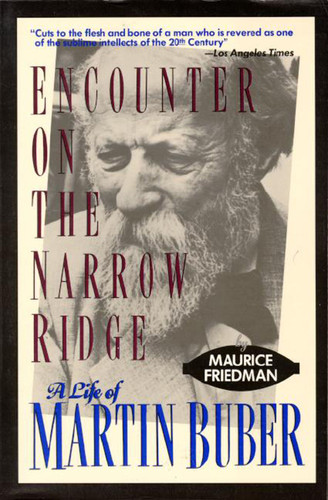
Encounter on the Narrow Ridge A Life of Martin Buber

Maurice Friedman
Martin Buber's stature as the most significant Jewish religious philosopher of the twentieth century is reinforced by his accomplishments and renown in areas as diverse as Hasidism, psychotherapy, education, folklore, and politics. His classic, I and Thou, is known and studied all over the world. In this complete and masterful biography, Maurice Friedman traces the interweaving of Buber's wholehearted engagement with world events and crises and the evolution of his unique and influential philosophy. We see the impact of World War I on the young thinker; his work in education, community, and politics between the wars; his leadership of the spiritual resistance to the Nazis in Hitler's Germany; and his more than forty years of fighting for Jewish-Arab understanding. In addition, we see Buber interact with Heidegger, Sartre, Jung, Ben Gurion, Hesse, Rosenzweig, and Hammarskjold. Through his close relationship with Buber and recent access to forty-five thousand unpublished letters, Maurice Friedman recreates Buber's vitality, his philosophy of dialogue, and his spirituality based on a personal relationship with God. Encounter on the Narrow Ridge delivers the essential spontaneity of a great man who saw in every encounter a focal point for human growth.
Paragon House 1998-06-15 496 pages

By faith alone: the medieval church and Martin Luther

Shestov, Lev
Lev Shestov's By Faith Alone confronts Eastern and Western European conceptions of faith through Russian literature, ancient and medieval philosophy, and Christian theology. Written from 1910-1914, this first English-language translation brings together important early writings on the medieval church and Martin Luther. Shestov reconciles the Greek notion of rational truth with Biblical revelation by drawing on a wide range of ancient, medieval, philosophical and theological sources from Plato to Hegel, Tertullian to Saint Augustine , and Saint Bernard of Clairvaux to William of Ockam. He argues that rational truth has skewed Christian belief by determining knowledge and truth in ways that prize the mind over the world. This approach marks a turning point in the evolution of Shestov's existential thought. It establishes a basic division that became central to Shestov's later work, between Athens as reason and Jerusalem as faith. By Faith Alone provides a crucial piece of the puzzle in the genesis of Shestov's later and better-known writings on medieval philosophy.
Bloomsbury Academic 2025-05-29 240 pages

Darwin in the Jewish imagination: Jews' engagement with evolutionary theory

Langton, Daniel R.
"The development of this project has taken many years and evolved in many unexpected directions as a result of the advice and feedback from many people. The subject is Darwin's Jews, that is, those Jewish thinkers in the late nineteenth- and early twentieth-centuries who have given Darwin a legacy within Jewish history beyond the tragic account of Nazi race theory and eugenics that all too often dominates the discussion of Jews and Darwin. For this reason, as much as any other, it seemed like a worthwhile endeavour. But the identification and selection of the different species of Darwin's Jews has proven to be difficult fieldwork, since there are so many ideological niches and environments for so many varieties of religious and non-religious Jews within the tangled bank of modern Jewish identity. Fortunately, I have not been working alone, and am grateful for the opportunity now to acknowledge the work of others"--
Oxford University Press 2026-02-04 310 pages

Personhood of God Biblical Theology, Human Faith and the Divine Image

Yochanan Muffs
A fascinating exploration of the many faces of God and what they reveal about our own humanity. He was a whole pantheon in Himself.... He constantly appeared in many and ever-changing roles lest He be frozen and converted into the dumb idols He Himself despised. God was a polyvalent personality who, by mirroring to man His many faces, provided the models that man so needed to survive and flourish. This is the true humanity of God. --from the Introduction In scholarly but accessible terms, with many startling and controversial insights, renowned Bible scholar Dr. Yochanan Muffs examines the anthropomorphic evolution of the Divine Image--from creator of the cosmos to God the father, God the husband, God the king, God the "chess-player," God the ultimate master--and how these different images of God have shaped our faith and world view. Muffs also examines how expressions of divine power, divine will and divine love throughout the Bible have helped develop the contemporary human condition and our enriching dialectic between faith and doubt.
Jewish Lights Publishing 2009-03 242 pages

Keter: the crown of God in early Jewish mysticism

Green, Arthur
Keter is a close reading of fifty relatively brief Jewish texts, tracing the motif of divine coronation from Jewish esoteric writings of late antiquity to the Zohar, written in thirteenth-century Spain. In the course of this investigation Arthur Green draws a wide arc including Talmudic, Midrashic, liturgical, Merkavah, German Hasidic, and Kabbalistic works, showing through this single theme the spectrum of devotional, mystical, and magical views held by various circles of Jews over the course of a millennium or more. The first portion of the work deals with late antiquity, emphasizing the close relationship between texts of what is often depicted as "normative" Judaism and their mystical/magical analogues. The mythic imagination of ancient Judaism, he suggests, is shared across this spectrum. The latter portion of the work turns to the medieval Jews who inherited this ancient tradition and its evolution into Kabbalah, where keter plays a key role as the first of the ten divine emanations or sefirot.The nature of these sefirot as symbols and the emergence of a structured and hierarchical symbolism out of the mythic imagery of the past are key themes in these later chapters. As a whole, Keter takes the reader on an exciting tour of the interior landscapes of the Jewish imagination, offering some remarkable insights into the nature of mystical and symbolic thinking in the Jewish tradition.Originally published in 1997.The Princeton Legacy Library uses the latest print-on-demand technology to again make available previously out-of-print books from the distinguished backlist of Princeton University Press. These editions preserve the original texts of these important books while presenting them in durable paperback and hardcover editions. The goal of the Princeton Legacy Library is to vastly increase access to the rich scholarly heritage found in the thousands of books published by Princeton University Press since its founding in 1905.
Princeton University Press 2014-07-14 244 pages

The divine symphony: the Bible's many voices

Knohl, Israel
In this fascinating book, Knohl shares his understanding of how the Torah was edited into its final form. He bridges the gap between ancient Israel (c.1400-586 B.C.E.) and Second Temple times (c.536 B.C.E.-70 C.E.) by showing the continuity between these eras and the gradual evolution of the biblical worldview, which formed the foundation of later rabbinic Judaism. The book focuses on the editing of the Torah, interpreting the textual evidence, most notably contradictions and redundancies, to show that the idea of a pluralistic understanding of Revelation can be traced back to the editing of the Torah itself. Knohl’s interpretation of biblical composition challenges a popular trend in contemporary biblical scholarship: the idea that ancient Israel never existed as a historical reality, but was invented and “retrojected” back in time by later Israelite priests as part of their national myth.
The Jewish Publication Society 2003-11-01 208 pages