4 results for "Evolution"

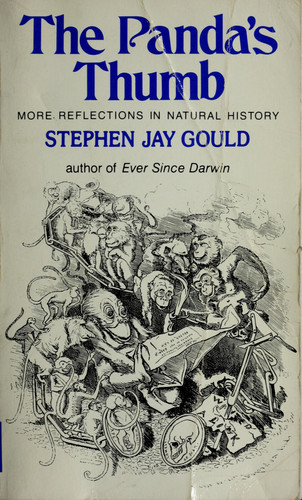
The panda's thumb: more reflections in natural history

Gould, Stephen Jay
A collection of essays by reknown scientist Jay Stephen Gould drawn from his columns in Natural History. The essays deal with topics such as: evolutionary opportunism (nature is a tinkerer, making the most of what's available in the course of adapting to the environment); new information on Darwin and his contemporaries; racism and cultural relativism; the evolutionary pattern of sudden rapid change; the origin of birds or the warm-bloodedness of dinosaurs; and, Teilhard de Chardin as a co-conspirator in the Piltdown hoax.
Norton 1980 343 pages

Hen's teeth and horse's toes

Gould, Stephen Jay
"Darwin relegated humanity to a species descended from apes ; Stephen Jay Gould adds that it is bound for extinction. Why all species, including our own, are destined to die out is just one of the fascinating questions addressed in this collection of essays by the author of Ever Since Darwin and The Panda's Thumb. In considering them, Stephen Jay Gould challenges the view that science is irrelevant to life. Darwinism has changed our view of the world and Gould brilliantly conveys here the active excitement of modern evolutionary theory. Fair, amusing, perceptive, eminently readable, Gould looks at facts that -- if we even know them in the first place -- we take for granted and, with a true scientist's desire for knowledge, digs beneath them to uncover their significance for evolutionary theory" -- Back cover.
Penguin 1984 413 pages

The astronomical revolution: Copernicus, Kepler, Borelli

Koyré, Alexandre
In these three studies-Copernicus, Kepler, Borelli- which are brought together in this volume, it is not my intention to review the history of astronomy in the sixteenth and seventeenth centuries from Corperius to Newton, but only the history of the 'astronomical revolution', that is to say, the history of the evolution and transformation the key-concepts by means of which endeavors to reduce to order, of to save, phenomena-by clearly setting forth the facts that underlie and explain the chaos of sentient appearances.
Hermann 1973 530 pages

Conflict in man-made environment

Rapoport, Anatol
"How the environment causes, or contributes to, psychic and social conflict is frequently discussed. Less often considered is the theme developed in this Pelican by Professor Rapoport--that human conflict intimately affects the 'symbolic' environment, which may be a more powerful determinant of man's condition than pollution, war or urbanization. By 'symbolic' environment is meant the whole non-material body of knowledge, science, art, history, language, beliefs and ideas which human intelligence has amassed. Outlining various theories of aggression, progress, evolution and the struggle for existence, Professor Rapoport examines in detail the systemic philosophies advanced by Hobbes, Hegel, Clausewitz, Marx, Lenin and the modern 'think-tanks'. He concludes--in a book which from the start is concerned with the functioning of systems--that the 'mind' of a system, backed by power, may be disastrously different from the psychology of any of its members. In this context Professor Rapoport detects a gleam of hope in the growing scepticism about all and any concentrations of power"--Back cover.
Penguin 1974 272 pages