4 results for "Finance"

The cost of rights: why liberty depends on taxes

Holmes, Stephen,Sunstein, Cass R.
All legally enforceable rights cost money. A practical, commonsense notion? Yes, but one ignored by almost everyone, from libertarian ideologues to Supreme Court justices to human rights advocates. The simple insight that rights are expensive reminds us that freedom is not violated by a government that taxes and spends, but requires it - and requires a citizenry vigilant about how money is allocated. Laying bare the folly of some of our most cherished myths about rights, this groundbreaking tract will permanently change the terms of our most critical and contentious political debates.
W.W. Norton 1999 255 pages

Madison's music: on reading the First Amendment

Neuborne, Burt
"Are you sitting down? It turns out that everything you learned about the First Amendment is wrong. For too long, we've been treating small, isolated snippets of the text as infallible gospel without looking at the masterpiece of the whole. Legal luminary Burt Neuborne argues that the structure of the First Amendment as well as of the entire Bill of Rights was more intentional than most people realize, beginning with the internal freedom of conscience and working outward to freedom of expression and finally freedom of public association. This design, Neuborne argues, was not to protect discrete individual rights--such as the rights of corporations to spend unlimited amounts of money to influence elections--but to guarantee that the process of democracy continues without disenfranchisement, oppression, or injustice. Neuborne, who was the legal director of the ACLU and has argued numerous cases before the Supreme Court, invites us to hear the "music" within the form and content of Madison's carefully formulated text. When we hear Madison's music, a democratic ideal flowers in front of us, and we can see that the First Amendment gives us the tools to fight for campaign finance reform, the right to vote, equal rights in the military, the right to be full citizens, and the right to prevent corporations from riding roughshod over the weakest among us. Neuborne gives us an eloquent lesson in democracy that informs and inspires."--
The New Press 2015 260 pages

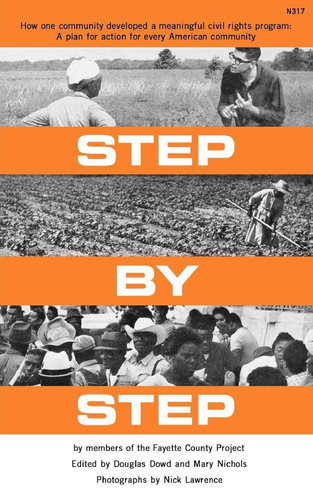
Step by Step Evolution and Operation of the Cornell Students' Civil-Rights Project in Tennessee, Summer, 1964

Douglas Dowd
The book arose out of the authors' experiences in a project which was itself unique: The Cornell-Tompkins Committee for Free and Fair Elections in Fayette County, Tennessee. The project entailed six to eight weeks of living in Fayette County by forty-five volunteers, mostly students from Cornell University, in the summer of 1964. The project was financed entirely, to an amount exceeding fifteen thousand dollars, by the contributions of students, faculty, and townspeople in and around Cornell University, and by contributions from more distant places solicited by those involved at Cornell.Of the many things learned from the Cornell project, one of the most important was how responsive a community can become when confronted with a concrete civil rights program, one with which it can identify, one small enough to be feasible and intelligible, but still compelling in terms of the needs involved.The authors believe that many thousands of Americans can find no good answer to the questions "What can I do." not because they are unwilling to do much, nor because there is little to be done, but because they lack the knowledge of what is needed where, and how and with whom one can go about responding to such needs. The book therefore undertakes, step by step, to describe and explain the development of the project at Cornell and its workings during the summer in Tennessee, and reasons that similar steps can be taken by others, with appropriate variations. It concludes with a detailed appendix listing civil rights projects and organizations desperately in need of help, whether in terms of money or volunteers or both.
W. W. Norton, Incorporated 1965-04 132 pages