16 results for "Finance"

How to Ruin the United States of America

Ben Stein
On the heels of his very successful books, How to Ruin Your Life, How to Ruin Your Love Life, and How to Ruin Your Financial Life, Ben Stein, in collaboration with his pal Phil DeMuth, has tongue firmly in cheek once again as he comes up with surefire ways to ruin the greatest nation in the history of the human race. Try a few of these on for size: Trust the United Nations to protect us and our security. Make it unlawful to worship God or even to show images of the Ten Commandments. Convert our universities into fortresses of anti-Americanism, hatred of freedom, and centers of confusion and ignorance. Encourage contempt for the family and for the community. Allow Hollywood to brainwash us into believing that only suckers and criminals fight for their country. Treat the military, the police, firefighters, and teachers as losers and pay them starvation wages. Hey, does any of this sound familiar? Maybe that's because it's already happening! Ben and Phil give you all the information you'll ever need in order to successfully ruin the USA even further! Sardonic, humorous, but also angrily emphatic, this is a book every old-fashioned patriot really needs to read!
ReadHowYouWant.com 2010-06-21 168 pages

Get What's Yours The Secrets to Maxing Out Your Social Security

Laurence J. Kotlikoff,Philip Moeller,Paul Solman
"Learn the secrets to maximizing your Social Security benefits and earn up to thousands of dollars more each year with expert advice that you can't get anywhere else. Want to know how to navigate the forbidding maze of Social Security and emerge with the highest possible benefits? You could try reading all 2,728 rules of the Social Security system (and the thousands of explanations of these rules), but Kotlikoff, Moeller, and Solman explain Social Security benefits in an easy to understand and user-friendly style. What you don't know can seriously hurt you: wrong decisions about which Social Security benefits to apply for cost some individual retirees tens of thousands of dollars in lost income every year. How many retirees or those nearing retirement know about such Social Security options as file and suspend (apply for benefits and then don't take them)? Or start stop start (start benefits, stop them, then re-start them)? Or--just as important--when and how to use these techniques? Get What's Yours covers the most frequent benefit scenarios faced by married retired couples, by divorced retirees, by widows and widowers, among others. It explains what to do if you're a retired parent of dependent children, disabled, or an eligible beneficiary who continues to work, and how to plan wisely before retirement. It addresses the tax consequences of your choices, as well as the financial implications for other investments. Many personal finance books briefly address Social Security, but none offers the thorough, authoritative, yet conversational analysis found here. You've paid all your working life for these benefits. Now, get what's yours"--
Thorndike Press 2015 465 pages

The Oath The Obama White House and The Supreme Court

Jeffrey Toobin
A Washington Post Notable Work of Nonfiction From the moment Chief Justice Roberts botched Barack Obama's oath of office, the relationship between the Court and the White House has been a fraught one. Grappling with issues as diverse as campaign finance, abortion, and the right to bear arms, the Roberts court has put itself squarely at the center of American political life. Jeffrey Toobin brilliantly portrays key personalities and cases and shows how the President was fatally slow to realize the importance of the judicial branch to his agenda. Combining incisive legal analysis with riveting insider details, The Oath is an essential guide to understanding the Supreme Court of our interesting times.
Knopf Doubleday Publishing Group 2013-06-04 352 pages

Men in Black How the Supreme Court Is Destroying America

Mark R. Levin
Conservative talk radio host, lawyer, and frequent National Review contributor Mark R. Levin comes out firing against the United States Supreme Court in Men in Black, accusing the institution of corrupting the ideals of America's founding fathers. The court, in Levin's estimation, pursues an ideology-based activist agenda that oversteps its authority within the government. Levin examines several decisions in the court's history to illustrate his point, beginning with the landmark Marbury v. Madison case, wherein the court granted itself the power to declare acts of the other branches of government unconstitutional. He devotes later chapters to other key cases culminating in modern issues such as same-sex marriage and the McCain-Feingold campaign finance reform bill. Like effective attorneys do, Levin packs in copious research material and delivers his points with tremendous vigor, excoriating the justices for instances where he feels strict constit utional constructivism gave way to biased interpretation. But Levin's definition of "activism" seems inconsistent. In the case of McCain-Feingold, the court declined to rule on a bill already passed by congress and signed by the president, but Levin, who thinks the bill violates the First Amendment, still accuses them of activism even when they were actually passive. To his talk-radio listeners, Levin's hard-charging style and dire warnings of the court's direction will strike a resonant tone of alarm, though the hyperbole may be a bit off-putting to the uninitiated. As an attack on the vagaries of decisions rendered by the Supreme Court and on some current justices, Men in Black scores points and will likely lead sympathetic juries to conviction. -
Regnery Publishing 2006-08-01 256 pages

Three Days at Camp David How a Secret Meeting in 1971 Transformed the Global Economy

Jeffrey E. Garten
The former dean of the Yale School of Management and Undersecretary of Commerce in the Clinton administration chronicles the 1971 August meeting at Camp David, where President Nixon unilaterally ended the last vestiges of the gold standard--breaking the link between gold and the dollar--transforming the entire global monetary system. Over the course of three days--from August 13 to 15, 1971--at a secret meeting at Camp David, President Richard Nixon and his brain trust changed the course of history. Before that weekend, all national currencies were valued to the U.S. dollar, which was convertible to gold at a fixed rate. That system, established by the Bretton Woods Agreement at the end of World War II, was the foundation of the international monetary system that helped fuel the greatest expansion of middle-class prosperity the world has ever seen. In making his decision, Nixon shocked world leaders, bankers, investors, traders and everyone involved in global finance. Jeffrey E. Garten argues that many of the roots of America's dramatic retrenchment in world affairs began with that momentous event that was an admission that America could no longer afford to uphold the global monetary system. It opened the way for massive market instability and speculation that has plagued the world economy ever since, but at the same time it made possible the gigantic expansion of trade and investment across borders which created our modern era of once unimaginable progress. Based on extensive historical research and interviews with several participants at Camp David, and informed by Garten's own insights from positions in four presidential administrations and on Wall Street, Three Days at Camp David chronicles this critical turning point, analyzes its impact on the American economy and world markets, and explores its ramifications now and for the future.
Harper 2022 464 pages

Breaking Free Public School Lessons and the Imperative of School Choice

Sol Stern
Explores the growing demand for school choice among poor families in the inner city. Stern describes the dramatic successes and occasional failures of this 'new civil rights movement' in three key cities: Milwaukee, Cleveland, and New York. Filled with timely insights and human drama, Breaking Free vividly describes how cash-starved Catholic schools in the South Bronx are performing small educational miracles every day with children the public schools have given up on. large numbers of poor minority children from violent, chaotic and failing public schools and allowed them to attend parochial and private schools where high expectations often result in high achievement. Drawing on personal observation and intimate conversations with parents, students and educators, Breaking Free is the first book to transform school choice from an abstract policy issue into a question of basic personal freedom, and indeed, for minority children at the bottom of the social ladder, into a question of survival. Equal access to the American dream through quality education is, Sol Stern convinces us, the unfinished business before us.
Encounter Books 2004-12 260 pages

Branson

Tom Bower
'Bower's book is a devastating indictment' Sunday Times 'Explosive ... Bower reveals a remarkable and sinister picture of the man who likes to appear as the ever-smiling hero' Daily Mail A sensational critical biography of the man and his business practices. No British tycoon is better known, few claim to be richer and none has masterminded a more recognisable brand than Richard Branson. What is behind the success of the buccaneering balloonist, the tabloids' favourite celebrity nude, the 'grinning jumper' and the scourge of corporate goliaths? Tom Bower has a uncovered a different tale to the one so eagerly promoted by Virgin's publicists. Here is the full story of Branson: his businesses, his friendships, his ambition, his law-breaking, his drug-taking, his bullying. Offering an intimate scrutiny of exactly how Richard Branson created and sold himself, this biography reveals Branson to be a single-minded profiteer who, while occasionally generous to others, has a fixed purpose to enhance his family's wealth in secret off-shore trust funds. Instead of a glittering saint, Branson emerges as a devious actor, proud of plucking for his own profit the good ideas of others.
Fourth Estate 2001 393 pages

Financing the Flames How Tax-Exempt and Public Money Fuel a Culture of Confrontation and Terror in Israel

Edwin Black
Edwin Black s latest book, Financing the Flames: How Tax-Exempt and Public Money Fuel a Culture of Confrontation and Terrorism in Israel, pulls the cover off the robust use of US tax-exempt, tax-subsidized, and public monies to foment agitation, systematically destabilize the Israel Defense Forces, and finance terrorists in Israel. In a far-flung investigation in the United States, Israel and the West Bank, human-rights investigative reporter Edwin Black documents that it is actually the highly politicized human rights organizations and NGOs themselves all American taxpayer supported which are financing the flames that make peace in Israel difficult if not impossible. Black spotlights key charitable organizations such as the Ford Foundation, George Soros s Open Society Foundations, the New Israel Fund, and many others, as well as American taxpayers as a group. Instead of promoting peace and reconciliation between Arabs and Israelis, a variety of taxpayer-subsidized organizations have funded a culture where peace does not pay, but warfare and confrontation do. Ironically, several Jewish organizations, scooping up millions in tax-subsidized donations, stand at the forefront of the problem. At the same time, the author details at great length the laudable and helpful activities of such groups as the New Israel Fund; he chronicles a heartbreaking conflict between stated intent and true impact on the ground. In addition to documenting questionable 501(c)(3) activity, Black documents the direct relationship between taxpayer assistance to the Palestinian Authority and individuals engaged in terrorism against civilians.
Dialog Press 2018-12-29 288 pages

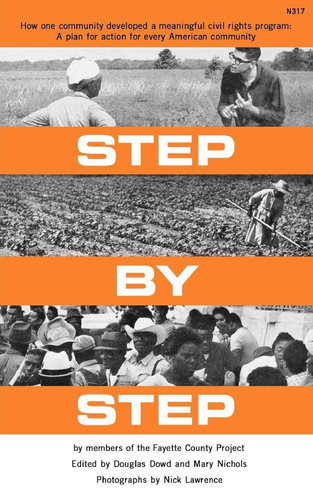
Step by Step Evolution and Operation of the Cornell Students' Civil-Rights Project in Tennessee, Summer, 1964

Douglas Dowd
The book arose out of the authors' experiences in a project which was itself unique: The Cornell-Tompkins Committee for Free and Fair Elections in Fayette County, Tennessee. The project entailed six to eight weeks of living in Fayette County by forty-five volunteers, mostly students from Cornell University, in the summer of 1964. The project was financed entirely, to an amount exceeding fifteen thousand dollars, by the contributions of students, faculty, and townspeople in and around Cornell University, and by contributions from more distant places solicited by those involved at Cornell.Of the many things learned from the Cornell project, one of the most important was how responsive a community can become when confronted with a concrete civil rights program, one with which it can identify, one small enough to be feasible and intelligible, but still compelling in terms of the needs involved.The authors believe that many thousands of Americans can find no good answer to the questions "What can I do." not because they are unwilling to do much, nor because there is little to be done, but because they lack the knowledge of what is needed where, and how and with whom one can go about responding to such needs. The book therefore undertakes, step by step, to describe and explain the development of the project at Cornell and its workings during the summer in Tennessee, and reasons that similar steps can be taken by others, with appropriate variations. It concludes with a detailed appendix listing civil rights projects and organizations desperately in need of help, whether in terms of money or volunteers or both.
W. W. Norton, Incorporated 1965-04 132 pages

Debt WSQ Volume 42, Numbers 1&2

Meena Alexander,Rosalind Petchesky
How do we make sense of debt? What does it mean to live in a world of debt, whether you are a university student crippled by student loans, a struggling farmer in India, a homeowner fighting to keep mortgage payments up, or even a country? WSQ investigates what happens when debt overwhelms moral obligations, de-moralising both debtor and creditor.
Feminist Press at The City University of New York 2014 324 pages

The Widening Circle of Genocide: Genocide - A Critical Bibliographic Review

Charny, Israel W.
This important study introduces the conceptual premise that families, like firms, analyze their circumstances, make decisions, and pursue courses of action on the basis of what they perceive to be the most efficient methods for producing and reproducing survival. Combining this premise with an extraordinary assemblage of facts gleaned over the period of a decade from the streets, markets and homes of Port-au-Prince, the author weaves a tapestry of despair and hope which only an unusual degree of intimacy with the details of everyday life in the city could provide. The result is a considerable deepening of understanding about the politics and economics by which family members earn their livelihoods, distribute resources within and between households, produce life and labor from food and water, provide shelter and schooling for themselves, and borrow money to finance these and other activities.These different dimensions of daily existence form a web of interdependency in which change in any one dimension causes change in all the others. As Professor Pass's work demonstrates, research and development assistance practices of public and private organizations, in such areas as employment, health, housing, education and credit are often irrelevant. This is because they are necessarily guided by prevailing concepts and theories with respect to the circumstances of the urban poor, which sometimes do the poor considerable disservice.With the additional insight provided by a decade of participation in the design of policies, programs and projects serving as a tempering influence, the author does not leap to easy criticism of prevailing views and practices. He notes that ideas and interventions change in response to new understanding, sometimes in ways that the producers of such understanding could never have imagined. The problem is that change is painfully slow, and in desperately poor countries like Haiti, waiting for change exacts an almost intolerable pric
Routledge 2018-04-16 375 pages

The Way It Works Inside Ottawa

Eddie Goldenberg
The ultimate insider takes us behind the scenes, in the book everyone is waiting for. As Jean Chrétien’s right-hand man for thirty years in Ministries all over Ottawa, Eddie Goldenberg got to know how things worked — especially from 1993 to 2003, when he was Senior Policy Advisor to the Prime Minister. What did this title mean? It meant that Eddie made things happen. For example, during Paul Martin’s years at Finance, Eddie was the go-between who linked Chrétien and Martin, who were for much of the time barely on speaking terms. Or when vital decisions about the Iraq War had to be made, Eddie was the man who wrote the words, “If military action proceeds without a new resolution of the Security Council, Canada will not participate.” And that’s the way this revealing book works; important decisions are used as case studies as we learn how things really happen in the tough world of politics. Those less concerned with mastering the system will simply enjoy reading this as an engaging account of an exciting arena, filled with memorable anecdotes about the world’s biggest names. “Journalists look for winners and losers so as to make good headlines. The real story is much more interesting, but is harder to write, and is very difficult to put in a clip of a few seconds.” “President Bush smiled and said, ‘You know the guy who wanted to see me, What’s-his-name? I didn’t see him.’ I thought, poor Joe Clark; he had gone from ‘Joe Who’ to ‘What’s-his-name’ in less than twenty years.” — Excerpt from The Way it Works
National Geographic Books 2007-09-18 432 pages

Walter Gordon A Political Memoir

Walter Gordon
Walter Gordon was a born member of the Canadian Establishment, a senior partner in one of the country's major accounting firms, successful and powerful in the world of business. After considerable persuasion by his close friend Prime Minister Lester Pearson, Gordon left business for politics and became finance minister in the Liberal government in 1963. But Gordon was different from many of his associates--he had an abiding concern for Canada, and for ensuring the independence of its enconomy. He worked to enshrine this perspective in the Liberal Party, the Pearson government and in Canadian politics generally. Walter Gordon: A Political Memoir tells the story of a politician who put principles above personal ambition, who suffered disappointments and defeats, but who always stood out as a man who remained true to his beliefs.
Formac Publishing Company 1983 395 pages