10 results for "Finance"

Family Properties Race, Real Estate, and the Exploitation of Black America (10th Anniversary Edition)

Beryl Satter
“Beryl Satter's Family Properties is really an incredible book. It is, by far, the best book I've ever read on the relationship between blacks and Jews. That's because it hones in on the relationship between one specific black community and one specific Jewish community and thus revels in the particular humanity of all its actors.” —Ta-Nehisi Coates, The Atlantic Part family story and part urban history, a landmark investigation of segregation and urban decay in Chicago -- and cities across the nation The "promised land" for thousands of Southern blacks, postwar Chicago quickly became the most segregated city in the North, the site of the nation's worst ghettos and the target of Martin Luther King Jr.'s first campaign beyond the South. In this powerful book, Beryl Satter identifies the true causes of the city's black slums and the ruin of urban neighborhoods throughout the country: not, as some have argued, black pathology, the culture of poverty, or white flight, but a widespread and institutionalized system of legal and financial exploitation. In Satter's riveting account of a city in crisis, unscrupulous lawyers, slumlords, and speculators are pitched against religious reformers, community organizers, and an impassioned attorney who launched a crusade against the profiteers—the author's father, Mark J. Satter. At the heart of the struggle stand the black migrants who, having left the South with its legacy of sharecropping, suddenly find themselves caught in a new kind of debt peonage. Satter shows the interlocking forces at work in their oppression: the discriminatory practices of the banking industry; the federal policies that created the country's shameful "dual housing market"; the economic anxieties that fueled white violence; and the tempting profits to be made by preying on the city's most vulnerable population. Family Properties: Race, Real Estate, and the Exploitation of Black Urban America is a monumental work of history, this tale of racism and real estate, politics and finance, will forever change our understanding of the forces that transformed urban America. "Gripping . . . This painstaking portrayal of the human costs of financial racism is the most important book yet written on the black freedom struggle in the urban North."—David Garrow, The Washington Post
Picador 2021-04-27 544 pages

Rich Bitch A Simple 12-Step Plan for Getting Your Financial Life Together... Finally

Nicole Lapin
NEW YORK TIMES BESTSELLER In this New York Times bestseller, journalist and financial expert Nicole Lapin shows women how to take charge of their lives by taking charge of their money "You might not know this but stressing over money can harm your overall health. Let Nicole be the doctor for your financial health and you will feel better in more ways than you'd think." --Dr. Oz, host of the "Dr. Oz Show", and Lisa Oz, host of the "Lisa Oz Show" Do your eyes glaze over just thinking about the mumbo-jumbo language of finance? Do you break out into hives when faced with getting your financial life together? Well, sister, you are not alone. In Rich Bitch, money expert and financial journalist Nicole Lapin lays out a 12-Step Plan in which she shares her experiences--mistakes and all--of getting her own finances in order. She talks to you not like a lecturer but as your friend. And even though money is typically an "off-limits" conversation, nothing is off-limits here. Lapin rethinks every piece of financial "wisdom" you've ever heard and puts her own fresh, modern, sassy spin on it. Sure, there are some hard-and-fast rules about finance, but when it comes to your money, the only person who can tell you how to spend it is you. Should you invest in a 401(k)? Maybe not. Should you splurge on that morning latte? Likely yes. Instead of focusing on nickel-and-diming yourself, Nicole's advice focuses on investing in yourself so you don't have to stress over the little things. Rich Bitch rehabs whatever bad money habits you might have and provides a plan you can not only sustain, but also thrive on. You won't feel deprived but rather inspired to go after the rich life you deserve, and confident enough to call yourself a rich bitch.
HarperCollins Publishers 2019-11-05 400 pages

The Gini Methodology A Primer on a Statistical Methodology

Shlomo Yitzhaki,Edna Schechtman
Gini's mean difference (GMD) was first introduced by Corrado Gini in 1912 as an alternative measure of variability. GMD and the parameters which are derived from it (such as the Gini coefficient or the concentration ratio) have been in use in the area of income distribution for almost a century. In practice, the use of GMD as a measure of variability is justified whenever the investigator is not ready to impose, without questioning, the convenient world of normality. This makes the GMD of critical importance in the complex research of statisticians, economists, econometricians, and policy makers. This book focuses on imitating analyses that are based on variance by replacing variance with the GMD and its variants. In this way, the text showcases how almost everything that can be done with the variance as a measure of variability, can be replicated by using Gini. Beyond this, there are marked benefits to utilizing Gini as opposed to other methods. One of the advantages of using Gini methodology is that it provides a unified system that enables the user to learn about various aspects of the underlying distribution. It also provides a systematic method and a unified terminology. Using Gini methodology can reduce the risk of imposing assumptions that are not supported by the data on the model. With these benefits in mind the text uses the covariance-based approach, though applications to other approaches are mentioned as well.
Springer New York 2014-12-13 548 pages

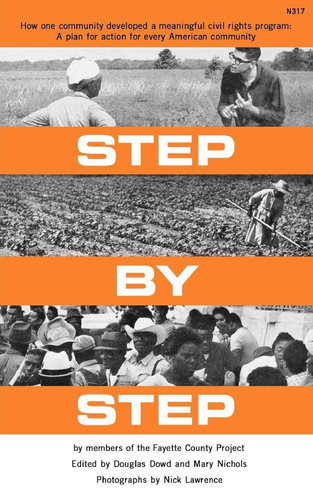
Step by Step Evolution and Operation of the Cornell Students' Civil-Rights Project in Tennessee, Summer, 1964

Douglas Dowd
The book arose out of the authors' experiences in a project which was itself unique: The Cornell-Tompkins Committee for Free and Fair Elections in Fayette County, Tennessee. The project entailed six to eight weeks of living in Fayette County by forty-five volunteers, mostly students from Cornell University, in the summer of 1964. The project was financed entirely, to an amount exceeding fifteen thousand dollars, by the contributions of students, faculty, and townspeople in and around Cornell University, and by contributions from more distant places solicited by those involved at Cornell.Of the many things learned from the Cornell project, one of the most important was how responsive a community can become when confronted with a concrete civil rights program, one with which it can identify, one small enough to be feasible and intelligible, but still compelling in terms of the needs involved.The authors believe that many thousands of Americans can find no good answer to the questions "What can I do." not because they are unwilling to do much, nor because there is little to be done, but because they lack the knowledge of what is needed where, and how and with whom one can go about responding to such needs. The book therefore undertakes, step by step, to describe and explain the development of the project at Cornell and its workings during the summer in Tennessee, and reasons that similar steps can be taken by others, with appropriate variations. It concludes with a detailed appendix listing civil rights projects and organizations desperately in need of help, whether in terms of money or volunteers or both.
W. W. Norton, Incorporated 1965-04 132 pages

Debt WSQ Volume 42, Numbers 1&2

Meena Alexander,Rosalind Petchesky
How do we make sense of debt? What does it mean to live in a world of debt, whether you are a university student crippled by student loans, a struggling farmer in India, a homeowner fighting to keep mortgage payments up, or even a country? WSQ investigates what happens when debt overwhelms moral obligations, de-moralising both debtor and creditor.
Feminist Press at The City University of New York 2014 324 pages

Personal Resilience Survival Strategies for Pandemic Times

Peter Tarlow,Séverine Obertelli
Humanity suffers crises and disasters constantly. But the breadth of the latest crisis--the Covid-19 pandemic--has affected almost all corners of the world and has caused millions of deaths and so many more victims who have survived its worst effects but may suffer long-lasting health issues from it. Those "lucky" enough to have suffered only mild cases or managed to avoid infection altogether are still victims because of social and economic distresses that the pandemic has caused. This book describes the crisis and offers advice and strategies for coping with the stresses of a pandemic. Each chapter explores briefly one of four areas of our human condition, be it health, spirituality, social issues or finances, and offers strategies through 100 questions and answers about dealing with a pandemic. This book is intended to supplement the seminal book of Personal Reconstruction, by the same author and others, with specific information about pandemics.
Quest Publishing 2021-03-31 166 pages

Social Insurance

Isaac Max Rubinow
This work has been selected by scholars as being culturally important, and is part of the knowledge base of civilization as we know it. This work is in the "public domain in the United States of America, and possibly other nations. Within the United States, you may freely copy and distribute this work, as no entity (individual or corporate) has a copyright on the body of the work. Scholars believe, and we concur, that this work is important enough to be preserved, reproduced, and made generally available to the public. We appreciate your support of the preservation process, and thank you for being an important part of keeping this knowledge alive and relevant.
Creative Media Partners, LLC 2022-10-27 544 pages

B'Nai B'Rith and the Challenge of Ethnic Leadership

Deborah Dash Moore
B'nai B'rith has a history almost as diverse as the story of American Jewry itself. The oldest secular Jewish organization in the United States, it was founded in 1843. Thereafter, it followed in the footsteps of its immigrant founders, spreading into the cities, towns, and villages of America, eventually becoming the worldwide order it is today. What is more, B'nai B'rith's physical expansion was paralleled by the scope of its activities. It supports one of the most prominent American Jewish defense organizations, the Anti-Defamation League. Its Hillel Foundations constitute an international network of student activities on college campuses. It sponsors a broad array of learning programs through its Adult Jewish Education Commission. The B'nai B'rith Youth Organization serves the entire Jewish community. It conducts projects and programs in Israel of philanthropic and educational nature, helps finance several national Jewish hospitals and homes for the aged, and supervises an International Council to coordinate its overseas units and to take responsible action on issues relating to world Jewish affairs. And it is partnered in all these activities by B'nai B'rith Women, an independent organization. This is the saga of B'nai B'rith, recounted by Professor Deborah Dash Moore. To elucidate the diverse facets of this venerable, yet youthful, organization and to reveal their integral relationship to the history of the Jews in America, Professor Moore focuses on the moments of innovation that have influenced its development and direction, and on the outstanding individuals who have guided the Order's destiny.
State University of New York Press 1981 288 pages

The Widening Circle of Genocide: Genocide - A Critical Bibliographic Review

Charny, Israel W.
This important study introduces the conceptual premise that families, like firms, analyze their circumstances, make decisions, and pursue courses of action on the basis of what they perceive to be the most efficient methods for producing and reproducing survival. Combining this premise with an extraordinary assemblage of facts gleaned over the period of a decade from the streets, markets and homes of Port-au-Prince, the author weaves a tapestry of despair and hope which only an unusual degree of intimacy with the details of everyday life in the city could provide. The result is a considerable deepening of understanding about the politics and economics by which family members earn their livelihoods, distribute resources within and between households, produce life and labor from food and water, provide shelter and schooling for themselves, and borrow money to finance these and other activities.These different dimensions of daily existence form a web of interdependency in which change in any one dimension causes change in all the others. As Professor Pass's work demonstrates, research and development assistance practices of public and private organizations, in such areas as employment, health, housing, education and credit are often irrelevant. This is because they are necessarily guided by prevailing concepts and theories with respect to the circumstances of the urban poor, which sometimes do the poor considerable disservice.With the additional insight provided by a decade of participation in the design of policies, programs and projects serving as a tempering influence, the author does not leap to easy criticism of prevailing views and practices. He notes that ideas and interventions change in response to new understanding, sometimes in ways that the producers of such understanding could never have imagined. The problem is that change is painfully slow, and in desperately poor countries like Haiti, waiting for change exacts an almost intolerable pric
Routledge 2018-04-16 375 pages