4 results for "Folklore"

Keeping slug woman alive: a holistic approach to American Indian texts

Sarris, Greg
This remarkable collection of eight essays offers a rare perspective on the issue of cross-cultural communication. Greg Sarris is concerned with American Indian texts, both oral and written, as well as with other American Indian cultural phenomena such as basketry and religion. His essays cover a range of topics that include orality, art, literary criticism, and pedagogy, and demonstrate that people can see more than just "what things seem to be." Throughout, he asks: How can we read across cultures so as to encourage communication rather than to close it down? Sarris maintains that cultural practices can be understood only in their living, changing contexts. Central to his approach is an understanding of storytelling, a practice that embodies all the indeterminateness, structural looseness, multivalence, and richness of culture itself. He describes encounters between his Indian aunts and Euro-American students and the challenge of reading in a reservation classroom; he brings the reports of earlier ethnographers out of museums into the light of contemporary literary and anthropological theory. Sarris's perspective is exceptional: son of a Coast Miwok/Pomo father and a Jewish mother, he was raised by Mabel McKay—a renowned Cache Creek Pomo basketweaver and medicine woman—and by others, Indian and non-Indian, in Santa Rosa, California. Educated at Stanford, he is now a university professor and recently became Chairman of the Federated Coast Miwok tribe. His own story is woven into these essays and provides valuable insights for anyone interested in cross-cultural communication, including educators, theorists of language and culture, and general readers.
University of California Press 1993-08-05 214 pages

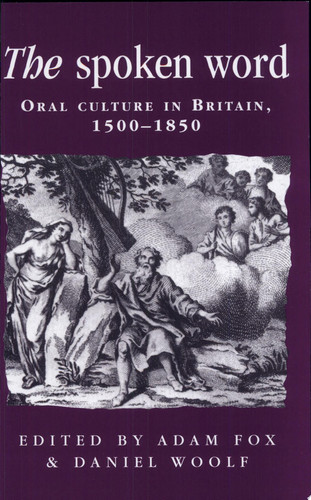
The spoken word: oral culture in Britain, 1500-1850

Adam Fox,Daniel Woolf
"The early modern period was of great significance throughout Europe with respect to its gradual transition from a largely oral to a fundamentally literate society. On the one hand, the spoken word remained of the utmost importance to the dissemination of ideas, the communication of information and the transmission of the cultural repertoire. On the other hand, the proliferation of written documents of all kinds, the development of printing and the spread of popular literacy combined to transform the nature of communication. Studies previous to this have traditionally focused on individual countries or regions, and emphasised the contradictions between oral and literate culture. The essays in this fascinating collection depart from these approaches in several ways. By examining not only English, but also Scottish and Welsh oral culture, they provide the first pan-British study of the subject. The authors also emphasise the ways in which oral and literate culture continued to compliment and inform each other, rather than focusing exclusively on their incompatibility, or on the 'inevitable' triumph of the written word. The chronological focus, ranging from the sixteenth to the mid-nineteenth century, with glances ahead to the twentieth, set the problem against a longer chronological span than most other studies, providing a link between early modern and modern oral and literate cultures. This book it will be of interest to students and scholars of British history, Linguistics, Literary Studies and Folklore Studies"--Publisher's description.
Manchester University Press 2002 286 pages

Explaining traditions: folk behavior in modern culture

Bronner, Simon J.
Why do humans hold onto traditions? Many pundits predicted that modernization and the rise of a mass culture would displace traditions, especially in America, but cultural practices still bear out the importance of rituals and customs in the development of identity, heritage, and community. In Explaining Traditions: Folk Behavior in Modern Culture , Simon J. Bronner discusses the underlying reasons for the continuing significance of traditions, delving into their social and psychological roles in everyday life, from old-time crafts to folk creativity on the Internet. Challenging prevailing notions of tradition as a relic of the past, Explaining Traditions provides deep insight into the nuances and purposes of living traditions in relation to modernity. Bronner's work forces readers to examine their own traditions and imparts a better understanding of raging controversies over the sustainability of traditions in the modern world.
University Press of Kentucky 2011-07-22 530 pages