13 results for "Folklore"

Elijah's Violin and Other Jewish Fairy Tales

Howard Schwartz
Tales of magic and wonder can be found in every phase of Jewish literature, from the sacred to the secular. The fairy tale in particular--set in enchanted lands and populated with a variety of human and supernatural beings, both good and evil--holds a very special place in the Jewish tradition. For in the fairy tale, where good and evil engage in a timeless struggle, we have a clear reflection of the Jewish world view, where faith in God can defeat the evil impulse. In Elijah's Violin, Howard Schwartz offers a sumptuous collection of thirty-six Jewish fairy tales from virtually every corner of the world. At once otherworldy and earthy, pious and playful, these celebrated tales from Morocco and India, Spain and Eastern Europe, Babylon and Egypt, illustrate not only their Jewish character but also their universality of themes. Invoking the biblical tale of David and Goliath, we read as King David defeats the giant by hovering above its spear in King David and the Giant. In the romantic tale of The Princess in the Tower, a variant of Rapunzel, we watch as the cautious King Solomon recognizes the vanity in trying to prevent Providence from taking place. And we see the religious nature of the quest for Elijah's violin in the title story. The successful completion of the king's quest enables the violin's imprisoned melodies, emblematic of the Jewish spirit, to be set free. Throughout this richly illustrated collection, one can find the quests and riddles of the traditional fairy tale along with the divine intervention that characterizes the Jewish fairy tale. Skillfully translated, these stories will captivate children and adults alike in which romance and magic become enchantingly entwined with faith, duty, and wisdom.
Harper & Row 1985 302 pages

Did God have a wife? archaeology and folk religion in ancient Israel

Dever, William G.
In this masterful commentary, respected biblical scholar Bruce Waltke carefully interprets the message of the prophet Micah, building a bridge between Micah's ancient world and our life today. Waltke's Commentary on Micah quickly distinguishes itself from other commentaries on this book by displaying an unprecedented exegetical thoroughness, an expert understanding of historical context, and a keen interest in illuminating the contribution of Micah to Christian theology. Tackling hard questions about date and authorship, Waltke contends that Micah himself wrote and edited the nineteen sermons comprising the book. Waltke's clear analytical outline leads readers through the three cycles of Micah, each beginning with an oracle of doom and ending with an oracle of hope, decisively showing that hope wins over doom. Learned yet amazingly accessible, combining scholarly erudition with passion for Micah's contemporary relevance, this book will well serve teachers, pastors, and students alike.
W.B. Eerdmans Pub. Co 2005 344 pages

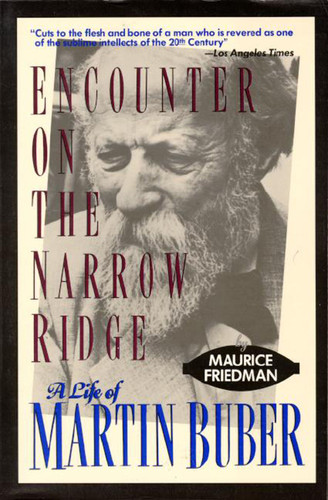
Encounter on the Narrow Ridge A Life of Martin Buber

Maurice Friedman
Martin Buber's stature as the most significant Jewish religious philosopher of the twentieth century is reinforced by his accomplishments and renown in areas as diverse as Hasidism, psychotherapy, education, folklore, and politics. His classic, I and Thou, is known and studied all over the world. In this complete and masterful biography, Maurice Friedman traces the interweaving of Buber's wholehearted engagement with world events and crises and the evolution of his unique and influential philosophy. We see the impact of World War I on the young thinker; his work in education, community, and politics between the wars; his leadership of the spiritual resistance to the Nazis in Hitler's Germany; and his more than forty years of fighting for Jewish-Arab understanding. In addition, we see Buber interact with Heidegger, Sartre, Jung, Ben Gurion, Hesse, Rosenzweig, and Hammarskjold. Through his close relationship with Buber and recent access to forty-five thousand unpublished letters, Maurice Friedman recreates Buber's vitality, his philosophy of dialogue, and his spirituality based on a personal relationship with God. Encounter on the Narrow Ridge delivers the essential spontaneity of a great man who saw in every encounter a focal point for human growth.
Paragon House 1998-06-15 496 pages

The Day the Rabbi Disappeared Jewish Holiday Tales of Magic

Schwartz, Dr. Howard
Noted folklorist Howard Schwartz retells 12 Jewish tales from around the world. Each tale combines elements of magic with a link to a Jewish holiday, giving new perspectives on Rosh Hashanah, Yom Kippur, Hanukkah, Purim, and Passover--plus Shabbat, the weekly Sabbath. These memorable stories of holiday miracles and miraculous escapes have been passed down orally for thousands of years. Now the best of them--from "A Flock of Angels" to "The Enchanted Menorah" and "The Magic Winecup"--have been collected, and enriched by Monique Passicot's luminous illustrations.
Jewish Publication Society 2003 80 pages

Butterflies Under Our Hats

Sandy Eisenberg Sasso
Once there was a town called Chelm where there was no luck. If something could go wrong, it did. The roofs of the houses always leaked. The sidewalks were cracked. The gardens grew only weeds. Nothing was ever right. So begins best-selling children's author, Sandy Eisenberg Sasso (nearly 500,000 copies of her books are in print) in this charming, original story inspired by a Jewish folktale.
Paraclete Press (MA) 2014-08 32 pages

Voices of the religious left: a contemporary sourcebook

Rebecca Alpert
What has happened to the religious left? If there is a religious left, why don't we hear more about it? The academics and activists who write this rich volume, edited by Rebecca Alpert, argue passionately on topics that concern all of us. Quoting from the Bible, the Torah, the Qur'an, the teachings of Buddha, as well as Native American folklore, they make the voices of the religious left heard -- teaching lessons of peace and liberation. As this invaluable sourcebook shows, the religious left is committed to issues of human rights and dignity. Answering questions of identity and ideology, the essays included here stem from the "culture wars" that have divided orthodox and liberal believers. Responding to the needs of and raised by marginalized social groups, the writers discuss economic issues and religious politics as they champion equal rights, and promote the teaching of progressive vision. Containing insightful perspectives of adherents to many faiths, Voices of the Religious Left makes it clear that there is a group dedicated to instilling the values of justice and freedom. They are far from silent. All of the essays in this collection "...represent the power of the written word as a vehicle for advocacy and social change....It is my hope that the readers of these essays will themselves feel compelled to think more about the importance of taking a stand on issues from religious perspectives, and to act on something that compels them." --Rabbi Rebecca Alpert
Temple University Press 2000-05-24 294 pages

Language and Myth

Ernst Cassirer
In this important study Ernst Cassirer analyzes the non-rational thought processes that go to make up culture. He demonstrates that beneath both language and myth there lies an unconscious "grammar" of experience, whose categories and canons are not those of logical thought. He shows that this prelogical "logic" is not merely an undeveloped state of rationality, but something basically different, and that this archaic mode of thought still has enormous power over even our most rigorous thought, in language, poetry and myth. The author analyzes brilliantly such seemingly diverse (yet related) phenomena as the metaphysics of the Bhagavat Gita, the Melanesian concept of Mana, the Naturphilosophie of Schelling, modern poetry, Ancient Egyptian religion, and symbolic logic. He covers a vast range of material that is all too often neglected in studies of human thought. These six essays are of great interest to the student of philosophy or the philosophy of science, the historian, or the anthropologist. They are also remarkably timely for students of literature, what with the enormous emphasis placed upon "myth" in modern literary speculation. This book is not superficial speculation by a dabbler, but a penetrating study by one of the most profound and sensitive philosophic minds of our time.
Dover Publications, Incorporated 2013-12-03 128 pages

Armenian and Iranian Studies

Russell, James R.
This book brings together select articles published in disparate journals and volumes over the past two decades. Some deal exclusively with either Armeniaca (ancient, medieval, and modern) or Iranica (pre-Islamic); in the case of the former, there is an emphasis on the sources and religious material of heroic epic and of folklore. A number of studies also deal with the visionaries of the Armenian tradition--Mashtots', Narekats'i, Ch'arents'. In the Iranian area, there are publications on Irano-Judaica and the culture of the Parsi Zoroastrians of India.
Armenian Heritage Press 2004 1462 pages

Star Myths of the World, Volume Three Star Myths of the Bible

David Warner Mathisen
The most complete guide to the ancient world-wide system of celestial metaphor, sometimes called Astro-theology, which forms the foundation for virtually all of the scriptures, myths, and sacred stories of humanity -- including the texts we call the Old Testament and New Testament of the Bible. Explore the scriptures and myths of humanity in a new light as you learn to hear the language in which they are all actually speaking: the language of the stars. Star Myths of the World and How to Interpret Them is a series of volumes exploring the amazing evidence of an ancient, world-wide system of metaphor which underlies all of the world's myths, and points to the conclusion that they are all closely related. Learn how to understand the clues and symbols in the stories which point to specific constellations, and how the constellations fit into the larger heavenly cycles, all of which are used by the ancient wisdom given to our ancestors as a precious inheritance, with information for our benefit and blessing. Volume One explored evidence that this system is worldwide, sampling a few representative myths and stories from ancient Egypt, ancient Mesopotamia, ancient India, ancient China and Japan, and myths from various cultures in Australia, Africa, the Americas, and the Pacific. Volume Two explored the massive evidence that the Greek myths are built on the same worldwide system, examining specific myths, gods, and goddesses -- as well as both the Iliad and Odyssey in depth, for their celestial patterns. Volume Three provides a broad survey of the celestial foundations of some of the most well-known stories and characters in the Old and New Testaments of the Bible, complete with hundreds of full-color illustrations and star charts.
Beowulf Books 2016-08-03 766 pages