13 results for "Folklore"

Veiled sentiments: honor and poetry in a Bedouin society

Abu-Lughod, Lila
Lila Abu-Lughod lived with a community of Bedouins in the Western Desert of Egypt for nearly two years, studying gender relations and the oral lyric poetry through which women and young men express personal feelings. The poems are haunting, the evocation of emotional life vivid. But her analysis also reveals how deeply implicated poetry and sentiment are in the play of power and the maintenance of a system of social hierarchy. What begins as a puzzle about a single poetic genre becomes a reflection on the politics of sentiment and the relationship between ideology and human experience.
University of California Press 2016-09-06 359 pages

Folklore and culture on the Texas-Mexican border

Paredes, Américo
Americo Paredes, in a distinguished career spanning the last forty years, has often set the pace and the standard in the two fields with which he is most strongly identified: folklore and Chicano studies. In folklore, he has been instrumental in establishing a new theoretical and methodological framework; in Chicano studies, he has exerted a seminal influence, inspiring an entire generation of scholars. For this book, the noted folklorist Richard Bauman has selected eleven of Americo Paredes's most significant scholarly articles. The selected articles, first published during the years 1958-1987, faithfully reflect the depth and breadth of Paredes's scholarship, as well as the rigor and eloquence of his writing. They represent scholarly discourse at its best: at once erudite and clear, demanding yet accessible, rich in both substance and style. Throughout his career, Paredes has centered his work on the folklore and culture of the Lower Rio Grande Border of South Texas and northeastern Mexico. His studies have always been contextualized, though, by a deep knowledge of Greater Mexico, and by the comparative scope of the folklorist. The essays collected here illustrate the transdisciplinary richness of Paredes's perspective - a synthesis of folkloric, anthropological, literary, and historical theory and method. They also demonstrate the revisionist power of his analysis, which challenges traditionalist conceptions and constructions of Texas-Mexican culture, the social base of folklore, and folklore genres. Paredes is best known for his studies of the corrido, and several articles on this ballad form are included in the collection. Other essays focus variously on decimas, jokes, legends, and the "neighborly names" of ethnic slurs. More general subjects are also addressed, including the nature of the ethnographic encounter, machismo in the United States and Mexico, and the clash of cultures along the Lower Rio Grande Border. What emerges is perhaps the most well wrought and subtle portrait to date of the life and culture of the Mexican American people. An introduction by Richard Bauman discusses the principal themes and focuses of Paredes's work, and his substantive, theoretical, and methodological contributions to scholarship. In addition, the volume includes a complete bibliography of Paredes's scholarly writings, compiled by Linda Adams.
CMAS Books, Center for Mexican American Studies, University of Texas at Austin 1993 287 pages

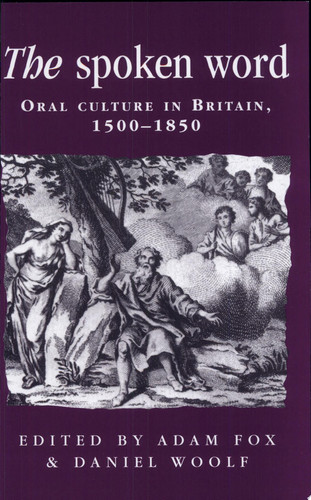
The spoken word: oral culture in Britain, 1500-1850

Adam Fox,Daniel Woolf
"The early modern period was of great significance throughout Europe with respect to its gradual transition from a largely oral to a fundamentally literate society. On the one hand, the spoken word remained of the utmost importance to the dissemination of ideas, the communication of information and the transmission of the cultural repertoire. On the other hand, the proliferation of written documents of all kinds, the development of printing and the spread of popular literacy combined to transform the nature of communication. Studies previous to this have traditionally focused on individual countries or regions, and emphasised the contradictions between oral and literate culture. The essays in this fascinating collection depart from these approaches in several ways. By examining not only English, but also Scottish and Welsh oral culture, they provide the first pan-British study of the subject. The authors also emphasise the ways in which oral and literate culture continued to compliment and inform each other, rather than focusing exclusively on their incompatibility, or on the 'inevitable' triumph of the written word. The chronological focus, ranging from the sixteenth to the mid-nineteenth century, with glances ahead to the twentieth, set the problem against a longer chronological span than most other studies, providing a link between early modern and modern oral and literate cultures. This book it will be of interest to students and scholars of British history, Linguistics, Literary Studies and Folklore Studies"--Publisher's description.
Manchester University Press 2002 286 pages

When you're up to your ass in alligators: more urban folklore from the paperwork empire

Dundes, Alan
Office copier folklore?those tattered sheets of cartoons, mottoes, zany poems, defiant sayings, parodies, and crude jokes that regularly circulate in office buildings everywhere?is the subject of this innovative study. this type of folklore represents a major form of tradition in modern America, and the authors have compiled this raw data for scholarship?and entertainment. These creations of the Paperwork Empire comment on topics and problems that concern all urban Americans. No one and nothing escapes their raunchy wit and sarcasm. Bosses, ethnic groups, minorities, the sexes, alternative lifestyles, politics, welfare, government workers, the law, bureaucracy, and even "The Night Before Christmas" all come under fire to form a biting, and hilarious, commentary on modern American society.
Wayne State University Press 1987 271 pages

American children's folklore

Simon J. Bronner
Concentrating on lore gathered since World War II, Bronner has assembled an anthology of what children really say, not what adults wish they would say. It is through such shared lore—songs, expressions, games and beliefs—that children adapt to new situations. Bronner includes secret languages, jump rope rhymes, song parodies, games, taunts, tongue twisters, jokes, and more. These treasures make for nostalgic reading for adults who want to relive their own childhoods or gain a window to their own children's world.
August House 1988 281 pages

Living our language: Ojibwe tales & oral histories

Treuer, Anton
A language carries a people's memories, whether they are recounted as individual reminiscences, as communal history, or as humorous tales. This collection of stories from Anishinaabe elders offers a history of a people at the same time that it seeks to preserve the language of that people.> As fluent speakers of Ojibwe grow older, the community questions whether younger speakers know the language well enough to pass it on to the next generation. Young and old alike are making widespread efforts to preserve the Ojibwe language, and, as part of this campaign, Anton Treuer has collected stories from Anishinaabe elders living at Leech Lake, White Earth, Mille Lacs, Red Lake, and St. Croix reservations. Based on interviews Treuer conducted with ten elders—Archie Mosay, Jim Clark, Melvin Eagle, Joe Auginaush, Collins Oakgrove, Emma Fisher, Scott Headbird, Susan Jackson, Hartley White, and Porky White—this anthology presents the elders' stories transcribed in Ojibwe with English translation on facing pages. These stories contain a wealth of information, including oral histories of the Anishinaabe people and personal reminiscences, educational tales, and humorous anecdotes. Treuer's translations of these stories preserve the speakers' personalities, allowing their voices to emerge from the page. This dual-language text will prove instructive for those interested in Ojibwe language and culture, while the stories themselves offer the gift of a living language and the history of a people.
Minnesota Historical Society Press 2001-05-01 272 pages

Explaining traditions: folk behavior in modern culture

Bronner, Simon J.
Why do humans hold onto traditions? Many pundits predicted that modernization and the rise of a mass culture would displace traditions, especially in America, but cultural practices still bear out the importance of rituals and customs in the development of identity, heritage, and community. In Explaining Traditions: Folk Behavior in Modern Culture , Simon J. Bronner discusses the underlying reasons for the continuing significance of traditions, delving into their social and psychological roles in everyday life, from old-time crafts to folk creativity on the Internet. Challenging prevailing notions of tradition as a relic of the past, Explaining Traditions provides deep insight into the nuances and purposes of living traditions in relation to modernity. Bronner's work forces readers to examine their own traditions and imparts a better understanding of raging controversies over the sustainability of traditions in the modern world.
University Press of Kentucky 2011-07-22 530 pages

The Jewish dark continent: life and death in the Russian pale of settlement

Deutsch, Nathaniel
"At the turn of the twentieth century, over forty percent of the world's Jews lived within the Russian Empire, almost all in the Pale of Settlement. From the Baltic to the Black Sea, the Jews of the Pale created a distinctive way of life little known beyond its borders. This led the historian Simon Dubnow to label the territory a Jewish 'Dark Continent.' Just before World War I, a socialist revolutionary and aspiring ethnographer named An-sky pledged to explore the Pale. He dreamed of leading an ethnographic expedition that would produce an archive--what he called an Oral Torah of the common people rather than the rabbinic elite--which would preserve Jewish traditions and transform them into the seeds of a modern Jewish culture. Between 1912 and 1914, An-sky and his team collected jokes, recorded songs, took thousands of photographs, and created a massive ethnographic questionnaire. Consisting of 2,087 questions in Yiddish--exploring the gamut of Jewish folk beliefs and traditions, from everyday activities to spiritual exercises to marital intimacies--the Jewish Ethnographic Program constitutes an invaluable portrait of Eastern European Jewish life on the brink of destruction. Nathaniel Deutsch offers the first complete translation of the questionnaire, as well as the riveting story of An-sky's almost messianic efforts to create a Jewish ethnography in an era of revolutionary change. An-sky's project was halted by World War I, and within a few years the Pale of Settlement would no longer exist. These survey questions revive and reveal shtetl life in all its wonder and complexity." -- Publisher's Web site.
Harvard University Press 2011-11-29 374 pages