162 results for "Future Technology"

21 lessons for the 21st century

Harari, Yuval N.
How do computers and robots change the meaning of being human? How do we deal with the epidemic of fake news? Are nations and religions still relevant? What should we teach our children? As technology advances faster than our understanding of it, hacking becomes a tactic of war, and the world feels more polarized than ever, Yuval Harari addresses the challenge of navigating life in the face of constant and disorienting change and raises the important questions we need to ask ourselves in order to survive. How can we retain freedom of choice when Big Data is watching us? What will the future workforce look like, and how should we ready ourselves for it? How should we deal with the threat of terrorism? Why is liberal democracy in crisis? Harari invites us to consider values, meaning, and personal engagement in a world full of noise and uncertainty. When we are deluged with irrelevant information, clarity is power.
Spiegel & Grau 2018 384 pages

Extraterrestrial The First Sign of Intelligent Life Beyond Earth

Avi Loeb
New York Times Bestseller | Wall Street Journal Bestseller | Publishers Weekly Bestseller | Publishers Marketplace 2020 Buzz Book | Amazon Best Book of the Year | Longlisted for the 2022 PEN/E.O. Wilson Literary Science Writing Award Harvard's top astronomer lays out his controversial theory that our solar system was recently visited by advanced alien technology from a distant star. "Provocative and thrilling ... Loeb asks us to think big and to expect the unexpected."--Alan Lightman, New York Times bestselling author of Einstein's Dreams and Searching for Stars on an Island in Maine In late 2017, scientists at a Hawaiian observatory glimpsed an object soaring through our inner solar system, moving so quickly that it could only have come from another star. Avi Loeb, Harvard's top astronomer, showed it was not an asteroid; it was moving too fast along a strange orbit, and left no trail of gas or debris in its wake. There was only one conceivable explanation: the object was a piece of advanced technology created by a distant alien civilization. In Extraterrestrial, Loeb takes readers inside the thrilling story of the first interstellar visitor to be spotted in our solar system. He outlines his controversial theory and its profound implications: for science, for religion, and for the future of our species and our planet. A mind-bending journey through the furthest reaches of science, space-time, and the human imagination, Extraterrestrial challenges readers to aim for the stars--and to think critically about what's out there, no matter how strange it seems.
HarperCollins Publishers 2022-02-22 240 pages

Interstellar The Search for Extraterrestrial Life and Our Future in the Stars

Avi Loeb
"The world's leading alien hunter" -- New York Times Magazine From acclaimed Harvard astrophysicist and bestselling author of Extraterrestrial comes a mind-expanding new book explaining why becoming an interstellar species is imperative for humanity's survival and detailing a game plan for how we can settle among the stars. In the New York Times bestseller Extraterrestrial, Avi Loeb, the longest serving Chair of Harvard's Astronomy Department, presented a theory that shook the scientific community: our solar system, Loeb claimed, had likely been visited by a piece of advanced alien technology from a distant star. This provocative and persuasive argument opened millions of minds internationally to the vast possibilities of our universe and the existence of intelligent life beyond Earth. But a crucial question remained: now that we are aware of the existence of extraterrestrial life, what do we do next? How do we prepare ourselves for interaction with interstellar extraterrestrial civilization? How can our species become interstellar? Now Loeb tackles these questions in a revelatory, powerful call to arms that reimagines the idea of contact with extraterrestrial civilizations. Dismantling our science-fiction fueled visions of a human and alien life encounter, Interstellar provides a realistic and practical blueprint for how such an interaction might actually occur, resetting our cultural understanding and expectation of what it means to identify an extraterrestrial object. From awe-inspiring searches for extraterrestrial technology, to the heated debate of the existence of Unidentified Aerial Phenomena, Loeb provides a thrilling, front-row view of the monumental progress in science and technology currently preparing us for contact. He also lays out the profound implications of becoming--or not becoming--interstellar; in an urgent, eloquent appeal for more proactive engagement with the world beyond ours, he powerfully contends why we must seek out other life forms, and in the process, choose who and what we are within the universe. Combining cutting edge science, physics, and philosophy, Interstellar revolutionizes the approach to our search for extraterrestrial life and our preparation for its discovery. In this eye-opening, necessary look at our future, Avi Loeb artfully and expertly raises some of the most important questions facing us as humans, and proves, once again, that scientific curiosity is the key to our survival.
HarperCollins Publishers 2024-08-20 256 pages

The Singularity Is Nearer

Kurzweil, Ray
"This successor volume to The Singularity Is Near explores how technology will refashion the human race in the decades to come. In this entirely new book, Ray Kurzweil brings a fresh perspective to advances in the singularity-assessing the progress of many of his predictions and examining the novel advancements that, in the near future, will bring a revolution in knowledge and an expansion of human potential. Among the topics he discusses are rebuilding the world atom by atom with devices like nanobots; radical life extension beyond the current age limit of 120; reinventing intelligence by expanding biological capacity with nonbiological intelligence in the cloud; how life is improving with declines in poverty and violence; and the growth of technologies that can be applied to everything from clothes to building materials to growing human organs. He also considers the potential perils of biotechnology, nanotechnology, and artificial intelligence, including such topics as how AI will impact unemployment and the safety of autonomous cars, and "After Life" technology, which will reanimate people who have passed away through a combination of data and DNA"--
Penguin USA 2025-06-03 432 pages

Queen bees & wannabes: helping your daughter survive cliques, gossip, boyfriends, and the new realities of girl world

Wiseman, Rosalind
When Rosalind Wiseman first published "Queen Bees & Wannabes," she fundamentally changed the way adults look at girls friendships and conflicts from how they choose their best friends, how they express their anger, their boundaries with boys, and their relationships with parents. Wiseman showed how girls of every background are profoundly influenced by their interactions with one another. Now, Wiseman has revised and updated her groundbreaking book for a new generation of girls and explores: How girls experiences before adolescence impact their teen years, future relationships, and overall success The different roles girls play in and outside of cliques as Queen Bees, Targets, and Bystanders, and how this defines how they and others are treated Girls power plays from fake apologies to fights over IM and text messages Where boys fit into the equation of girl conflicts and how you can help your daughter better hold her own with the opposite sex Checking your baggage recognizing how your experiences impact the way you parent, and how to be sanely involved in your daughter s difficult, yet common social conflicts Packed with insights about technology s impact on Girl World and enlivened with the experiences of girls, boys, and parents, the book that inspired the hit movie "Mean Girls "offers concrete strategies to help you empower your daughter to be socially competent and treat herself with dignity."
Three Rivers Press 2009 433 pages

The age of surveillance capitalism: the fight for a human future at the new frontier of power

Zuboff, Shoshana
"Shoshana Zuboff, named "the true prophet of the information age" by the Financial Times, has always been ahead of her time. Her seminal book In the Age of the Smart Machine foresaw the consequences of a then-unfolding era of computer technology. Now, three decades later she asks why the once-celebrated miracle of digital is turning into a nightmare. Zuboff tackles the social, political, business, personal, and technological meaning of "surveillance capitalism" as an unprecedented new market form. It is not simply about tracking us and selling ads, it is the business model for an ominous new marketplace that aims at nothing less than predicting and modifying our everyday behavior--where we go, what we do, what we say, how we feel, who we're with. The consequences of surveillance capitalism for us as individuals and as a society vividly come to life in The Age of Surveillance Capitalism's pathbreaking analysis of power. The threat has shifted from a totalitarian "big brother" state to a universal global architecture of automatic sensors and smart capabilities: A "big other" that imposes a fundamentally new form of power and unprecedented concentrations of knowledge in private companies--free from democratic oversight and control"--
PublicAffairs 2020-03-03 691 pages

The age of AI: and our human future

Kissinger, Henry,Schmidt, Eric,Huttenlocher, Daniel P.
"Artificial Intelligence (AI) is transforming human society in fundamental and profound ways. Not since the Age of Reason have we changed how we approach security, economics, order, and even knowledge itself. In the Age of AI, three deep and accomplished thinkers come together to consider what AI will mean for us all."
Back Bay Books, Little, Brown and Company 2022 266 pages

Alone together: why we expect more from technology and less from each other

Turkle, Sherry
In "Alone Together," MIT technology and society professor Sherry Turkle explores the power of our new tools and toys to dramatically alter our social lives. It's a nuanced exploration of what we are looking for--and sacrificing--in a world of electronic companions and social networking tools, and an argument that, despite the hand-waving of today's self-described prophets of the future, it will be the next generation who will chart the path between isolation and connectivity.
Basic Books 2012-10-02 360 pages

She has her mother's laugh: the powers, perversions, and potential of heredity

Zimmer, Carl
Shortlisted for The Baillie Gifford Prize for Non-Fiction 2018She Has Her Mother's Laugh presents a profoundly original perspective on what we pass along from generation to generation. Charles Darwin played a crucial part in turning heredity into a scientific question, and yet he failed spectacularly to answer it. The birth of genetics in the early 1900s seemed to do precisely that. Gradually, people translated their old notions about heredity into a language of genes. As the technology for studying genes became cheaper, millions of people ordered genetic tests to link themselves to missing parents, to distant ancestors, to ethnic identities . . . But, Zimmer writes, 'Each of us carries an amalgam of fragments of DNA, stitched together from some of our many ancestors. Each piece has its own ancestry, traveling a different path back through human history. A particular fragment may sometimes be cause for worry, but most of our DNA influences who we are-our appearance, our height, our penchants-in inconceivably subtle ways.' Heredity isn't just about genes that pass from parent to child. Heredity continues within our own bodies, as a single cell gives rise to trillions of cells that make up our bodies. We say we inherit genes from our ancestors-using a word that once referred to kingdoms and estates-but we inherit other things that matter as much or more to our lives, from microbes to technologies we use to make life more comfortable. We need a new definition of what heredity is and, through Carl Zimmer's lucid exposition and storytelling, this resounding tour de force delivers it. Weaving together historical and current scientific research, his own experience with his two daughters, and the kind of original reporting expected of one of the world's best science journalists, Zimmer ultimately unpacks urgent bioethical quandaries arising from new biomedical technologies, but also long-standing presumptions about who we really are and what we can pass on to future generations.
Picador 2019-06-11 672 pages

That Used to Be Us

Thomas L. Friedman
America has a huge problem. It faces four major challenges, on which its future depends, and it is failing to meet them. In "That Used to Be Us," Thomas L. Friedman, one of our most influential columnists, and Michael Mandelbaum, one of our leading foreign policy thinkers, analyze those challenges--globalization, the revolution in information technology, the nation's chronic deficits, and its pattern of energy consumption--and spell out what we need to do "now" to rediscover America and rise to this moment. They explain how the end of the cold war blinded the nation to the need to address these issues. They show how our history, when properly understood, provides the key to addressing them, and explain how the paralysis of our political system and the erosion of key American values have made it impossible for us to carry out the policies the country needs. They offer a way out of the trap into which the country has fallen, which includes the rediscovery of some of our most valuable traditions and the creation of a new, third-party movement. "That Used to Be Us" is both a searching exploration of the American condition today and a rousing manifesto for American renewal. "As we were writing this book," Friedman and Mandelbaum explain, "we found that when we shared the title with people, they would often nod ruefully and ask: 'But does it have a happy ending?' Our answer is that we can write a happy ending, but it is up to the country--to all of us--to determine whether it is fiction or nonfiction. We need to study harder, save more, spend less, invest wisely, and get back to the formula that made us successful as a country in every previous historical turn. What we need is not novel or foreign, but values, priorities, and practices embedded in our history and culture, applied time and again to propel us forward as a country. That is all part of our past. That used to be us and can be again--if we will it."
Farrar, Straus & Giroux 2011-09-05 380 pages

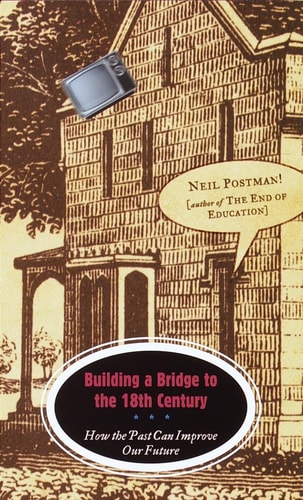
Building a bridge to the 18th century: how the past can improve our future

Postman, Neil
In Building a Bridge to the 18th Century , acclaimed cultural critic Neil Postman offers a cure for the hysteria and hazy values of the postmodern world. Postman shows us how to reclaim that balance between mind and machine in a dazzling celebration of the accomplishments of the Enlightenment-from Jefferson's representative democracy to Locke's deductive reasoning to Rousseau's demand that the care and edification of children be considered an investment in our collective future. Here, too, is the bold assertion that Truth is invulnerable to fashion or the passing of time. Provocative and brilliantly argued, Building a Bridge to the 18th Century illuminates a navigable path through the Information Age-a byway whose signposts, it turns out, were there all along.
Knopf 2000-10-10 213 pages

Summa technologiae

Lem, Stanisław
The Polish writer Stanislaw Lem is best known to English-speaking readers as the author of the 1961 science fiction novel Solaris , adapted into a meditative film by Andrei Tarkovsky in 1972 and remade in 2002 by Steven Soderbergh. Throughout his writings, comprising dozens of science fiction novels and short stories, Lem offered deeply philosophical and bitingly satirical reflections on the limitations of both science and humanity. In Summa Technologiae --his major work of nonfiction, first published in 1964 and now available in English for the first time--Lem produced an engaging and caustically logical philosophical treatise about human and nonhuman life in its past, present, and future forms. After five decades Summa Technologiae has lost none of its intellectual or critical significance. Indeed, many of Lem's conjectures about future technologies have now come true: from artificial intelligence, bionics, and nanotechnology to the dangers of information overload, the concept underlying Internet search engines, and the idea of virtual reality. More important for its continued relevance, however, is Lem's rigorous investigation into the parallel development of biological and technical evolution and his conclusion that technology will outlive humanity. Preceding Richard Dawkins's understanding of evolution as a blind watchmaker by more than two decades, Lem posits evolution as opportunistic, shortsighted, extravagant, and illogical. Strikingly original and still timely, Summa Technologiae resonates with a wide range of contemporary debates about information and new media, the life sciences, and the emerging relationship between technology and humanity.
University of Minnesota Press 2010 409 pages

The coming anarchy: shattering the dreams of the post Cold War

Kaplan, Robert D.
Robert Kaplan, bestselling author of Balkan Ghosts , offers up scrupulous, far-ranging insights on the world to come in a spirited, rousing, and provocative book that has earned a place at the top of the reading lists of the world's policy makers. The end of the Cold War has not ushered in the global peace and prosperity that many had anticipated. Volatile new democracies in Eastern Europe, fierce tribalism in Africa, civil war and ethnic violence in the Near East, and widespread famine and disease—not to mention the brutal rift developing as wealthy nations reap the benefits of seemingly boundless technology while other parts of the world slide into chaos—are among the issues Kaplan identifies as the most important for charting the future of geopolitics. Historical antecedents in Gibbon's Decline and Fall and in the legacies of statesmen such as Henry Kissinger contribute to this bracingly prophetic framework for addressing the new global reality. Bold, erudite, and profoundly important, The Coming Anarchy is a compelling must-read by one of today's most penetrating writers and provocative minds.
Vintage Books 2000 198 pages

Language and the Internet

Crystal, David
According to popular mythology, the Internet will be bad for the future of language--technospeak will rule, standards will be lost, and creativity diminished as globalization imposes sameness. David Crystal, one of the foremost authorities on language, argues the reverse in his new book: that the Internet is enabling a dramatic expansion of the range and variety of language and is providing unprecedented opportunities for personal creativity. In order to grow and be maintained as a linguistic medium, the principles and standards of the Internet must evolve--and they will be very different from other mediums. Is the Internet a revolution? Is it a linguistic revolution? Beyond the visual panache of the presentation on a screen, the Internet's "linguistic" character is immediately obvious to anyone online. As the Internet has become incorporated into our lives, it is becoming clearer how it is being shaped by and is adapting language and languages. Language and the Internet is the first book by a language expert on the linguistic aspects of the Internet. Opening up linguistic issues for a general readership, Crystal argues that "netspeak" is a radically new linguistic medium that we cannot ignore. David Crystal is one of the foremost authorities on language, and as editor of the Cambridge Encyclopedia he has used the Internet for research purposes from its earliest manifestations. His work for the technology company Classification Data Limited has involved him in the development of an information classification system with several Internet applications, and he has extensive professional experience of Web issues. Crystal is author of several books with Cambridge, including the Cambridge Encyclopedia of Language (1997), Cambridge Encyclopedia of the English Language (1995), English as a Global Language (1997), and Langugage Death (2000) and Words on Words (University of Chicago, 2000) . An internationally renowned writer, journal editor, lecturer and broadcaster, he received an OBE in 1995 for his services to the English language. His edited books include The Cambridge Encyclopedia (Fourth Edition, 2000) The Cambridge Paperback Encyclopedia (Third Edition, 1999), The Cambridge Biographical Encyclopedia (Second Edition, 1997) and The Cambridge Factfinder ( Fourth Edition, 2000).
Cambridge University Press 2001-09-20 272 pages

First freedom: a ride through America's enduring history with the gun

Harsanyi, David
From “one of America’s smartest political writers” (Glenn Beck) comes a fascinating and accessible history of the United States’ unique and enduring relationship with guns, for fans of Chris Kyle’s American Gun . For America, the gun is a story of innovation, power, violence, character, and freedom. From the founding of the nation to the pioneering of the West, from the freeing of the slaves to the urbanization of the twentieth century, our country has had a complex and lasting relationship with firearms. Now, in First Freedom , nationally syndicated columnist and veteran writer David Harsanyi explores the ways in which firearms have helped preserve our religious, economic, and cultural institutions for over two centuries. From Samuel Colt’s early entrepreneurism to the successful firearms technology that helped make the United States a superpower, the gun is inextricably tied to our exceptional rise. In the vein of popular histories like Salt and Seabiscuit , Harsanyi takes you on a captivating and thrilling ride of Second Amendment history that demonstrates why guns are not only an integral part of America’s past, but also an essential part of its future.
Threshold Editions 2018-10-02 310 pages

The unwanted gaze: the destruction of privacy in America

Rosen, Jeffrey
The Unwanted Gaze is an important book about one of the most pressing issues of our day: how changes in technology and the law have combined to demolish our rights of privacy, and what we can and must do to re-secure them. In a world in which Ken Starr can subpoena Monica Lewinsky's bookstore receipts and deleted e-mail messages can be used as justification for firing employees, it's clear that private information of all kinds can be taken out of context and wielded against us. Where exactly did our constitutional guarantees on privacy go? In superbly lucid prose, Jeffrey Rosen tells not only where those privacy rights went but also how we can get them back. The Unwanted Gaze is utterly indispensable for anyone who cares about the future of his or her private life.
Vintage Books 2001-06-12 282 pages

A little book of language

Crystal, David
"With a language disappearing every two weeks and neologisms springing up almost daily, understanding the origins and currency of language has never seemed more relevant. In this charming volume, expert linguist David Crystal proves why the story of language deserves retelling. From an infant's first words to the peculiar dialect of text messaging, A Little Book of Language ranges widely, revealing language's myriad intricacies and quirks. Crystal delves into the development of unique linguistic styles, the origins of obscure accents and the search for the first written word. He discusses the plight of endangered languages, as well as successful cases of linguistic revitalisation. Much more than a history, this book also turns to the future of language, exploring the effect of technology on our day-to-day reading, writing and speech. Through enlightening diagrams and quizzes, as well as Crystal's avuncular and entertaining style, A Little Book of Language reveals the story of language to be a captivating tale for all ages"--Inside front flap.
Yale University Press 2025-04-04 272 pages

And now for the good news..: to the future with love

Wax, Ruby
We know the stars, and have tamed most species that have crossed our paths; we've roamed the world over and travelled to Space; we've mastered industrialisation then created technology that our grandparents couldn't have dreamt of. So, what's next? Ruby Wax builds on her exploration on forgiveness to demonstrate that the next great barrier to progress is compassion. And Now for the Good News teaches us essential tools for making the most out of the relationships in our loves and protect our hearts and mind amidst the madness of hashtags and 24-hour news cycles. Introducing a new mindfulness practice (tuning into the body), Wax creates a call to arms to living more intuitive lives. Drawing on how education, businesses, technology can use kindness to reform and better themselves as well as the purpose of kindness, this book will investigate why greater compassion is our one-way ticket to a better future.
Penguin Life 2020-09-17 243 pages